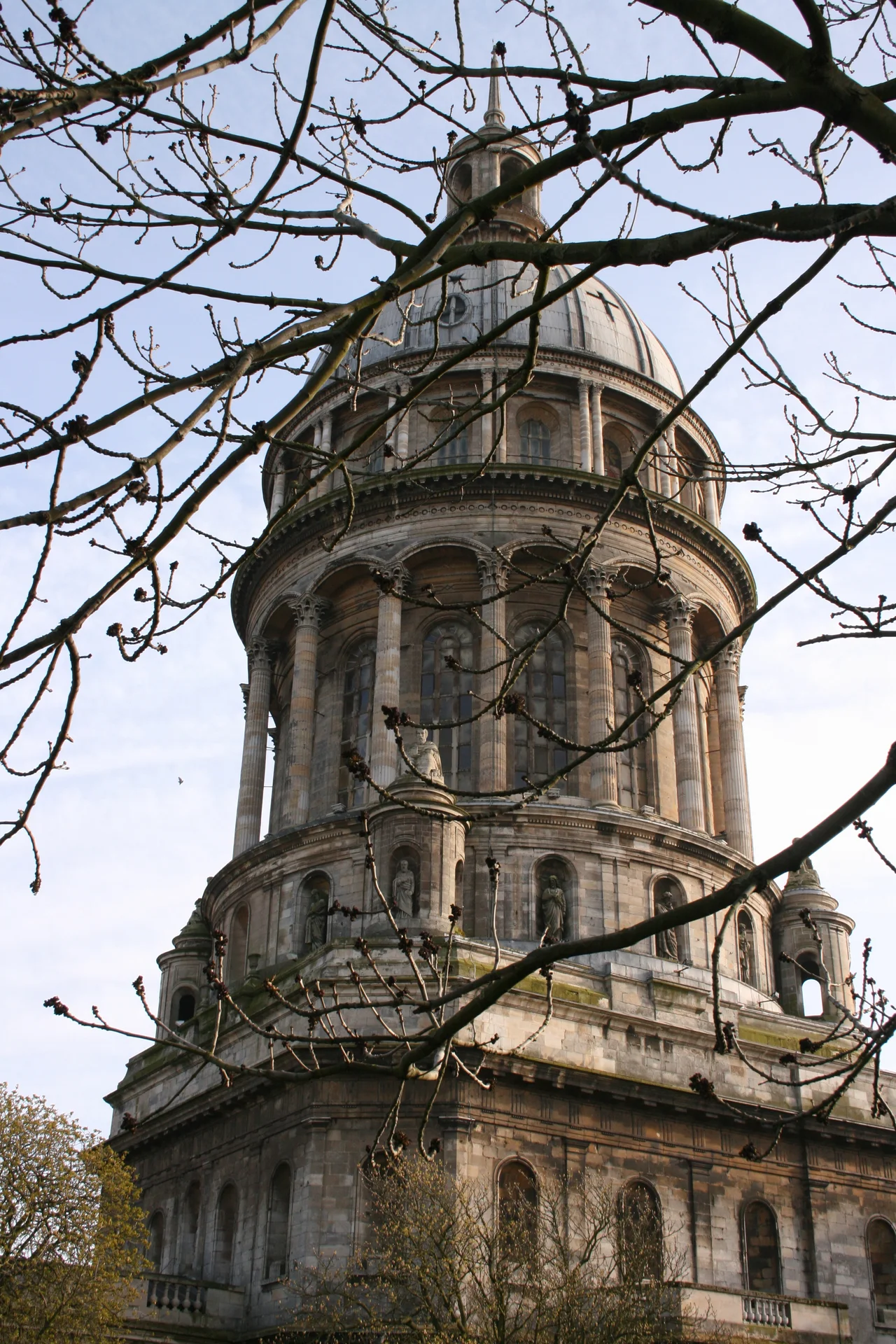

Basilica of Notre-Dame, Boulogne
Around the year 633, according to a story that the people of Boulogne have been telling for thirteen centuries, a boat without sailors and without oars drifted into the estuary at the mouth of the Liane. It carried a single passenger: a luminous wooden statue of the Virgin Mary holding the infant Christ. The townspeople carried her up the hill, and the miracles began almost at once. Pilgrims followed for nine hundred years - kings and beggars alike - until the French Revolution's wood-burners hauled her into the street in 1793 and burned her. Only a fragment of one hand survived. The great dome that now rises 101 metres above the haute ville was built, in part, to bring her home.
The Boat Without Sailors
Saint Audomare, the bishop of Therouanne, was the first witness in the legend. By 633, Boulogne was already an old town - Roman emperors had launched invasions of Britain from this hill, and Christians had been worshipping on its crest since at least the fifth century. When the unmanned vessel appeared in the calm water, locals lifted the statue ashore and installed her in the church on the heights. She became Notre-Dame de la Mer, Our Lady of the Sea, and for nearly a millennium her shrine drew pilgrims from across northern Europe. In 1308 the church hosted the wedding of Edward II of England to Isabella of France, a doomed political match commemorated in the crypt below. Wealth flowed up the hill on the strength of one wooden carving that may, or may not, have arrived on its own.
Revolution and Ashes
The miraculous statue did not survive the Revolution. The Civil Constitution of the Clergy of 1790 brought the cathedral - elevated to that status in 1567 - under state control. Worship was forbidden, then the building was sold off to traders from outside Boulogne and demolished in stages. In 1793 the statue herself was thrown onto a fire. A few faithful saved what they could; a small piece of the Virgin's hand was rescued from the flames, and it is still venerated today. Of the medieval cathedral, only the eleventh-century Romanesque crypt survived intact, its columns and vaulted rooms buried beneath the rubble of the church above. For decades the bare hill was empty of its great signpost.
A Self-Taught Architect's Vow
Benoit Haffreingue was a local priest with no architectural training and an enormous determination. He vowed to rebuild the lost cathedral, gathered support from Victor Hugo and Francois-Rene de Chateaubriand, and laid the rotunda's first stones in 1827. Construction would take nearly fifty years. The dome - inspired by St Paul's in London - was completed in 1854; the western towers followed in the 1870s. The bishop's seat never returned to Boulogne, so the rebuilt church became a basilica in 1879 rather than a cathedral, though locals stubbornly call it the cathedral to this day. Haffreingue's lack of formal training showed in 1921 when the nave's arches collapsed. The reconstruction added concrete reinforcement, which almost certainly saved the building from the bombing that flattened so much of the city in World War II.
The Longest Crypt in France
When workmen began digging in 1827, they uncovered something extraordinary: a vast Romanesque crypt that had been filled in and forgotten, probably during Henry VIII's siege of Boulogne in 1544. At 128 metres it is thought to be the longest crypt in France, a labyrinth of columns and side chapels stacked over the foundations of a Roman temple to Mars. The Tudor cannonballs that ended one chapter of the church's history lie next to offerings left by medieval pilgrims who came to pray to Our Lady of the Sea. In one of the chapels, between 1850 and 1861, rested the body of Jose de San Martin - the Argentine general who liberated half of South America - before it was finally returned to Buenos Aires.
Two Churches in One
Stand inside the basilica today and the strangeness of Haffreingue's design becomes plain. The space beneath the dome was originally meant to be the entire church; when more money arrived, a tall nave and transept were added, producing a Latin cross. The result reads as two distinct churches sharing a wall - the rotunda intimate and circular, the nave processional and lined with slender Corinthian columns. Sunlight pours down through the dome and across the marble. Below your feet lies the Roman temple. Somewhere in the city, in a small reliquary, rests the surviving fragment of the Virgin's hand. The pilgrimage continues.
From the Air
Coordinates 50.7261°N, 1.6150°E in Pas-de-Calais. Best viewed from 1,500-3,000 feet AGL; the 101-metre dome is the unmistakable landmark of the haute ville, visible far out over the Channel. Nearest airfield is Le Touquet-Cote d'Opale (LFAT), about 30 km south. Boulogne-sur-Mer's old town sits on a hill east of the Liane estuary; on a clear day the white cliffs of Dover lie 35 km across the strait.
Nearby Stories
- Siege of Gravelines (1644) 1.7 km away
- Battle of Dungeness 4.8 km away
- 1996 Channel Tunnel fire 6.3 km away
- Battle of Saint-Omer 11 km away
- Dungeness Lighthouse 23 km away
- Courrieres Mine Disaster 56 km away
- Cléon 126 km away
- Battle of Cocherel 156 km away