
Battle of Aldie
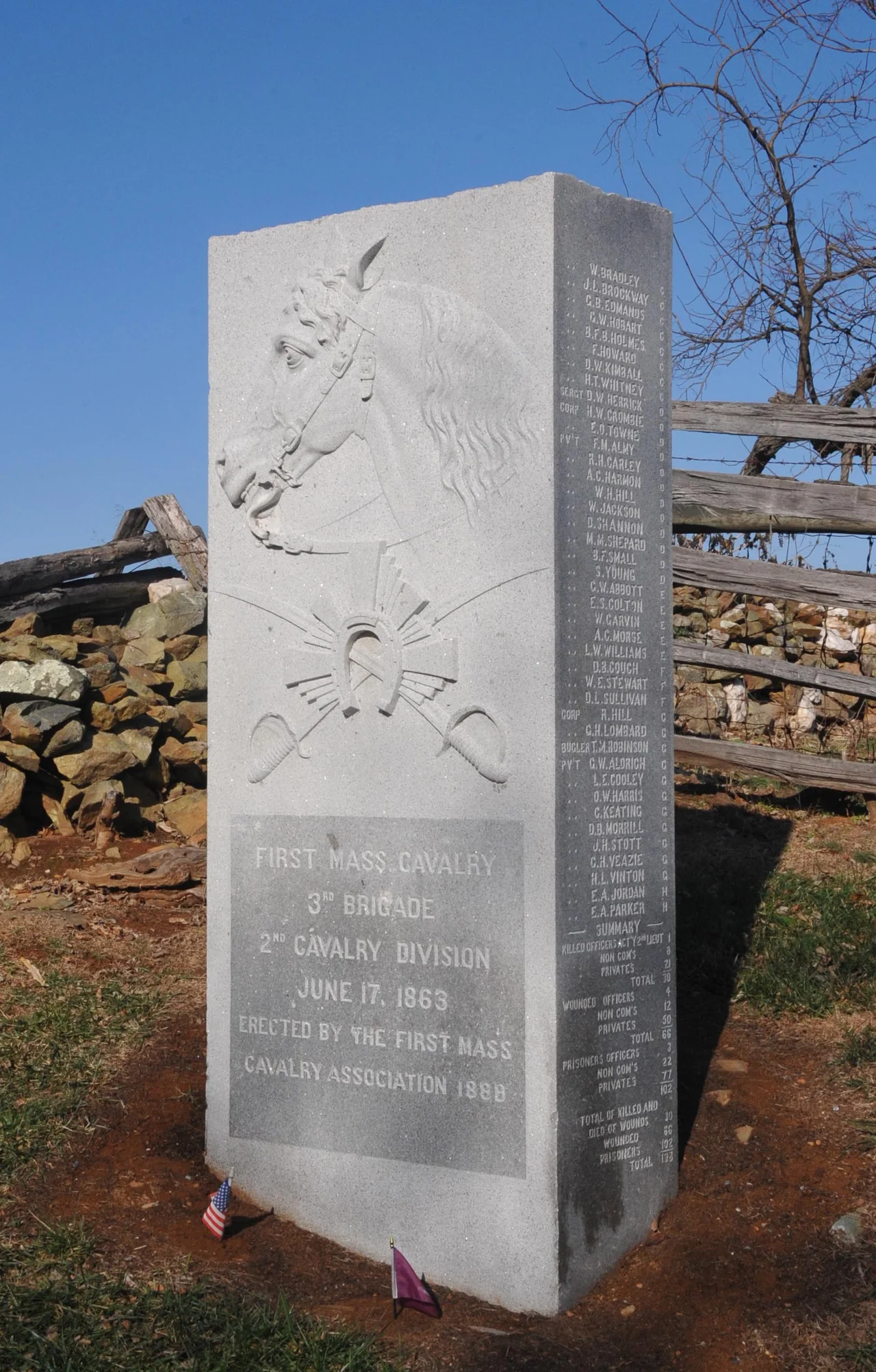
There is a blind curve on the old Snicker's Gap Turnpike just west of Aldie, Virginia, where a stone wall comes up sharply on the right. On the afternoon of June 17, 1863, eight companies of the 1st Massachusetts Cavalry rode into that curve at speed. Confederate sharpshooters from the 5th Virginia Cavalry were waiting along the wall. The Massachusetts men could not turn around, could not see ahead, and could not get out. In a matter of minutes the regiment lost 198 of the 294 men engaged - including the detachment under Henry Lee Higginson, almost wiped out in hand-to-hand fighting. A monument the survivors erected after the war still stands at the curve.
Pleasonton's Push
In June 1863 Robert E. Lee was moving the Army of Northern Virginia north up the Shenandoah Valley toward Pennsylvania. J.E.B. Stuart's cavalry screened the movement by holding the gaps in the Blue Ridge Mountains. Joseph Hooker, commanding the Union Army of the Potomac, had no idea where Lee was. He was furious with his cavalry chief Alfred Pleasonton for failing to penetrate Stuart's screen. On June 17 Pleasonton decided to force the issue. He sent David McM. Gregg's cavalry division west from Manassas Junction down the Little River Turnpike toward Aldie, the village at the eastern edge of the Loudoun Valley where the Turnpike intersected both the Ashby's Gap Turnpike and the Snicker's Gap Turnpike - the two roads that led west through the Blue Ridge into the valley where Lee was hiding. If Pleasonton could take and hold Aldie, he could force the passes. If Stuart could hold him at Aldie, the screen would last.
The Encounter at 2 p.m.
That same morning, Confederate Colonel Thomas T. Munford led the 2nd and 3rd Virginia Cavalry eastward across the Loudoun Valley toward Aldie on a reconnaissance and forage mission. He posted pickets in the village and pulled his main force back to camp on the Franklin Carter farm. At 2 p.m. Brigadier General Judson Kilpatrick's Union brigade - the advance of Gregg's division - rolled into Aldie. The 1st Massachusetts ran into Munford's pickets just west of town and drove them back. Almost simultaneously, the rest of Munford's brigade, including the 1st, 4th, and 5th Virginia Cavalry under Colonel Williams Carter Wickham, arrived at Dover Mills west of Aldie. Wickham sent Colonel Thomas L. Rosser and the 5th Virginia forward to find a campsite closer to the village. Rosser instead found the 1st Massachusetts. He drove them back through Aldie, then took position on a ridge west of town along the Ashby's Gap Turnpike and posted sharpshooters under Captain Reuben F. Boston east of the William Adam farmhouse.
The Blind Curve
The Massachusetts cavalry, supported by the 4th New York, charged what they assumed was a Confederate retreat. Rosser's line held; his sharpshooters poured volleys into the Union flank from prepared positions; a Confederate countercharge drove the Federals back. Kilpatrick then turned his attention to the Snicker's Gap Turnpike just to the north. An artillery duel broke out. More Confederate cavalry arrived. Federal charges met withering rifle fire from Confederate sharpshooters positioned behind a long stone wall along the Turnpike. The 1st Massachusetts charged down the road and rode into the blind curve where the wall came up sharp on the right. The Confederates fired from less than ten yards. The Massachusetts column could not turn, could not retreat. Of 294 men engaged, 198 were killed, wounded, or captured. Higginson's detachment was virtually annihilated in close-quarter combat. He himself was severely wounded but survived to become, after the war, the founder of the Boston Symphony Orchestra.
Reinforcements at Dusk
Union reinforcements continued arriving through the late afternoon. The 6th Ohio Cavalry mounted a charge in the fading light that overran Boston's sharpshooter detachment on the Ashby's Gap Turnpike, capturing or killing most of his 50 men. By 8 p.m. the fighting was dying down. Munford, having received orders from Stuart to withdraw because Federal cavalry had been sighted at Middleburg, pulled his command west toward that town. Munford did not consider Aldie a defeat - he had held the position for four hours, prevented Pleasonton from forcing the gaps, and inflicted disproportionate casualties on the Union force. Total Union losses were 305 dead and wounded. Confederate losses came to between 110 and 119. Colonel Luigi Palma di Cesnola of the 4th New York Cavalry was captured during the battle and held in Libby Prison until May 1864; he later received the Medal of Honor for his conduct at Aldie. After the war he became the first director of the Metropolitan Museum of Art in New York.
The Stone Wall Today
Aldie was the first of three cavalry battles - Aldie on June 17, Middleburg on June 17-19, and Upperville on June 21 - that together failed to break Stuart's screen and allowed Lee's army to slip into Pennsylvania uncontested. Together the three engagements are sometimes called the largest cavalry battles of the entire war by men engaged. The Aldie battlefield is partially preserved. U.S. Route 50 has been widened over the original Ashby's Gap Turnpike portion of the fighting, but the stone wall along the Snicker's Gap Turnpike - now Virginia Route 734 - still survives intact, including the blind curve where the 1st Massachusetts was trapped. The Massachusetts survivors erected a monument at the curve after the war; it stands there still. The American Battlefield Trust and its partners have acquired and preserved 605 acres of the battlefield in four separate land transactions since 2001. Aldie Mill, half a mile east, looks much as it did at the time of the battle - the Moore family was still running it then. The village itself is small, walkable, and preserved enough that the geometry of the battle is still legible on the ground.
From the Air
The Battle of Aldie site sits at 38.983 N, 77.659 W, in and around the village of Aldie, Loudoun County, Virginia. Recommended viewing altitude is 2,000 to 3,500 feet AGL for a clear look at the village, Aldie Mill, the stone wall along Virginia Route 734 (the old Snicker's Gap Turnpike), and the broader battlefield landscape extending toward Middleburg to the west. The nearest airport is Leesburg Executive (KJYO), about 11 nautical miles north. Manassas Regional (KHEF) lies 12 nm southeast. Dulles International (KIAD) is 13 nm north - check Class B airspace. The Bull Run Mountains rise 5 nm east; the Blue Ridge another 15 nm west. Best light for the stone wall is mid-morning.
Nearby Stories
- Bladensburg Dueling Grounds 4.6 km away
- Monocacy Aqueduct 6.4 km away
- Howard County, Maryland 7.9 km away
- Third Battle of Winchester 8.1 km away
- Long Branch Plantation 12 km away
- Stafford County, Virginia 24 km away
- Battle of Cedar Mountain 30 km away
- St. Mary's City, Maryland 73 km away