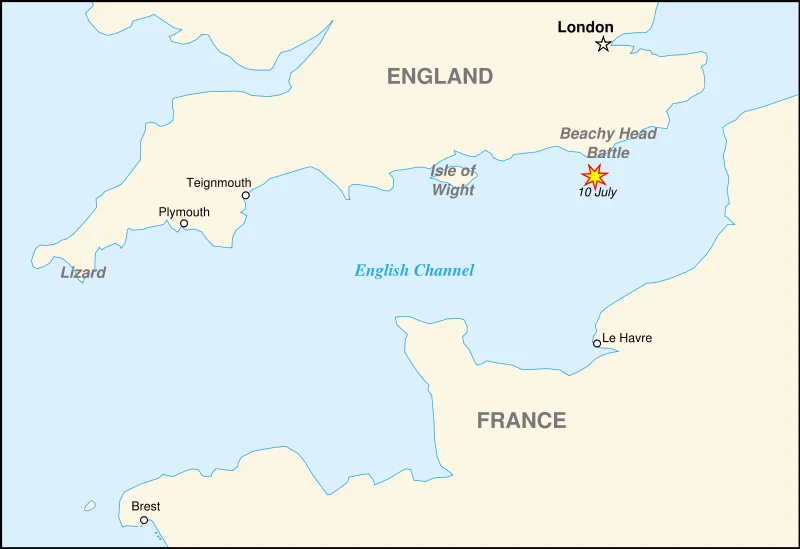

Battle of Beachy Head (1690)
Stand on Beachy Head on a clear July morning and look south. The chalk falls 162 metres to the surf below, gulls riding the updraft, the horizon ruled flat between cliff and sea. On the morning of 10 July 1690, somewhere out beyond that horizon, 75 French ships of the line under the Comte de Tourville stood off the Sussex coast and beat an Anglo-Dutch fleet less than three quarters their size. It was the most significant French naval victory over the Grand Alliance during the entire Nine Years' War. The diarist John Evelyn, in London, wrote that 'the whole nation now exceedingly alarmed by the French fleet braving our coast even to the very Thames mouth.' Louis XIV had, for one summer, taken control of the English Channel - and then proceeded, to his fury, to do almost nothing useful with it.
An Empty Channel
The setup, in the spring of 1690, was almost embarrassingly favourable for France. William of Orange, now William III of England, had taken his best troops to Ireland to fight the deposed James II and his French-backed army. The English fleet was scattered: a substantial portion in the Mediterranean under Vice Admiral Henry Killigrew, six men-of-war shepherding 280 transports across the Irish Sea under Sir Cloudesley Shovell, and Admiral Herbert, Earl of Torrington, left holding the Channel with what remained. Louis XIV's naval minister had, against his own pessimistic instincts, agreed to throw the full weight of the French fleet against him. The Comte de Tourville, commanding the combined Brest and Toulon squadrons - 75 ships of the line and 23 fire ships - sailed into the Channel on 23 June. By 30 June he was off the Lizard. Torrington came down from the Nore with 56 ships and 4,153 guns, against Tourville's 4,600. Off the Isle of Wight he was joined by a Dutch squadron of 22 ships under Cornelis Evertsen the Youngest. He still had fewer guns. He had fewer hulls. He had the wind.
An Order He Did Not Want
Torrington's instinct was to refuse battle. He proposed instead to retreat eastward to the Straits of Dover and keep his fleet 'in being' - intact as a threat - while waiting for Killigrew to come home from Cadiz. He was probably right. But in William's absence, Queen Mary and her advisors, the so-called Council of Nine, were not in a tolerant mood. Carmarthen, the Earl of Nottingham and Admiral Russell back in London thought Torrington was exaggerating French strength, possibly out of cowardice, possibly out of disloyalty. They sent him a written order on 9 July, while he was already off Beachy Head, instructing him to engage. Torrington called a council of war. His captains agreed: not to fight was direct disobedience to the crown. To fight, in his own judgement, was to risk losing the fleet, the Channel and the country. They sailed at dawn.
The Battle Off the Cliffs
About eight in the morning on 10 July, with the chalk of Beachy Head visible to the north, the Anglo-Dutch line ran down on the French in line abreast, elongated to prevent doubling at either end. The Dutch squadron under Evertsen held the van. Torrington took the centre red squadron. Vice-Admiral Ralph Delaval, with English and Dutch ships mixed, held the blue rear. Tourville aboard the *Soleil Royal* commanded the French centre; the Marquis de Chateaurenault held the van, Victor-Marie d'Estrees the rear. The Dutch bore down hard on the leading French squadron - too hard, and too early. Chateaurenault's leading division slipped across their path and doubled on them, hammering Evertsen's ships from both sides. Vice Admiral Ashby with the English red squadron was too slow to come up. Torrington, when he did bring the rest of the red into action, found the French line sagging away from him, and could not close inside twice gunshot range. By late afternoon, with the Dutch shattered and his own line outmatched, Torrington broke off and ran for the Thames estuary.
A Victory That Did Nothing
Tourville had won decisively, and Louis XIV had no plan for what to do with the victory. The Marquis de Seignelay, his naval minister, had written to Tourville before the battle: 'I shall be content if you will let me know as soon as possible after the battle your thoughts on the employment of the fleet for the rest of the campaign.' That is not the planning of an invasion. The day after Beachy Head, on 11 July, William smashed James II at the Battle of the Boyne in Ireland. James fled to France, his cause finished. Louis declined to use his temporary Channel supremacy to land an army. Tourville sailed instead to Le Havre to refit and land his sick. The sum of his victory, when Seignelay finally allowed him to do something, was the symbolic burning of the small Devon coastal town of Teignmouth later in July. Louis was furious. Tourville was relieved of command. By the end of August, with English squadrons reunited, the Allied fleet had 90 ships cruising the Channel and temporary French control was over.
The Politics of Defeat
In England, the panic that had greeted news of Beachy Head did not last but the search for someone to blame did. Torrington was court-martialled. To the outrage of William and his ministers - and to the quiet delight of Englishmen who had always thought the Dutch king was prioritising Dutch interests over English ones - the court-martial acquitted him. The judgment, in retrospect, was sound: he had been ordered into a battle he had warned against, he had executed it as well as the odds allowed, and the Dutch had taken the worst of it not through his fault. William saw it differently. He refused to receive Torrington at court, dismissed him from the navy on 12 December, and replaced him at sea with a triumvirate of Henry Killigrew, John Ashby and Sir Richard Haddock - who were themselves soon replaced by Admiral Russell. The Channel went back to being contested. The white cliffs went on being white. And Tourville, for two years, sat at Brest, until 1692 brought him a far less successful day off La Hougue.
From the Air
The battle was fought offshore from Beachy Head, in the English Channel south of Eastbourne. Coordinates of the headland itself 50.7374 N, 0.2477 E; the action ranged across several square miles of sea to the south. Nearest airports: Brighton City Shoreham (EGKA) 19 nautical miles west, Lydd (EGMD) 21 nautical miles east, and London Gatwick (EGKK) 32 nautical miles north. Recommended viewing altitude 2,500 to 5,000 feet AGL - the white chalk wall of Beachy Head and the Seven Sisters running west toward Birling Gap are unmistakable, with the red-and-white striped lighthouse standing on its iron platform 165 metres seaward of the cliff base. From altitude, the geometry of the Channel itself - France just under 60 miles south - tells you why the battle happened where it did.
Nearby Stories
- Ashdown Forest 12 km away
- Battle of Dungeness 21 km away
- Amberley Museum & Heritage Centre 25 km away
- Camber Castle 25 km away
- Charterhouse School 31 km away
- German Auxiliary Cruiser Komet 116 km away
- Cléon 128 km away
- D-Day: The Longest Day 138 km away