
Ashdown Forest
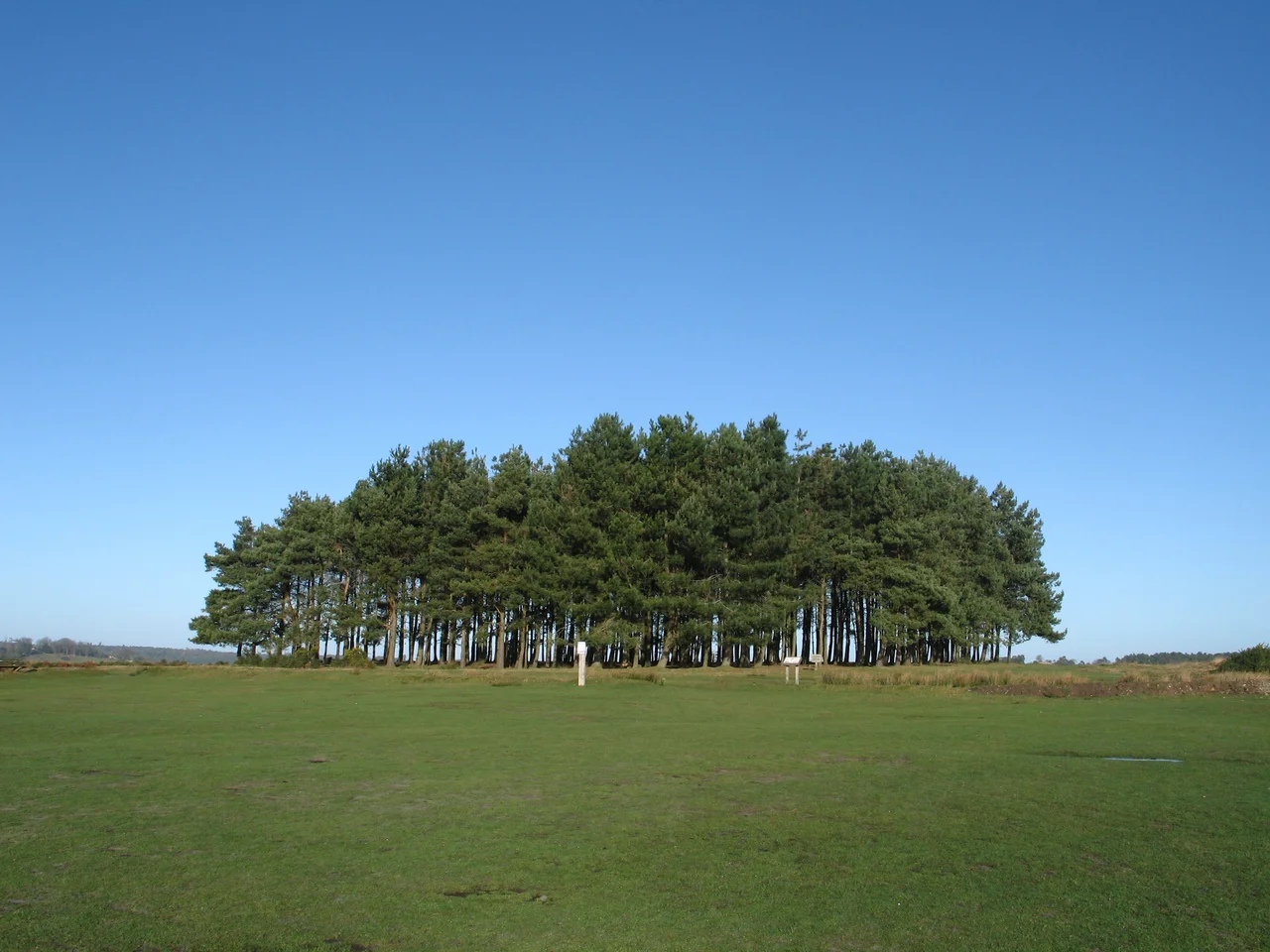
Most visitors arrive expecting woodland. What they find is heath: open, springy, treeless ground rolling away across the highest sandy ridge of the High Weald, with a single line of Scots pines on the skyline like a row of green torches. The clumps were planted by the lord of the manor in 1816 to give cover to blackgame. A century later they became the most recognisable feature of A. A. Milne's Hundred Acre Wood, drawn by E. H. Shepard from the real trees on Gills Lap. Ashdown Forest is not a forest in the modern sense at all. It is the largest area of public-access open country in southeast England, 30 miles south of London, and the word 'forest' here is a Norman legal term meaning land set aside for the king's deer.
A Forest Made by Law
Ashdown Forest does not appear in the Domesday Book. The Normans created it after 1066 as part of the much larger Forest of Pevensel within the Rape of Pevensey. By 1283 it was fenced with a 23-mile pale - a ditch and bank topped by an oak palisade - enclosing about 20 square miles. Thirty-four gates and hatches still echo in place names like Chuck Hatch and Chelwood Gate. Commoners could graze livestock, gather firewood, cut bracken for animal bedding; royal hunters took the deer. Henry VIII hunted from a lodge at Bolebroke Castle near Hartfield and is said to have courted Anne Boleyn at nearby Hever Castle. In 1693, more than half the forest was enclosed for private ownership and the remaining 6,400 acres set aside as common land, which is roughly the shape of the public forest today.
Iron, Then Heath
The forest's underlying sandstone, the Lower Cretaceous Ashdown Formation, is poor for crops and rich in iron-bearing clay. In 1496, at Newbridge near Coleman's Hatch, the first English blast furnace was built; an inscription at the site credits Henry VII with the order and marks the beginning of Britain's modern iron and steel industry. Newbridge's output was modest - perhaps 150 tons a year - but it triggered a Wealden iron boom that consumed the forest's woodlands for charcoal through the 16th century. The Crown was already lamenting by 1520 that 'much of the King's woods were cut down and coled for the iron mills.' The combination of grazing commoners, cattle by the thousand and charcoal-burners produced what visitors see today: open heath dominated by ling, bell heather and dwarf gorse, with bracken-filled valleys and scattered birch.
The Hundred Acre Wood
A. A. Milne bought Cotchford Farm at the northern edge of the forest in 1925. He took his son Christopher Robin walking on the heath. Five Hundred Acre Wood, a private woodland inside the medieval pale, became Milne's Hundred Acre Wood. The Wealdway long-distance footpath now passes through it. Shepard's illustrations - the lone pines on the skyline, the open expanses where Pooh and Piglet hunt heffalumps, the line of sandy track - are recognisable across the forest. The Pooh memorial at Gills Lap is on the high ground above the spot Shepard drew most often. Poohsticks Bridge, half a mile downstream from Cotchford, has been rebuilt twice; the original beams are now in the V and A. The forest is now visited by at least 1.35 million people a year, many on what local rangers privately call Pooh pilgrimages.
Prime Ministers, Presidents, Dartford Warblers
Harold Macmillan lived at Birch Grove on the edge of the forest at Chelwood Gate during and after his time as British prime minister. He hosted John F. Kennedy there. Two clumps of Scots pines commemorate each man: Macmillan Clump near Chelwood Gate, and Kennedy Clump for JFK's 1963 visit. The ecology is internationally recognised. Ashdown is a Site of Special Scientific Interest, a Special Protection Area for birds and a Special Area of Conservation. It is one of the last strongholds of the Dartford warbler, Britain's scarcest heathland bird; the European nightjar churrs at dusk in summer; the silver-studded blue butterfly is common where the gorse and heather are. Exmoor ponies, kept by the conservators rather than truly wild, graze scrub to keep the heath open.
The Airman's Grave
On the southern slopes between Nutley and Duddleswell, hidden in the heather, is a small stone-walled enclosure called the Airman's Grave. It is not a grave. It is a memorial to the six-man crew of a Wellington bomber of 142 Squadron who died on 31 July 1941, when their aircraft came down on the forest as it returned from a raid on Cologne. The memorial began as a wooden cross planted by Mrs Sutton, mother of the 24-year-old second pilot Sergeant Victor Ronald Sutton. Each Remembrance Sunday a wreath is laid here by a forest ranger, alongside others from the conservators, the riding association and local groups. Visitors who come for Winnie-the-Pooh and find this place tend to stand for longer than they expected, looking out across the heath, before walking back to the car park at Hollies.
From the Air
Ashdown Forest occupies the high sandy ridge of the High Weald in East Sussex, centred at roughly 51.07 degrees north, 0.07 degrees east. The forest rises to 223 metres at its highest point and offers expansive views north to the chalk North Downs and south to the South Downs. London Gatwick (EGKK) is about 12 miles to the northwest. From altitude, look for the distinctive mosaic of open heathland - paler than the surrounding farmland - dotted with the iconic clumps of Scots pines. The forest is roughly triangular, about seven miles across. Crowborough sits at the eastern edge, East Grinstead to the northwest, Forest Row at the north.
Nearby Stories
- Lullingstone Castle 3.6 km away
- Belle Tout Lighthouse 7.5 km away
- Oatlands Palace 8.7 km away
- Queenborough Castle 10 km away
- The Mermaid Inn, Rye 13 km away
- Surrey 22 km away
- Fratton Park 50 km away
- Battle of Boulogne 65 km away