
Battle of Beaver Dam Creek
"There they come like flies on a piece of gingerbread." That was Brigadier General John F. Reynolds, a Pennsylvania officer, gesturing at the Confederate brigades emerging from the woods across Beaver Dam Creek on the afternoon of June 26, 1862. The Confederates had been ordered into a frontal assault on dug-in Union infantry supported by thirty-two guns. It was the opening battle of the Seven Days - Robert E. Lee's first major offensive as commander of the Army of Northern Virginia - and it began with everything going wrong. Stonewall Jackson, who was supposed to flank the Union position, arrived four hours late and then went to sleep four miles away. A.P. Hill, impatient, attacked anyway. Lee himself rode up mid-battle to find his army hurling itself at prepared positions, and when Jefferson Davis arrived with the Confederate cabinet to watch, Lee responded with one of the war's better dry quips: "I don't know, Mr. President. It is not my army and this is no place for it."
The Plan That Did Not Survive Contact
After the Battle of Seven Pines, McClellan's Army of the Potomac had sat at the outskirts of Richmond for almost a month. Lee, newly in command, used the time to reorganize his army and to summon Stonewall Jackson down from the Shenandoah Valley, where Jackson had just finished a brilliant campaign. Jackson arrived on June 25 with four divisions. Lee's plan called for Jackson to attack Porter's V Corps from the north on June 26, swinging in from the right. A.P. Hill's Light Division would advance from Meadow Bridge when Jackson's guns were heard, clear Mechanicsville, and move on Beaver Dam Creek. D.H. Hill and James Longstreet would support. South of the Chickahominy, Benjamin Huger and John B. Magruder would demonstrate against McClellan's main body to keep the Union army pinned. The plan moved 65,000 Confederates against 30,000 Federals north of the river, leaving only 25,000 to hold Richmond against the 60,000 Federals south of the river. It was the kind of audacious concentration that Lee would attempt again and again in the war. It depended entirely on Jackson arriving on time.
Jackson Late, Hill Impatient
Jackson's men - exhausted from the long march out of the Shenandoah - ran at least four hours behind schedule on June 26. By 3 p.m. A.P. Hill had had enough. Without orders, he opened the attack. His division entered Mechanicsville and skirmished with George McCall's Pennsylvania Reserves, who fell back across Beaver Dam Creek to prepared defensive positions on the eastern bank. There, John F. Reynolds and Truman Seymour dug in with George G. Meade's brigade in reserve. Behind their roughly 14,000 entrenched infantry stood 32 guns in six batteries, with George Morell's and George Sykes's divisions forming a supporting semicircle. The total Union force on the field came to about 26,000 men with 32 artillery pieces. Hill had 11,000 men, most of them green regiments who had never been in battle. He attacked anyway.
Flies on Gingerbread
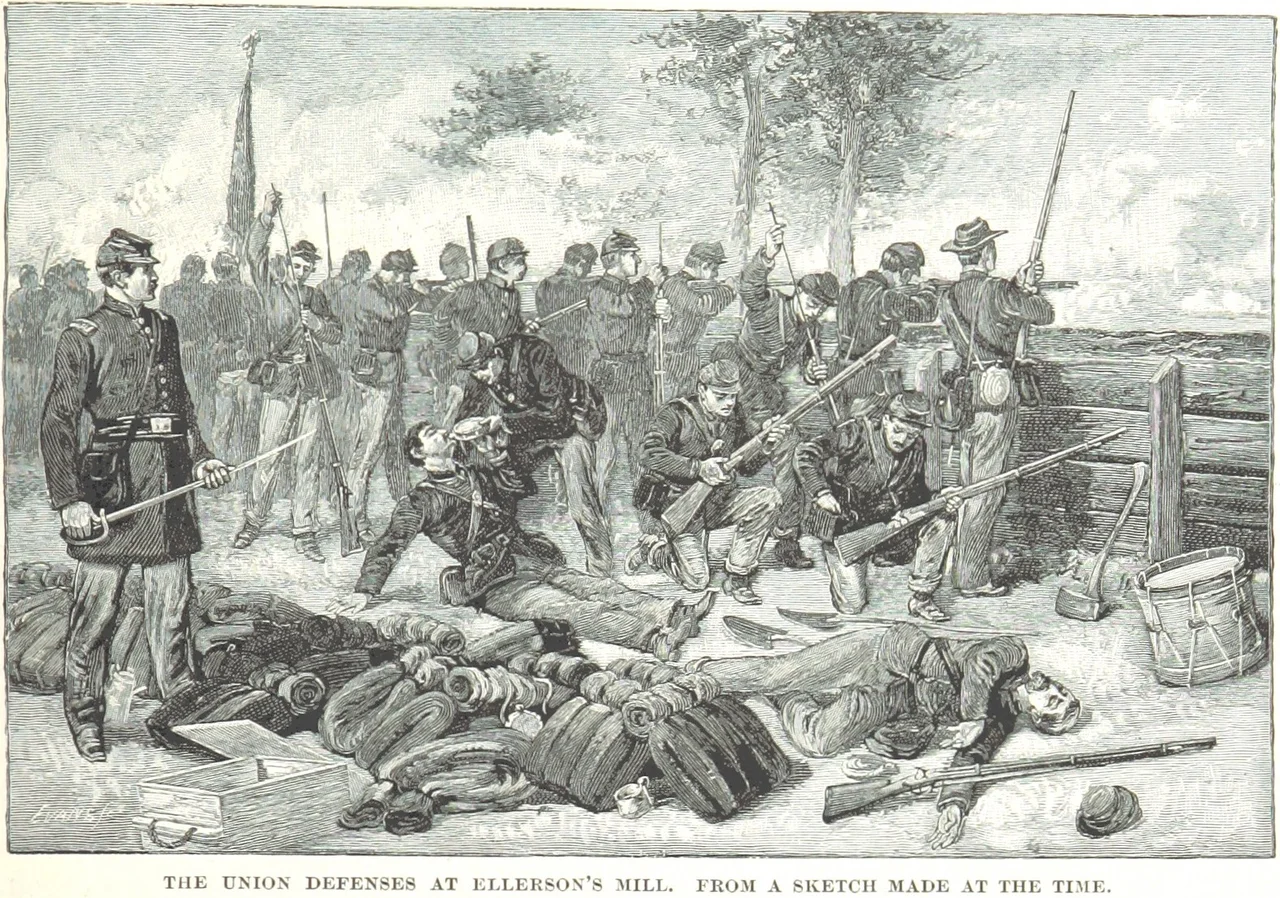
John R. Anderson's brigade hit the Union right; James Archer's and Charles W. Field's brigades supported. Maxcy Gregg's brigade was held in reserve and never engaged. The Union artillery and musketry tore enormous holes in the Confederate lines as they tried to cross the creek. Hill had twenty-four guns of his own but never massed them, instead sending individual batteries forward in piecemeal support, where they were quickly silenced. Anderson's men briefly got across the creek and threatened Reynolds's position, but Meade's brigade and two regiments from Morell's division reinforced him and threw them back. William D. Pender's brigade attacked the Union left at Ellerson's Mill. They too were repulsed. Then came Roswell Ripley's brigade of D.H. Hill's division, ordered against the same Union left flank, and Ripley's men suffered the worst losses of the day: over 600 casualties. The 44th Georgia lost 335 men out of 514, a roughly 65 percent casualty rate, including their colonel Robert A. Smith. The 1st North Carolina took 50 percent casualties - 133 men killed, wounded, or captured - including their commander Colonel Montford Stokes. Ripley himself survived but came within inches of being decapitated by an artillery shell.
Jackson Asleep, Lee Sarcastic
Jackson arrived on the field late in the afternoon. Unable to find A.P. Hill or D.H. Hill, and apparently uncertain what to do, he ordered his troops to make camp for the night - despite the fact that a major battle was raging within earshot. It remains one of the strangest moments of Jackson's career, and historians have argued for a century and a half about what it meant. Was he exhausted from the Valley Campaign? Was he confused by Lee's orders? Was his famously erratic command judgment failing him? Whatever the answer, the most aggressive corps commander in the Confederacy spent the late afternoon of June 26 with his men in bivouac while their comrades died across the creek. Meanwhile, Lee rode onto the battlefield as Jefferson Davis and the cabinet arrived to observe. Davis asked Lee what all this army was doing here. Lee gave one of the war's coldest answers: "I don't know, Mr. President. It is not my army and this is no place for it."
The Tactical Win That Lost the Campaign
When darkness fell, Longstreet and the rest of D.H. Hill's division had finally come up. There was no light left to deploy them. By any battlefield measure the day had been a Union victory - the Confederates had taken roughly 1,500 casualties to about 400 Union losses. And yet McClellan, alarmed by Jackson's presence near Porter's flank, ordered Porter to withdraw east to Boatswain's Swamp under cover of night. McClellan was worried that the Confederate buildup threatened his supply line on the Richmond and York River Railroad. He decided to shift his base of supply south to the James River - a strategic decision that meant abandoning his siege of Richmond entirely. The next day, the Seven Days continued at Gaines's Mill. Company F of the 8th Pennsylvania Reserve Regiment - The Hopewell Rifles, from Bedford County - never got the order to retreat, and were taken prisoner. They would spend the rest of the war in Belle Isle and Castle Thunder. Twenty years later D.H. Hill would write of his army's frontal assaults: "The attacks on the Beaver Dam entrenchments, on the heights of Malvern Hill, at Gettysburg, were all grand, but of exactly the kind of grandeur the South could not afford."
From the Air
The battlefield centers on Beaver Dam Creek at approximately 37.5985°N, 77.3599°W, in Hanover County about 8 miles northeast of downtown Richmond near the small town of Mechanicsville. A walking trail along the lower section of the creek is part of Richmond National Battlefield Park. Recommended viewing altitude 2,000-3,000 feet AGL; the creek itself runs roughly north-south and the Chickahominy River, which dominated the campaign, is a few miles south. Nearest airport: Hanover County (KOFP), 12 miles north; Richmond International (KRIC) is about 10 miles south. Ellerson's Mill site and the Union defensive positions are preserved by the National Park Service.
Nearby Stories
- Kings Dominion 8.4 km away
- Battle of Hatcher's Run 9.7 km away
- Francisco's Fight 14 km away
- Piney Grove at Southall's Plantation 17 km away
- Jamestown Settlement 19 km away
- Battle of Amelia Springs 22 km away
- Menokin 29 km away
- Highland (James Monroe House) 42 km away