
Battle of Curlew Pass
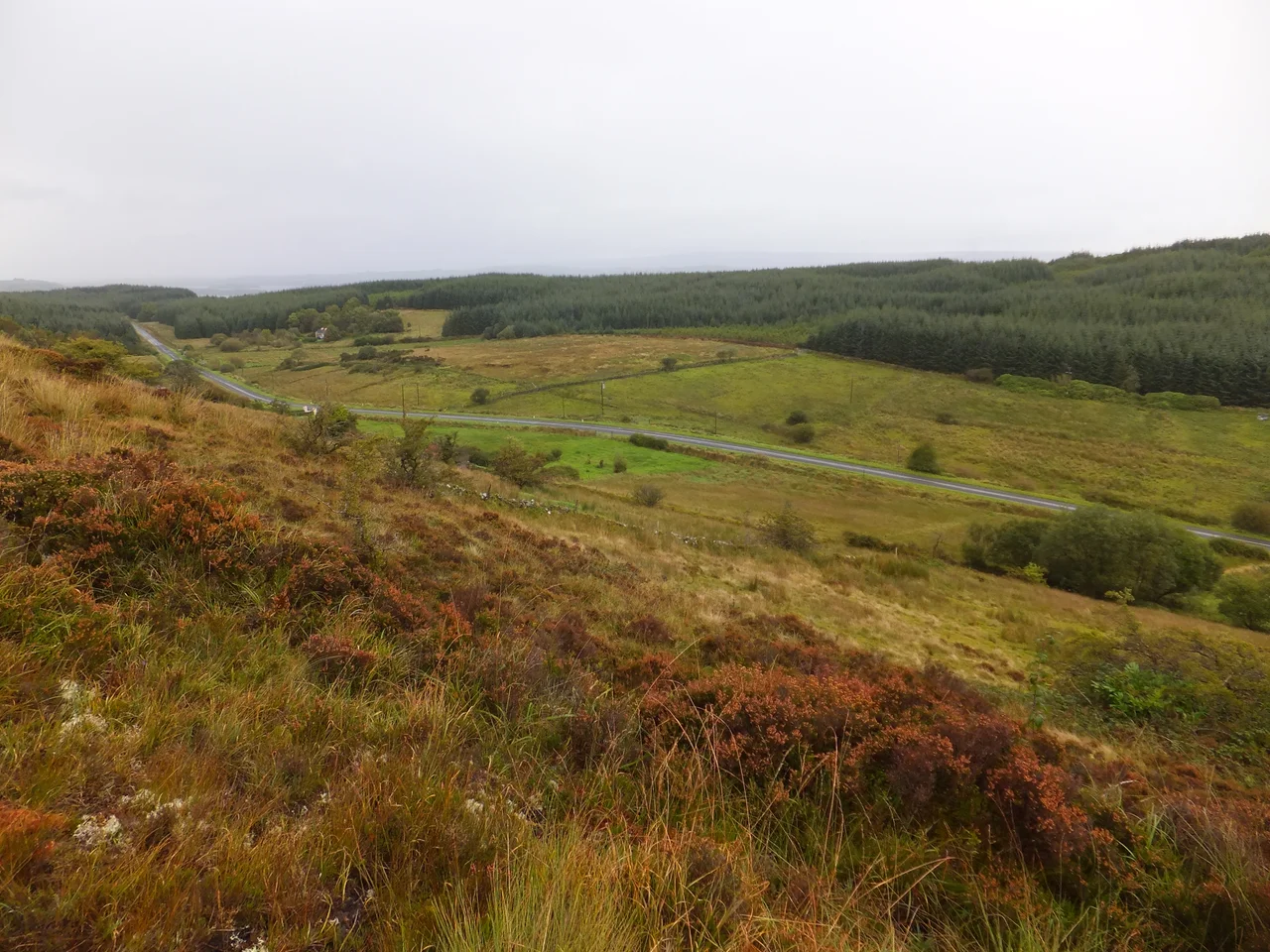
The road ran through the bog. Limestone slabs six or seven feet wide laid edge to edge, with stretches of soft black peat between them, climbing the low spine of the Curlew Mountains north of the town of Boyle. On the afternoon of 15 August 1599 - a feast day, the Assumption of Mary, harvest weather hot and still - Sir Conyers Clifford led 1,500 English infantry and 200 cavalry up that road toward Sligo. He had been told the pass was undefended. He was wrong. Inside the woods on either side, Conor MacDermott had hidden six hundred musketeers and archers. Behind the ridge beyond, out of sight, Red Hugh O'Donnell had concealed the main Irish infantry. And waiting in the trees, with one hundred and sixty heavy axemen, was Brian Og O'Rourke of the Breifne. The English would not reach Sligo.
Connacht's Last Chieftain
The Nine Years' War had begun in Ulster in 1593 and by 1599 it had spread to most of Ireland. Hugh O'Neill of Tyrone and Red Hugh O'Donnell of Tirconnell led a Gaelic alliance that had handed England its worst defeat in Ireland at the Yellow Ford only a year before. The 2nd Earl of Essex, brought ashore in April 1599 with over 17,000 men - the largest expedition ever sent from England to Ireland - was already losing it. Sir Conyers Clifford's task was urgent: relieve the English-aligned Gaelic chieftain Sir Donogh O'Connor Sligo, besieged in Collooney Castle by O'Donnell's two thousand. Clifford's force marched out of Athlone in late summer, through Roscommon, through Tulsk, through Boyle. By four o'clock on a hot harvest afternoon they reached the foot of the Curlews. Eight hundred and sixty feet to the summit. Sligo on the other side. Clifford promised his men beef for supper if they could push through that night.
Ninety Minutes of Smoke
The first barricade between Boyle and Ballinafad was lightly held. The Irish there fired a few shots and fell back on horseback to warn the main army. Clifford pushed on, his musketeers leading the column up the rocky bog-road. Hit-and-run fire began from the trees on the flanks - O'Donnell's skirmishers harassing the line without ever showing themselves. Soldiers slipped away into the woods. The firefight that followed lasted about ninety minutes. The Irish, firing from prepared cover on either side of the road, had cleaner shots than the English could ever return. MacDermott's pipers played battle songs in the woods - the steady, taunting drone of war pipes echoing back from rocks and treeline. The English musketeers ran low on powder. Their vanguard commander Alexander Radcliffe was hit in the face and the leg, and called on the Anglo-Irish officer Henry Cosby to lead a charge. Cosby refused. Radcliffe, dying in the arms of his officers, told him bitterly that to die at his countrymen's hands would be better than what awaited Cosby on return.
Like Folding Doors
Then Brian Og O'Rourke led his gallowglasses out of the trees. These were the heavy axemen of the Gaelic world - tall, mailed Scottish-Irish professional soldiers carrying two-handed Lochaber axes - and they had been waiting for this moment. A contemporary account describes the instant when MacDermott's gunmen on either side of the road parted: 'Like hounds slipped from the leash, O'Rourke's Brenny men went upon the Queen's vanguard. MacDermott's gunmen and archers gave way to the right hand and to the left, opening out like folding doors as the Brenny men, with a shout at such an instant changed fortitude to alarm, and alarm to panic terror, went upon the foe.' Radcliffe wheeled his pikemen for a final charge and was shot dead. Clifford rallied, ran forward against the enemy, and was shot through the chest. Behind the ridge, O'Donnell's main body of pike and axe poured down the slope and into the disintegrating English column. Roughly half of Clifford's 1,500 infantry were killed. Irish casualties were light - they had been firing from cover into a routed enemy.
Aftermath in Two Pieces
Brian Og O'Rourke had Clifford's head cut off and sent it back to O'Donnell, who had watched without joining the fight; the head was carried to Collooney Castle and shown to its defenders, who surrendered within days. The trunk MacDermott took to the monastery on Trinity Island in Lough Key, hoping to ransom it for his own captured men. It was buried there in the end. The English chronicler noted, with the gentle horror that runs through these stories, that Clifford had recently dreamed of being captured by O'Donnell and carried by monks into their convent. The cavalry commander Sir Griffin Markham - with the inventor John Harington of the flushing water-closet riding in his ranks - led the only thing that saved the English from total annihilation, a desperate uphill charge 'amongst rocks and bogs where never horse was seen to charge before.' It bought the survivors enough time to flee back to Boyle Abbey. Robert Cecil, the queen's chief secretary, rated Curlew Pass and the simultaneous defeat at Wicklow as the two heaviest blows ever suffered by English arms in Ireland. Today the bronze 'Gaelic Chieftain' by Maurice Harron - unveiled in 1999 for the four-hundredth anniversary - stands above the N4 about two kilometres northeast of the actual battlefield, watching the cars climb the same low pass.
From the Air
Located at approximately 53.998 degrees north, 8.312 degrees west, in the Curlew Mountains just south of the County Sligo border. The pass is the saddle on the N4 road between Boyle and the south end of Lough Arrow. The bronze 'Gaelic Chieftain' sculpture is the most visible modern landmark. Best viewed at 2,000-4,000 feet. Nearest airports: Ireland West Knock (EIKN) about 40 km west, Sligo (EISG) about 35 km north.
Nearby Stories
- Tulsk 1 km away
- Holywell ambush 5.8 km away
- Enniskillen Royal Grammar School 6.5 km away
- Aclare 7.6 km away
- Bawnboy 7.8 km away
- Clonfin Ambush 10 km away
- Benbulbin 14 km away
- RMS Empress of Britain (1930) 125 km away