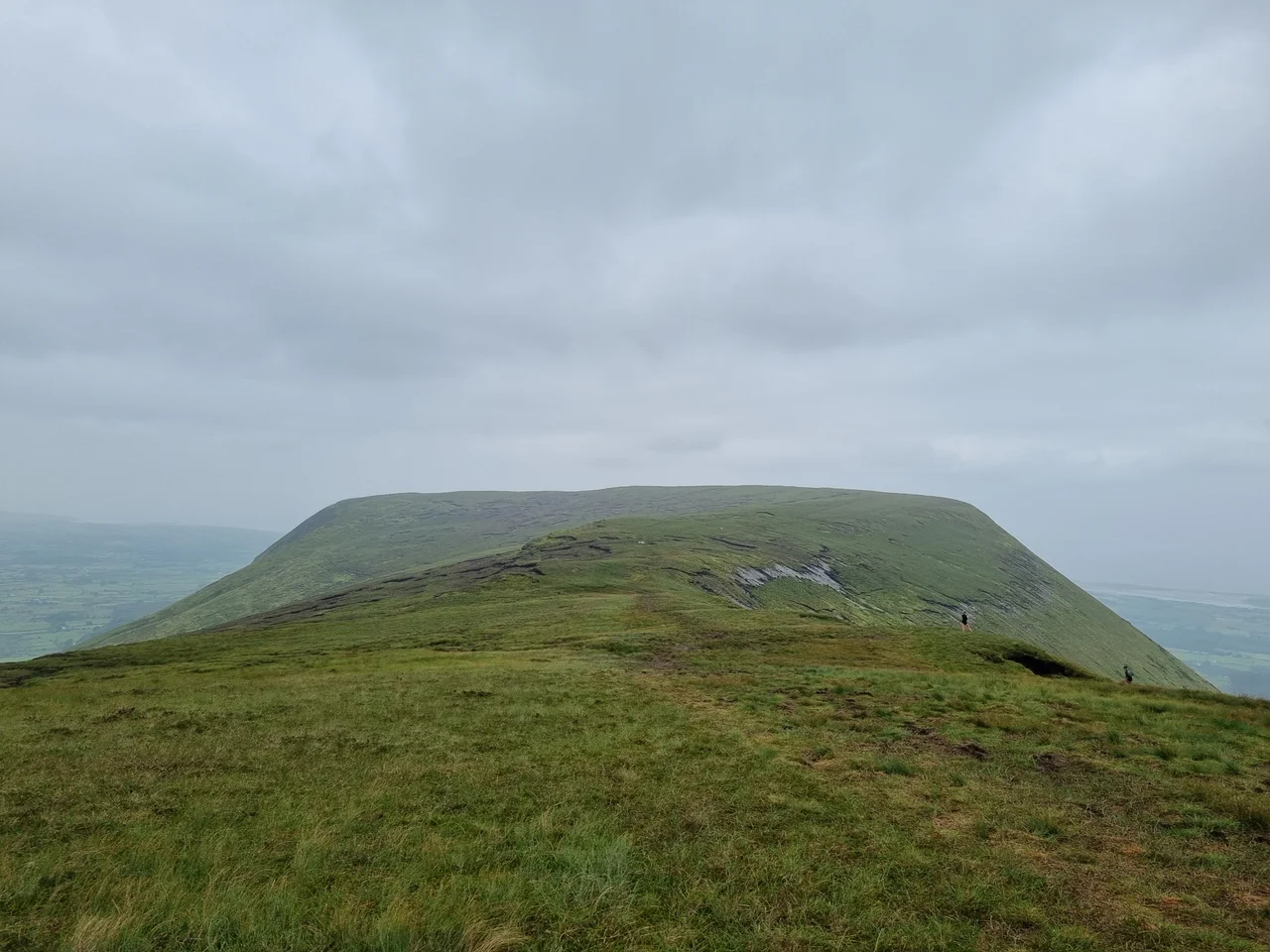

Benbulbin
On a September day in 1948, the body of William Butler Yeats came home to Sligo and was buried in the small churchyard at Drumcliff, exactly where he had asked to be laid down: under bare Ben Bulben's head. The mountain that gave the line its weight rises 526 metres above the coastal plain, flat-topped and steep-sided, a long limestone wall that catches the Atlantic light and throws shadows across the fields below. Glaciers shaped it during the last Ice Age, scraping a high plateau into its present silhouette. Out here in north Sligo, you do not look at Benbulbin - it looks at you, and at everything else for thirty kilometres in every direction.
A Mountain That Was a Plateau
Benbulbin is a nunatak - rock that stood above the ice during the last glacial period, when most of Ireland lay beneath glaciers. The mountain was originally a much larger limestone plateau, shaped into its present form by ice moving from northeast to southwest, which carved away the softer rock and left the harder cap standing. The whole structure is layered: a thick upper limestone called the Dartry Limestone Formation, a thinner transitional limestone called the Glencar Limestone Formation, and below them the shaly mudstone of the Benbulben Shale Formation. Scree deposits gather at the base where freeze-thaw cycles continue the slow disassembly. The rocks themselves are roughly 330 million years old, formed in a Carboniferous shallow sea long before there was anything resembling Ireland.
Plants That Beat the Ice Age
Because Benbulbin's summit stays cooler than the surrounding lowlands, it hosts a community of Arctic-alpine plants that exist nowhere else in Ireland. In 2012, researchers established that the fringed sandwort found on its ledges has been growing here for around 100,000 years - long enough to predate the last Ice Age, meaning these particular plant communities survived the glaciation in refugia on the mountain itself rather than recolonising afterward. The discovery reopened a long-standing debate about whether parts of Ireland's flora pre-date the ice rather than being entirely post-glacial. Alpine saxifrage, arctic meadow-rue, snowbed willow, bluebells, and rare species of Meconopsis and Polystichum cling to the cliff ledges. On the slopes below, badger, hare, and red fox still hunt and forage.
The Noble Six
On 20 September 1922, during the Irish Civil War, six anti-Treaty Republican fighters were hunted across these slopes by National Army forces. Their names were Brigadier Seamus Devins TD (an elected member of the Dáil), Brian MacNeill, Captain Harry Benson, Lieutenant Paddy Carroll, and Volunteers Tommy Langan and Joe Banks. Their armoured car had been destroyed by another armoured car belonging to the Free State, and the six fled up Benbulbin's flank. They were caught. All six were killed - by some accounts, after they had surrendered - by Free State forces avenging the death of Brigadier Joseph Ring eight days earlier. They are remembered locally as the Noble Six. A cross marks the slope where they fell. Two of the dead and the man they died avenging - Ring - became part of later political lineages: McNeill was the uncle of future Tánaiste Michael McDowell; Devins was the grandfather of Sligo TD Jimmy Devins; Ring was the great-uncle of Mayo TD Michael Ring. Sligo's civil war is still bound up in its modern politics.
Two Planes, Both Down
During the Second World War, two military aircraft crashed into the Dartry Mountains close to Benbulbin. On 21 March 1941, an RAF Catalina flying boat using the Donegal Corridor - the narrow strip of Irish airspace neutral Ireland allowed Allied aircraft to traverse - crashed at Glenade on the east side of Truskmore. All nine airmen aboard died. On 9 December 1943, a USAAF Boeing B-17G Flying Fortress en route from Goose Bay in Labrador to Prestwick in Scotland struck the mountain at Truskmore just east of Benbulbin. Ten airmen were aboard; three of them died, two at the scene and one from injuries. The mountain's cliffs are a hazard most pilots only encounter once. Wreckage from both crashes remains on the slopes; small memorials mark where the dead fell.
Under Ben Bulben
Yeats began writing about this mountain decades before he asked to be buried beneath it. In his 1893 collection The Celtic Twilight, in his poem On a Political Prisoner, in his late great poem Under Ben Bulben - the mountain is woven into the imaginative geography that became known as Yeats Country. The Yeats family had spent their summers at Rosses Point a few miles south, and Benbulbin had stood over those summers as a constant, weather-changing presence. When the poet died in southern France in January 1939, his wishes for burial were specific: Drumcliffe churchyard, the family church on the plain immediately below the mountain. The war delayed the move. In September 1948, the Irish naval corvette Macha carried his body home. The stone over his grave bears his own epitaph, exactly as he wrote it: "Cast a cold eye on life, on death. Horseman, pass by."
Things Done in Its Shadow
Benbulbin overlooks the village of Mullaghmore, where Lord Mountbatten and three others - including two children - were murdered by an IRA bomb in 1979. In 1977 Sinn Féin's Brits Out campaign painted the mountain itself with slogans 180 feet wide and 25 feet high; the H-Block lettering later replaced them. In May 2018, anti-abortion campaigners erected a vast NO sign on the slopes ahead of the Eighth Amendment referendum, severely impacting the iconic view; it came down the next day. Andy "The Bull" McSharry, who lives near the mountain, became famous for a seventeen-year dispute over walking access across his land. The mountain absorbs all this human noise without much commenting. It will be here long after the slogans and the disputes have weathered off.
From the Air
Benbulbin sits at 54.367°N, 8.467°W in north County Sligo, part of the Dartry Mountains, rising 526 m above the coastal plain. From the air, the distinctive flat-topped silhouette with steep northern cliffs is a major landmark visible from much of the northwest. The northern face is notoriously hazardous - high winds and storms off the Atlantic, with two WWII military crashes in the immediate area (RAF Catalina 1941, USAAF B-17G 1943). Sligo Airport (EISG) is 18 km south; Donegal Airport (EIDL) is 30 km north. Maintain safe terrain clearance (at least 2,000 ft above the summit recommended); expect significant mountain wave and turbulence in strong winds; Drumcliffe churchyard with Yeats's grave lies on the plain 5 km southwest of the summit.
Nearby Stories
- Roman Catholic Diocese of Killala 3.2 km away
- County Leitrim 6.2 km away
- Glencolmcille 8.3 km away
- Ballymote 8.5 km away
- Caves of the Tullybrack and Belmore Hills 15 km away
- Ballycastle, County Mayo 20 km away
- Castlederg 32 km away
- RMS Empress of Britain (1930) 80 km away