.jpg)
Battle of Fraga
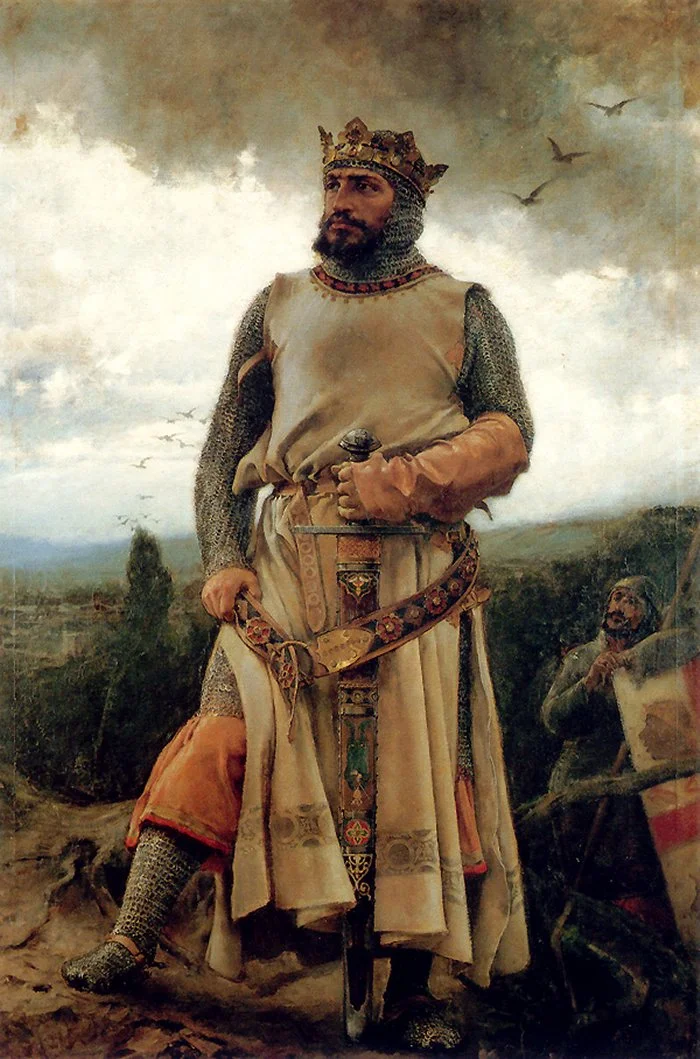
For nearly three decades, Alfonso I of Aragon earned his name in the field. His own subjects called him el Batallador, the Battler. To the Muslims of the frontier he was Ibn Rudmir, son of Ramiro, and sometimes al-Farandji, the Frank. By the summer of 1134 he had spent a lifetime pushing the borders of Aragon southward, and when he laid siege to the frontier town of Fraga that July, he expected the campaign to end the way most of his campaigns did. It did not. The battle fought outside these walls on 17 July 1134 broke his army in a single afternoon, and within weeks it broke him.
The Long Frontier
Since the second half of the eleventh century, the kings of Aragon and the counts of Barcelona and Urgell had pressed with stubborn persistence against the Muslim towns and fortresses of the Marca Superior, the Upper March of al-Andalus. Their eyes were fixed on the lowlands along the Segre and Cinca rivers, a fertile, prosperous corridor that ran all the way to the mouth of the Ebro and, beyond it, the Mediterranean. Four towns anchored the region: Lleida, Mequinenza, Fraga, and Tortosa. Take them, and Aragon would reach the sea. Fraga was one link in that chain, and Alfonso meant to have it. He had made a career of exactly this kind of frontier warfare, wearing down Muslim strongholds one by one, and few opponents had ever made him pay for his boldness. He brought his army down from Aragon and closed his grip around the town, confident that hunger and pressure would do the rest.
The Relief Comes Riding
The Almoravid answer was swift and coordinated. From Cordoba, the emir, a son of the caliph, fielded two thousand horsemen. The emir of Murcia and Valencia, Yahya ibn Ghaniya, added five hundred more, and the governor of Lleida contributed another two hundred. Combined under the command of Ibn Iyad, the governor of Lerida, this relief force rode hard for the besieged town. When it appeared on the morning of 17 July, the defenders inside Fraga saw their chance and sallied out from the gates. Alfonso, still trusting in what he judged to be his numerical and tactical advantage, did not flinch. He rallied his men to meet both threats at once, the sortie in front and the relief on his flank. Between the town's fighters and the relief column he now faced thousands of fresh horsemen on open ground, yet a lifetime of narrow victories had taught him to trust his own judgment over the arithmetic.
One Confident Morning
The king's own entourage crashed into the cavalry of Yahya ibn Ghaniya, and there the day turned. Almoravid horsemen cut the Aragonese ranks apart. Sensing the collapse, the townspeople poured out of Fraga and fell upon the lightly guarded Christian camp, killing the soldiers left behind and carrying off the army's entire store of provisions back behind the walls. Then the emir of Cordoba launched his cavalry in a final charge and shattered what remained of the Christian line. Alfonso, who had won so often by holding his nerve, had nothing left to hold. Stripped of most of his soldiers, the Battler turned and rode north for the safety of Zaragoza, a beaten man on a road he had traveled many times in triumph.
What the Field Took
The toll fell heaviest on men who had followed the king across the Pyrenees. Among the dead were French knights of real standing: Aimery II of Narbonne, Bertran de Risnel, and Centule VI, Viscount of Bearn, who had marched with Alfonso as an ally rather than a subject. Guy of Lescar was taken alive and carried into captivity at Valencia. These were not anonymous casualties but named lords, each with lands and families who would soon receive word that no one wanted to bring. The king survived the field but not the wound to his cause. Alfonso I of Aragon, the Battler who had fought a lifetime of battles, died on 7 September 1134, less than two months after the worst of them. The Mediterranean he had reached for stayed out of Christian hands for another generation, and Lleida itself would not fall until 1149.
From the Air
Fraga lies at 41.52 N, 0.35 E on the frontier lowlands between Lleida and Zaragoza, where the Cinca runs down toward the Ebro. From roughly 4,000 to 5,000 feet the old town stacks up one bank while the modern town spreads across the river, the irrigated plain reading as a green patchwork against dry ochre hills. Lleida-Alguaire (LEDA) is the nearest field, about 30 km east; Reus (LERS) sits roughly 90 km southeast and Barcelona (LEBL) about 150 km east. Summer haze over the Ebro basin softens the horizon, so the clearest air usually follows a spring or autumn front.
Nearby Stories
- Vallbona Abbey 6 km away
- Món Casteller Human Tower Museum of Catalonia 16 km away
- Serra de Montsant Natural Park 24 km away
- Roca dels Bous (archaeological site) 27 km away
- Tremp Formation 31 km away
- Battle of Belchite (1937) 63 km away
- Zaragoza Barracks Bombing 73 km away
- Castle of Loarre 74 km away