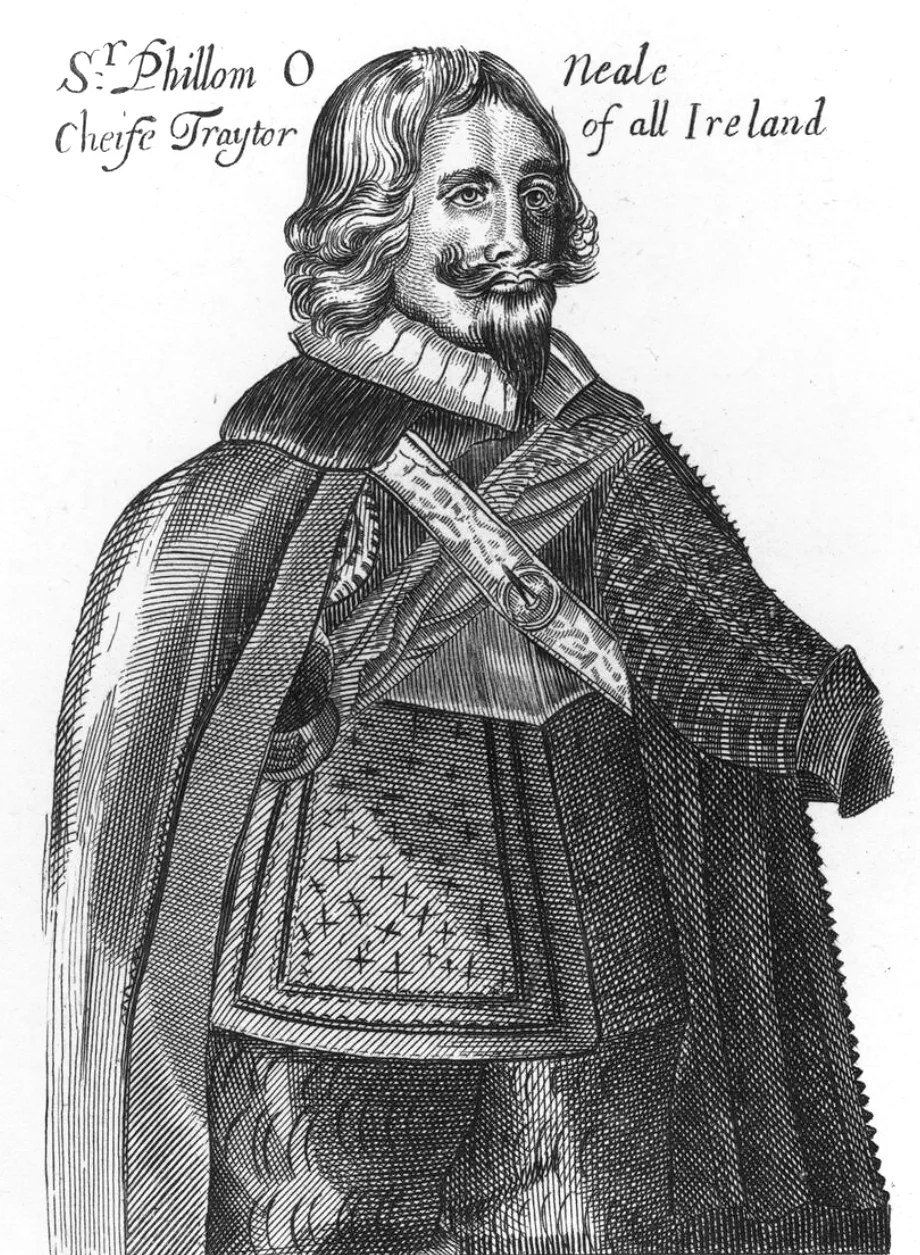

Battle of Glenmaquin
Sir Robert Stewart sent a small vanguard of sharpshooters partway across the field and waited. The Confederates obliged him exactly as he had hoped, charging downhill full force into the small detachment. The sharpshooters turned and ran, drawing the Confederates onto the Laggan Army's fortified position - and into a hail of musket fire that the Confederates, caught in the open, could not survive. The Battle of Glenmaquin lasted only minutes. By the time it ended on 16 June 1642, an estimated five hundred Irish Confederate soldiers lay dead in a Donegal valley, the Confederate Ulster Army's confidence in Sir Felim O'Neill had collapsed, and the Plantation settlers who built the Laggan Army had won themselves another decade of survival.
The Settlers' Army
The Irish Rebellion of 1641 had broken across Ulster the previous autumn, and thousands of Protestant settlers had been driven from their lands. Their houses burned. Their possessions taken. Their families hunted. Some escaped to Royalist strongholds, others sailed for England or Scotland and never came back. The Stewart brothers - Sir William and Sir Robert - were Scottish settlers who had served King Charles I militarily, and during the Plantation of Ulster the crown had rewarded them with large tracts of escheated land on condition they brought tenant settlers across from Scotland. Now those same tenants needed protecting. King Charles authorized the brothers to raise a regiment of 1,000 foot and a troop of horse for the king's service. Originally meant to defend the Laggan Valley in eastern Donegal, the unit Stewart raised - the Laggan Army - became the most effective Royalist militia in Ulster, escorting refugees, relieving strongholds, and conducting reprisal attacks on the Confederate forces.
A Spotty Record
Sir Felim O'Neill, the man who had organized the initial 1641 uprising and now commanded the Confederate Ulster Army, had a spotty military record - more defeats than victories. His soldiers were undisciplined and prone to plunder rather than fight. In the late spring of 1642 he decided to invade Donegal, why exactly is unclear. Perhaps to win over hesitant local Irish lords who had been lukewarm to the rebellion. Perhaps to capture undefended Derry. Perhaps because the alternative - sitting still while the Scottish expeditionary force under Sir Robert Monro pressed in from the east - was worse. Reinforced by the MacDonnells of Antrim and supported by Alasdair Mac Colla, the Scottish officer who had recently defected to the Confederate cause, Felim marched west with an army estimated at 6,000 foot and several hundred horse. Stewart waited for him with 2,000.
Two Lines on a Hillside
On 14 June, Felim crossed the Foyle into Donegal. Stewart was aware of the approach and chose not to attack immediately. He withdrew instead, pulling Felim into terrain where the Laggan Army would have the advantage. By the night of 15 June, the two forces faced each other a few hundred metres apart across a valley near the small village of Glenmaquin. Stewart's men spent the night building defensive earthworks. Felim, who intended to attack the next morning, chose not to fortify. At dawn, both armies formed up - the Confederates in two infantry lines on the open hillside, the Royalists waiting behind their works. The two armies stood out of musket range and without artillery, waiting for the other to make the first move. Stewart moved first. He sent the sharpshooters forward to bait the Confederates into charging. The bait worked exactly as designed.
Aftermath
When the first Confederate line broke under musket fire, it retreated in such disorder that it collided with the second line still trying to advance. Both lines panicked. Felim and his officers shouted commands no one heard. Stewart unleashed his cavalry to pursue the fleeing army. The Confederates lost perhaps 500 men, including the Antrim chieftain Donnell Gorm MacDonnell, among many officers. Laggan casualties went unrecorded but were far lower. Alasdair Mac Colla and his Antrim Scots interceded to slow the pursuit, saving Felim from total annihilation. Felim retreated 80 kilometres east to his headquarters at Charlemont in County Armagh. His army was demoralized. Many soldiers walked home, having lost faith in their commander. The Laggan Army would keep operating in Ulster for years. The arrival of the experienced Owen Roe O'Neill in 1642 to take command of the Ulster Army would eventually professionalize Irish resistance, leading to the catastrophic Confederate victory at Benburb in 1646. But on a hillside above Glenmaquin in June 1642, five hundred men had died for nothing in particular, and an empire had bought itself another decade of breathing room in Ulster.
From the Air
Battle site coordinates approximately 54.91 degrees N, 7.67 degrees W, near the village of Glenmaquin in east County Donegal, between the Foyle Valley and the Laggan farmland. Best viewed at 2,500 feet AGL to appreciate the valley terrain Stewart used to draw in O'Neill. Nearest airport is City of Derry Airport (EGAE) roughly 30 km north-northeast. Donegal Airport (EIDL) at Carrickfinn sits about 55 km west. Foyle Valley weather can be damp and low-ceiling; expect Atlantic-driven cloud.
Nearby Stories
- Donegal Castle 2.2 km away
- Greencastle, County Donegal 3.1 km away
- Dungiven 6.8 km away
- Dunaff 9.7 km away
- Tory Island 12 km away
- Omagh 18 km away
- Gweedore 19 km away
- Castlecaulfield 22 km away