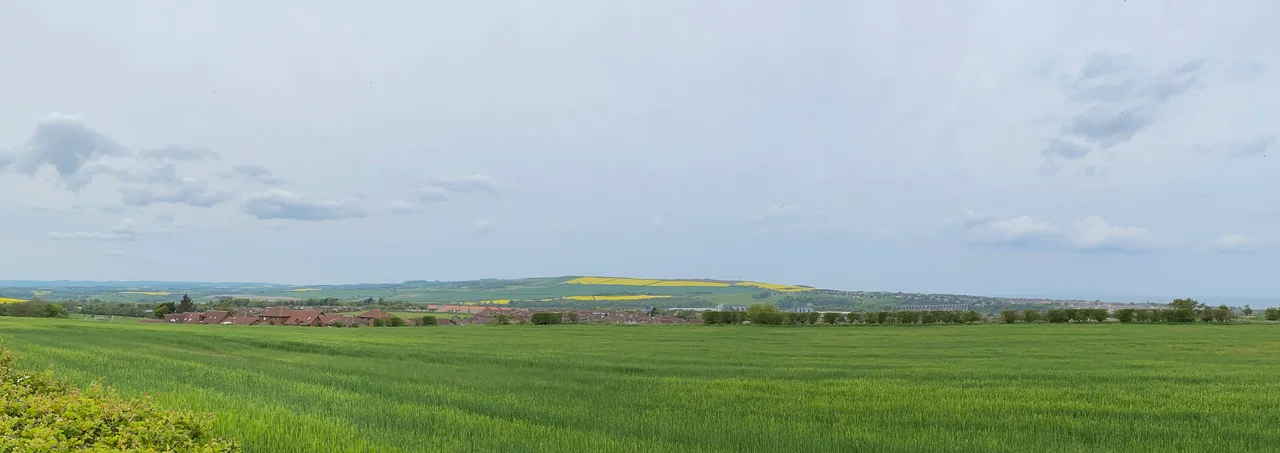

Battle of Halidon Hill
Thomas Seton was hanged in sight of his parents on the walls of Berwick-upon-Tweed. The young man had been given as a hostage in a truce, his father was the governor of the town, and when the truce ran out without relief, Edward III had the gallows built where the boy's mother could not look away. The English king was nineteen years old and already understood spectacle. Five days later, on 19 July 1333, the Scottish relief army would climb the wrong hill at the wrong time, and somewhere between two and three thousand of them would die in the marsh below Halidon Hill while Berwick's defenders watched from the ramparts they could no longer save.
The King Without a Country
Edward Balliol had been crowned king of Scotland at Scone in September 1332 and ambushed in his nightshirt at the Battle of Annan three months later. He fled to England on horseback - one chronicle says naked - and threw himself on the protection of Edward III, who had been quietly funding him all along. Edward had a useful pretext now. He recognised Balliol as the rightful Scottish king, gathered an army, and marched on Berwick in the spring of 1333. The border town was the richest port in Scotland, the source of the Scottish crown's largest single tax revenue, and the strategic key to the eastern march. A chronicler called it "another Alexandria, whose riches were the sea and the waters its walls." Edward besieged it from March, with his fleet cutting it off by sea and his men digging trenches around the walls.
The Hostage
By June the walls were crumbling under the trebuchets and the water supply had been cut. Sir Alexander Seton, the governor, asked for a short truce. Edward agreed on one condition - if Berwick was not relieved by 11 July, it would surrender, and twelve hostages would be held to guarantee the bargain. Thomas Seton was one of them. When 11 July came and the Scottish guardian Sir Archibald Douglas had only managed to send two hundred horsemen who slipped into the town from the wrong direction, Edward declared the truce broken. The gallows went up. Thomas was hanged first because he was the highest-ranking hostage. Edward issued instructions that two more hostages would die every day Berwick continued to resist. A new truce was negotiated on 15 July: surrender on 19 July at sunset, unless an army from Scotland forced its way across a specific stretch of the Tweed, or defeated the English in open battle on Scottish soil.
The Wrong Hill
Douglas marched east, devastated Tweedmouth in sight of the English army, and Edward did not move. He marched south to besiege Bamburgh Castle, where Queen Philippa was staying. Edward did not move. Time was running out for Berwick. By 18 July the Scottish army had reached Duns. On the morning of 19 July it approached Halidon Hill from the north-west. Edward had positioned his army on the summit - a low rise of about 600 feet, two miles from Berwick, with a perfect view of the Tweed crossing and the surrounding country. Below him lay a marshy hollow. The Scots formed up on a hill across the marsh, in three traditional schiltrons. The men were tired - they had marched 60 miles in 48 hours - but morale was high. Douglas gave a rousing speech and ordered that no prisoners be taken. The English and Scottish champions, a Norfolk knight named Robert Benhale and a Scot named Turnbull, fought between the armies. Turnbull and his enormous dog both died. Still nobody moved. A little after noon, Douglas finally ordered the assault.
Like Motes in a Sunbeam
The Scots came downhill, splashed through the marsh, and started the climb. The English longbowmen were waiting. The Lanercost Chronicle records the moment: "The Scots who marched in the front were so wounded in the face and blinded by the multitude of English arrows that they could not help themselves, and soon began to turn their faces away from the blows of the arrows and fall." The arrows fell, in a chronicler's phrase, "as thick as motes in a sun beam." The Scots were exhausted from the march and exposed in the open hollow. Their schiltrons reached the English line still in formation, but only just. When they engaged hand-to-hand the fighting was brief. Two of the three Scottish formations broke and routed. The third, tasked with cutting through to the town, fought on "with the ferocity of lions" until both its noble commanders were dead. Then the English men-at-arms remounted and the slaughter began. The Scots were chased for eight miles. Many drowned trying to escape into the sea. Edward had ordered that no prisoners be taken. The day after the battle, about a hundred Scots who had been taken alive were beheaded. Berwick surrendered that morning on the terms agreed in the indenture.
Aftermath
Of the nine most senior Scots present, six were killed - including Archibald Douglas, the Guardian of the Realm himself. One account claims that of 203 men knighted on the morning of the battle, only five lived to see sunset. The total Scottish dead was probably around 2,900, though English chroniclers claimed numbers fifteen times higher. English losses were reported as fourteen, or seven, depending on which chronicle you read. Balliol was reinstalled, did homage to Edward for Scotland, and ceded the eight south-eastern counties outright in the Treaty of Newcastle. None of it stuck. He was deposed in 1334, restored in 1335, deposed again in 1336. Then the Hundred Years' War broke out and England's attention turned to France. Young King David II grew up and consolidated his rule, then walked his army into another English ambush at Neville's Cross in 1346 and was captured. His ransom of 100,000 marks took eleven years to negotiate and a four-decade truce to settle. There is now a rough stone monument on Halidon Hill with the date incised on it. The marsh below was drained around 1800 and is now farm fields. Berwick has not been Scottish since 1482.
From the Air
Halidon Hill at 55.79°N, 2.05°W, about 2 miles north-west of Berwick-upon-Tweed. Recommended viewing altitude 2,000-3,500 ft AGL for the full sweep from the Tweed estuary to the Cheviots. The hill rises about 600 ft above the surrounding farmland; from the air, look for the gentle rise just north of the A1 with Berwick visible to the south-east. Nearest ICAO airport: EGPH (Edinburgh) 45 nm north-west; EGNT (Newcastle) 60 nm south. The North Sea coast is 3 nm east, the Cheviot Hills rise 20 nm south-west. On a clear day, Lindisfarne is visible 12 nm south on the Northumbrian coast.
Nearby Stories
- Chillingham Castle 3 km away
- Battle of Ancrum Moor 9.3 km away
- Bass Rock 11 km away
- HMS Nottingham (1913) 12 km away
- HMS Pathfinder (1904) 15 km away
- Yester Castle 18 km away
- German submarine U-1274 23 km away
- Alexander L. Kielland (Platform) 282 km away