
Battle of Hannut
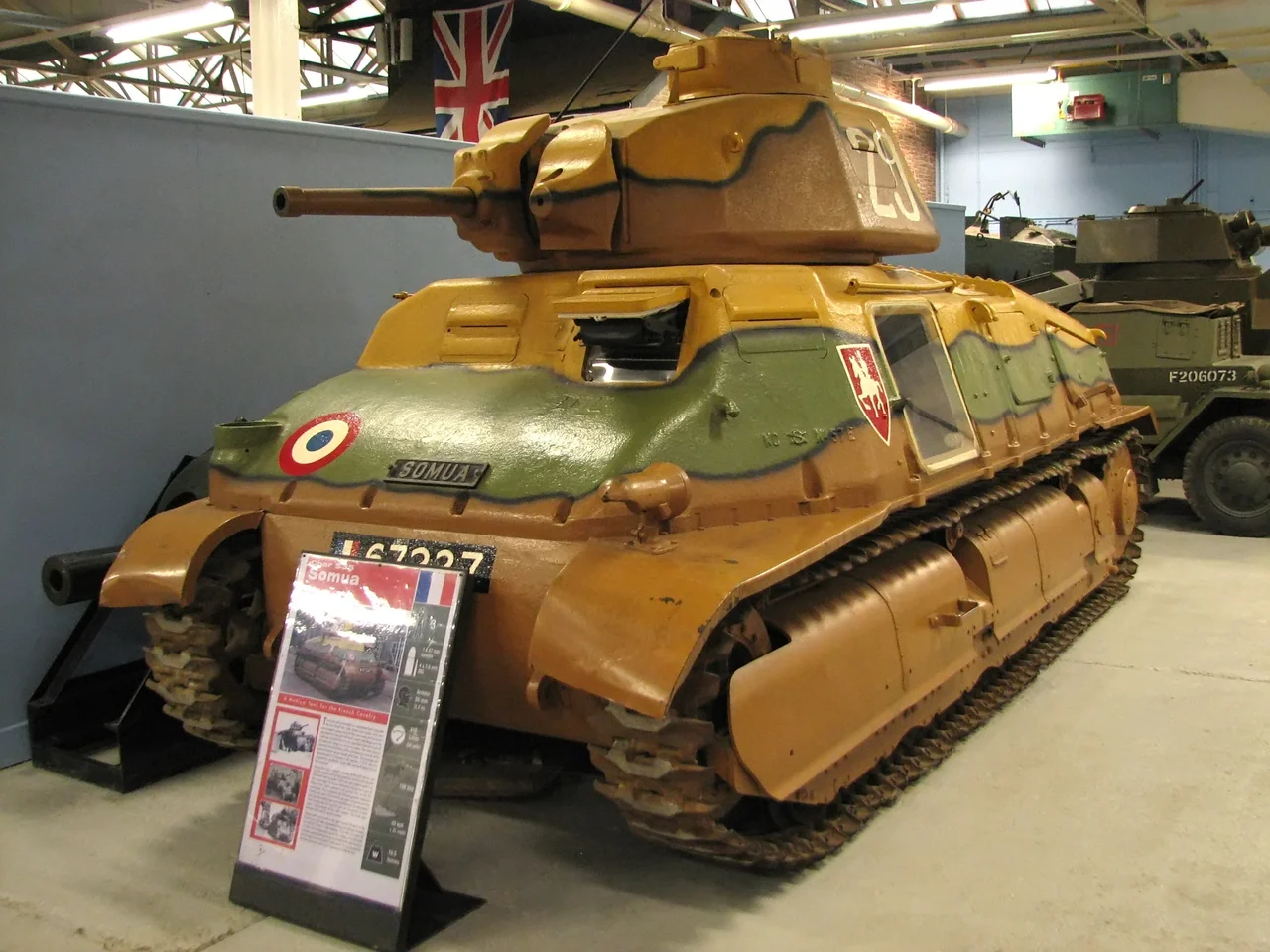
On the morning of 12 May 1940, French SOMUA S35 tanks rolled into positions along a ridge between Hannut and Merdorp, and for two days fought the largest tank battle the world had ever seen. The SOMUAs were better armored than anything the Germans had brought. Their guns could kill a Panzer at any range a Panzer could kill them. The French crews fought well, held their ground, and bled the German divisions hard. And while they did, three hundred kilometers south, the real German attack slipped through the Ardennes forest unopposed. The Battle of Hannut was not lost on its battlefield. It was lost by being fought at all.
The Trap
Erich von Manstein had spent the winter convincing the German high command to overturn the obvious plan. The obvious plan was a repeat of 1914 - a sweep through Belgium toward the English Channel, the kind of attack the French and British were prepared for. Manstein proposed something subtler. Make the obvious attack anyway, but only as a feint. Send the strongest divisions through the Ardennes, the heavily wooded hills that everyone agreed were impassable for armor. While the Allies committed their best forces to defending Belgium, slip past them in the south, cross the Meuse at Sedan, and race for the sea behind them. The plan worked because the French did exactly what they had been telegraphed to do. On 10 May, German Army Group B crossed into the Low Countries with airborne troops and Panzers. The French First Army - the best mechanized force the Allies possessed - sprinted forward into Belgium to meet it. By the time anyone in Paris understood what was happening through the Ardennes, the trap was already closing.
The Tanks
General René Prioux's Corps de Cavalerie was the spearhead. Two divisions, the 2e DLM and the newer 3e DLM, between them fielding 520 tanks: 176 SOMUA S35 medium tanks, 172 Hotchkiss H35 lights, and reconnaissance vehicles. The SOMUA was a remarkable machine. It mounted a 47mm gun, carried armor that could shrug off most German anti-tank rounds, and outclassed every German tank present except the still-rare PzKpfw III and IV. Against it, General Erich Hoepner's XVI Army Corps led with the 3rd and 4th Panzer Divisions - bristling with Panzer Is and IIs, vehicles whose armor a French 37mm gun could perforate. On paper, the French should have won. They were facing weaker tanks with stronger ones. What they did not have - what no one yet understood was decisive - was radios in every tank, doctrine for combined-arms maneuver, and the assumption that armor moves to a single concentrated purpose.
Day One
The Germans reached Hannut on 12 May. The 4th Panzer Division attacked toward Crehen, hit French strongpoints along the ridge, and bled trying to push through. The 2nd Cuirassiers Hotchkisses fought from prepared positions until their commander fell. The dragoons lost heavily. Then SOMUAs of the 2e DLM counterattacked, broke the German line, and freed the trapped Cuirassiers in an armored thrust that left the right flank of the 4th Panzer dangerously exposed. The German official history later admitted: 'On the very first day, French armour - contrary to German reports - definitely emerged victorious.' Both sides ended the day with knocked-out tanks burning in the May twilight. Crews from both armies, retreating in the dark, occasionally stumbled into each other and fought small, confused fights in farm courtyards before scattering. The plan held. The French had stopped the German advance for a day. They needed to stop it for one more.
Day Two
On 13 May, the 3rd Panzer Division joined the 4th, and German doctrine began to tell. The Panzers maneuvered in concentrated formations coordinated by radio. The French operated in small groups, each commander seeing only his own piece of the field, communications running by liaison officer and field telephone. At Orp, the 5th Panzer Regiment was caught in the flank by French armor and stood alone for fifteen desperate minutes before reinforcement arrived. At Jandrain, German numbers ground down a SOMUA squadron - the 3rd Panzer Brigade tallied 54 French tanks knocked out by day's end against 'slight' German losses. The French had concentrated nothing. They were strong everywhere and decisive nowhere. By evening the 2nd and 3rd DLM began a general retreat westward, falling back on the Gembloux Gap as planned. Day two ended with the French holding the strategic objective. The cost was unsustainable.
What It Bought
On 14 May the 3rd and 4th Panzers attacked again, this time at Perwez and Gembloux. They broke through some sectors, were stopped in others, took heavy losses again. The French First Army had reached its trench lines and was dug in, which was the entire point of Hannut. The 2nd DLM mounted a rearguard so fierce the German command briefly thought a major counterattack had begun. Both sides regrouped overnight. And as they did, two hundred kilometers to the south, German Panzers crossed the Meuse at Sedan and began their drive for the Channel. The First Army's success at Hannut had pinned it in the worst possible place. Within a week it would be cut off, fighting its way back to Lille, holding ground at terrible cost to allow the British Expeditionary Force, French units, and Belgian troops to evacuate from Dunkirk. The French and German dead at Hannut both died fighting bravely. The French died for a plan that had already been outflanked. The Germans died as part of a feint.
Lessons Written in Iron
The Battle of Hannut would remain the largest tank battle in history until Kursk in 1943 - which dwarfed it. But Hannut taught the lessons Kursk would test. Armor concentrated and coordinated by radio beats armor dispersed across a wide front, even when the dispersed armor is individually superior. Combined arms - tanks moving with infantry, artillery, and air support as a single team - beats tanks operating alone. The French SOMUA was a better tank than almost anything it faced. France lost the campaign anyway, in six weeks. After the war, both armies studied Hannut closely. The conclusions still shape doctrine today. The crews who died testing them - young men from Lyon and Tournai, from Hamburg and Wuppertal, kids who had been working farms and clerk jobs eight months earlier - never knew what they had been part of teaching.
From the Air
Coordinates 50.67°N, 5.08°E. Hannut sits in the rolling agricultural country of the Hesbaye plateau in central Belgium, about 30 km northwest of Liège. View from 3,000 ft on a clear day shows the open farmland and gentle ridges where the SOMUAs and Panzers fought, with the small village clusters of Crehen, Merdorp, Thisnes, and Wansin still clearly visible along the original battle line. The Mehaigne creek curves south of the town. Liège-Bierset (EBLG) is 25 km southeast. Brussels (EBBR) is 50 km west. No major battlefield monument marks the site - the land itself is the memorial.
Nearby Stories
- Diest 3.4 km away
- Hoge Kempen National Park 3.9 km away
- Waterloo Campaign: Waterloo to Paris (18-24 June) 5.4 km away
- Royal Carillon School "Jef Denyn" 8.3 km away
- Fort Eben-Emael: The Largest Fort in the World 10 km away
- Marcinelle Mining Disaster 12 km away
- Fort Jeanne d'Arc 152 km away
- Courrieres Mine Disaster 156 km away