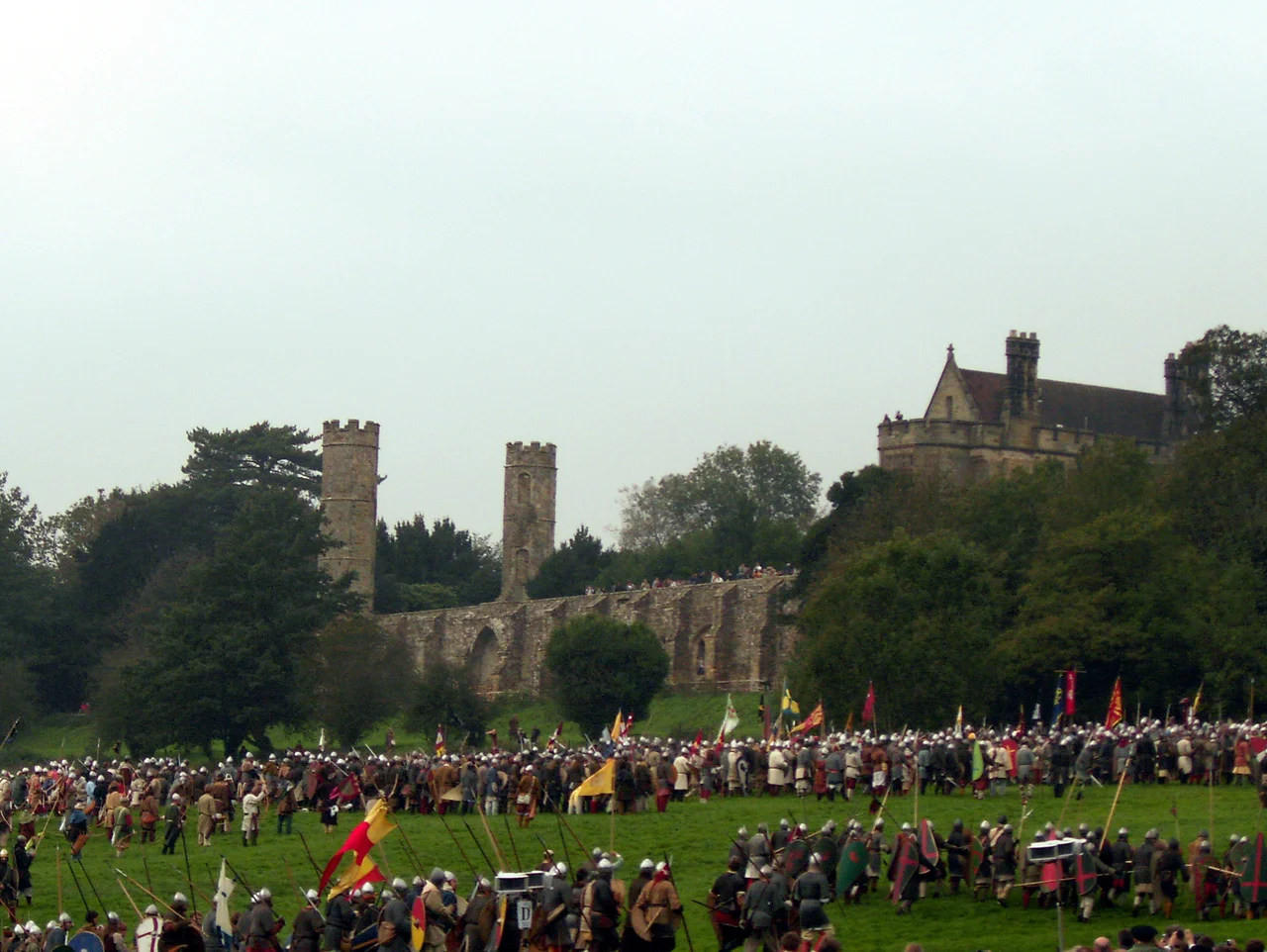

Battle of Hastings
King Harold Godwinson had marched his army roughly two hundred miles in a single week. Three weeks earlier he had broken the Norwegian invasion at Stamford Bridge in Yorkshire, killing his own brother Tostig and Harald Hardrada in the battle. Now, on the night of 13 October 1066, he camped at Caldbec Hill in Sussex, beside an old apple tree, eight miles from where William of Normandy had landed at Pevensey two weeks before. He had perhaps twelve hours to sleep. In the morning he would set his shield wall on a low hill afterwards called Senlac, and by the end of the afternoon his crown, his life, and a kingdom seven centuries old would all be gone.
Norman Forces
William's army that morning is hard to count precisely. Contemporary chroniclers gave wildly inflated figures - up to 150,000 men - but modern historians estimate something closer to between 7,500 and 12,000, including perhaps a thousand to two thousand mounted knights. The infantry wore knee-length chainmail hauberks split for riding, with conical helmets featuring a vertical nasal bar. Some had scale armour of horn or hardened leather rather than mail. Round wooden shields for the foot soldiers, kite-shaped shields for the cavalry. The standard weapon was a straight double-edged sword, long enough to use from horseback or on foot. Archers carried self bows or crossbows but generally no armour. The famous couched lance - the lance tucked tightly under the arm for a concerted cavalry charge - was a newer technique, and the broken terrain of the Sussex hillside made traditional Norman cavalry charges less effective than they might have been on level ground. Of the long lists of "Companions of William the Conqueror" assembled in later centuries, only about thirty-five named individuals can be reliably identified as having actually been there.
Harold's March South
Harold had left much of his army in the north under Edwin and Morcar after Stamford Bridge. He took the rest south, perhaps learning of William's landing on the way, and reached London for a week of frantic mustering before continuing toward the coast. The southward march - around twenty-seven miles a day - was an extraordinary feat of late Anglo-Saxon logistics, but it left him with a tired force when he arrived. There has long been speculation about why he did not wait at London for reinforcements; perhaps he hoped to repeat the surprise of Stamford Bridge, perhaps he wanted to prevent the Normans from devastating any more of southern England than they already had. Whatever the reason, on the morning of 14 October he formed his shield wall on the ridge of Senlac Hill above the road to London. Behind it stood the housecarls - the king's professional guard, the heart of any Anglo-Saxon royal army - bearing the great two-handed Danish axes that could cleave a horse and rider in one stroke.
The First Attacks
William opened with archers and crossbowmen. The lack of English archers in Harold's line meant there were few enemy arrows to be picked up and reused, which limited the volley rate. After the archery, Norman spearmen and swordsmen pushed up the slope and were met with javelins, axes and stones thrown from the English wall. At some point in the morning a rumour spread through the Norman ranks that William himself had been killed; parts of his army began to flee, and English fyrdmen broke ranks to pursue them down the hill - a fatal error. William rode through his own troops, pulling off his helmet so men could see he was alive, then led a counter-attack against the now disordered pursuers. Some English rallied on a hillock and were overwhelmed. The Carmen de Hastingae Proelio claims that William himself killed Harold's brother Gyrth in personal combat, perhaps mistaking him for the king. William of Poitiers records that the bodies of Gyrth and Leofwine - Harold's other brother - were found near Harold's, suggesting they died late in the battle. The military historian Peter Marren speculates that if the brothers died early, that may have stiffened Harold's resolve to stand and fight to the end.
Feigned Flights
Sometime around midday the battle paused. Both sides needed rest, food and water; soldiers in chainmail in October had been fighting now for several hours and were spent. When the fighting resumed, William of Poitiers says, the Normans twice used the tactic of feigned flight - deliberately turning to run, drawing more English troops out of their shield wall, then wheeling about and cutting them down once they had broken formation. Some modern scholars have suggested this was a chronicler's invention to excuse the earlier real flight; others note that feigned flight was a documented Norman cavalry tactic. Either way it worked. The shield wall held but thinned. The housecarls in the front ranks took heavy casualties and were replaced by less professional fyrd. According to the Carmen, William had two horses killed under him during the battle; William of Poitiers claims three. The sun was beginning to drop. The English line still held.
The Death of Harold
Harold died late in the afternoon, though exactly how is contested. William of Poitiers gives no details. The Bayeux Tapestry famously shows a figure with an arrow in his eye next to another figure being cut down by a mounted Norman; over both is the inscription "Here King Harold has been killed." Scholars have argued for over a century whether the arrow-in-the-eye figure is Harold, the cut-down figure is Harold, or both are Harold at successive moments. The tradition that an arrow struck him in the eye may be later embroidery; the cleaner reading of the tapestry is that he was hacked down by Norman cavalry late in the battle. With the king dead and his brothers Gyrth and Leofwine fallen beside him, the English line finally broke. The fyrd scattered. The housecarls of the royal bodyguard stood their ground and were cut down where they stood - a final point of honour for the household troops of an Anglo-Saxon king. By dusk the battle was over. The bodies of Harold, Gyrth and Leofwine lay together on a hill that would soon hold an abbey. Half a kingdom had ended in eight hours.
From the Air
Located at 50.91°N, 0.49°E, immediately south of the town of Battle in East Sussex. The battlefield occupies the gentle south-facing slope below the present-day Battle Abbey ruins, with the marshy ground at the foot of the slope - where the Normans had to advance from - still visible as wetter pasture. The town of Battle and its railway station lie just north of the abbey. Nearest airfield is Lydd (EGMD) about 30 km east; Deanland (EGCD) is roughly 20 km west. Best viewed at 1,500-3,000 ft AGL; the topography is most legible in low autumn light, particularly around the actual anniversary date of 14 October.
Nearby Stories
- Battle of Lewes 1.5 km away
- Staplehurst rail crash 4.1 km away
- Canterbury Castle 14 km away
- The Carrington Event: The Solar Storm That Could Happen Again 15 km away
- Shorncliffe Redoubt 21 km away
- Le Paradis Massacre 113 km away
- Swanage Lifeboat Station 137 km away
- Cléon 150 km away