.jpg)
Battle of Hexham
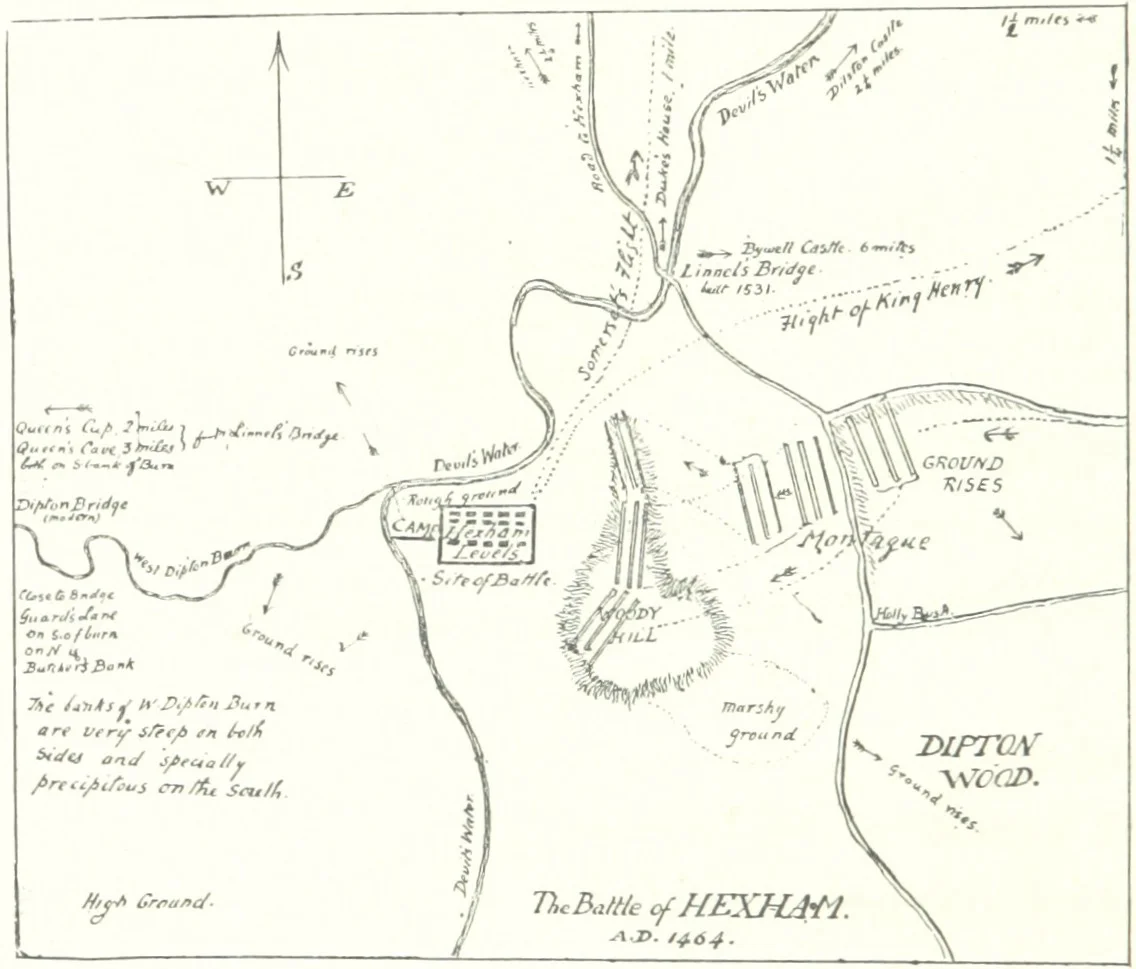
The river is called the Devil's Water, and on 15 May 1464 it earned its name. The Lancastrians had encamped in a meadow near Linnels Bridge, just south of Hexham, when the Yorkist army of John Neville came charging down from higher ground. The right wing of the Lancastrian line, commanded by Lord Roos, turned and ran across the river before a single blow had been struck. The remainder of Henry Beaufort's army was hemmed in against the water, unable to manoeuvre, and the Yorkists drove them straight into the Devil's Water itself. Men drowned trying to ford it. Others were crushed against the steep north bank trying to climb out. By evening the Wars of the Roses, as a serious campaign in the north of England, were finished.
What Was Left of the Lancastrians
After the catastrophe of the Battle of Towton in 1461, the Lancastrian cause survived on the goodwill of Scotland and a handful of northern castles. In 1463 the Yorkists concluded a peace with Scotland, closing the back door, and Henry Beaufort, 3rd Duke of Somerset began a desperate campaign in Northumberland to rally support before Edward IV could march north with his main army. The Lancastrians lost the Battle of Hedgeley Moor on 25 April 1464 to a Yorkist force under John Neville, Lord Montagu. Less than three weeks later they met Neville again outside Hexham. Somerset's army may have been 3,000 to 4,000 strong - sources disagree - and Neville's force comparable. The numbers were modest by Wars of the Roses standards. The political stakes were not.
The Yorkist Charge
Neville crossed the Tyne south of Hexham on the night of 12-13 May and reached attack position by the morning of the 14th. Despite warnings from their scouts, the Lancastrians had little time to deploy. Somerset rushed his force to a site near Linnels Bridge over the Devil's Water and set his troops in three detachments in the meadow there. The position was bad. The Yorkists held higher ground and used it: when they charged, the Lancastrian right wing under Lord Roos broke without contact. The remainder of Somerset's army was trapped against the river and the steep banks. The Yorkists drove through the one opening at the east end of the meadow and rolled up the Lancastrian centre. The fighting was relatively short. Most of the Lancastrian casualties came not from combat but from the rout - men trapped in West Dipton Wood across the river were forced to surrender when the Yorkists closed in.
Thirty Executions in an Evening
John Neville had none of Edward IV's appetite for political reconciliation. By the evening of 15 May, thirty leading Lancastrians had been executed in Hexham. Henry Beaufort, the captured Duke of Somerset, was among them. Lord Roos, whose flight had triggered the rout, was beheaded too. William Tailboys was captured shortly afterward while trying to flee north with two thousand pounds from Henry VI's war chest - the practical reserve of the Lancastrian cause - and was executed as well. Beaufort had been one of the most formidable Lancastrian commanders. His death and the loss of the war chest broke the resistance in the north. Within months the remaining Lancastrian castles fell.
Henry VI on the Run
Henry VI was not at the battle. He had been kept safely away by his guard - he had already been captured in battle three times during the wars, and his protectors had become careful. After Hexham he went into hiding, sheltered by Lancastrian sympathisers across the north of England. He stayed for periods at Muncaster Castle on the Cumbrian coast, then at Bolton Hall, then at Waddington Hall in Lancashire, the home of Richard Tempest. On 13 July 1465, more than a year after Hexham, Henry was betrayed by a man the chroniclers remembered only as a black monk of Addington. Yorkist agents - including Richard Tempest's own brother John - entered the house to arrest him. Henry fled into nearby woods but was taken within hours. He went to the Tower of London. The Wars of the Roses paused, until the Earl of Warwick changed sides four years later and they began again.
From the Air
The Battle of Hexham was fought at approximately 54.97°N, 2.10°W, in the meadow near Linnels Bridge over the Devil's Water, just south of the town of Hexham in Northumberland. The Devil's Water joins the Tyne about a mile north of the battlefield. From the air the site is a small wooded valley running south to north, with steep banks where the rout ended. Best viewed at 1,500-2,500 feet AGL. Newcastle International (EGNT) lies about 15 nm east; the A69 trunk road runs east-west along the Tyne valley just north of Hexham, providing a clear ground reference. The town of Hexham itself, with the abbey at its centre, is the obvious large landmark.
Nearby Stories
- Seaburn Dene 1.2 km away
- SM UB-115 3.5 km away
- Kielder Forest 4.5 km away
- Appleby Horse Fair 9 km away
- Simonside Hills 9.7 km away
- Streatlam Castle 12 km away
- Stockton-on-Tees 12 km away
- RAF Spadeadam 14 km away