,_1263.JPG)
Battle of Largs
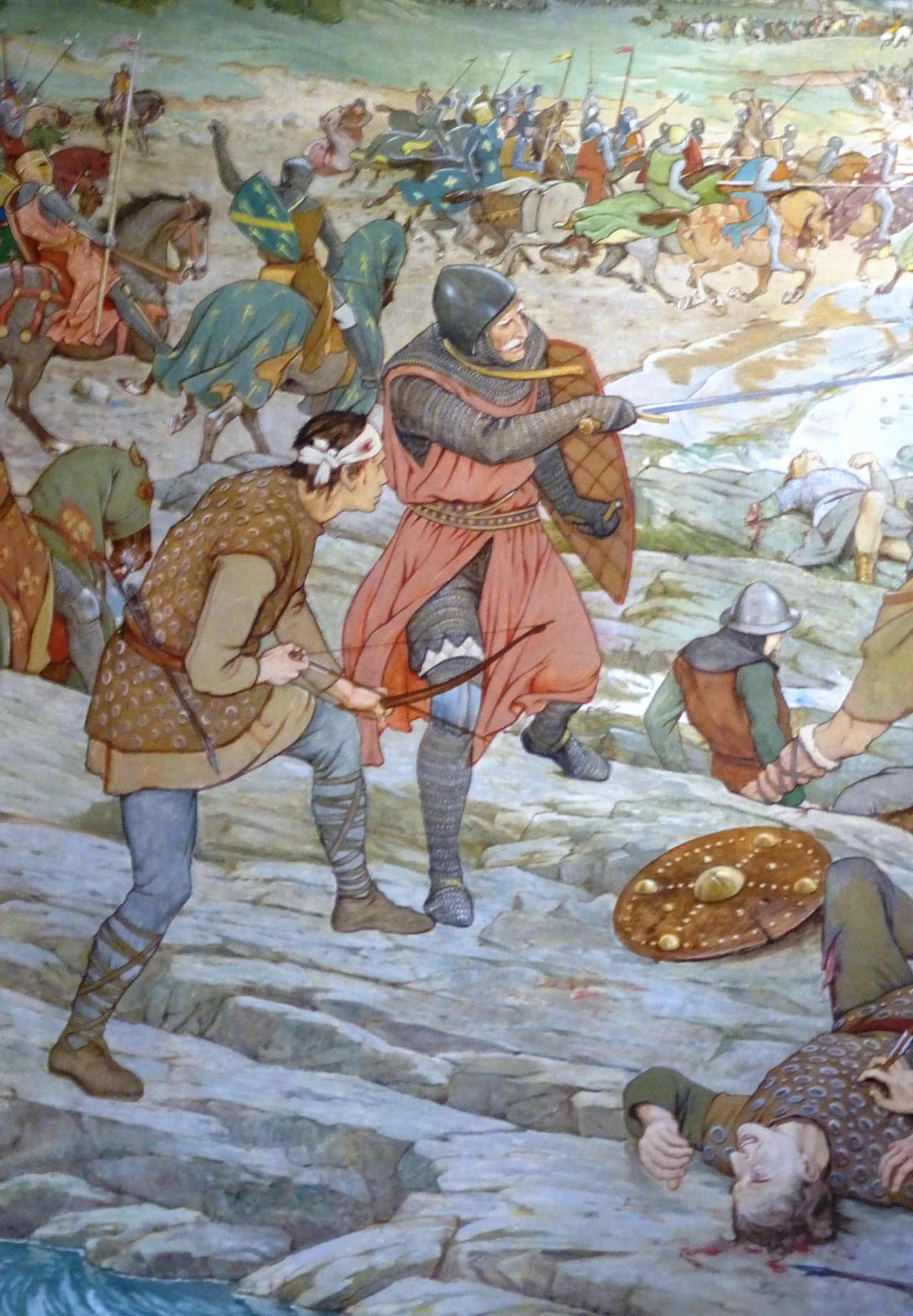
On 2 October 1263, a Norwegian merchantman lay broken on the beach near Largs, and her crew were trying to salvage what the storm had not already destroyed. A Scottish army arrived from the south, and what followed was less a battle than a series of unhappy improvisations: a Norwegian retreat down a mound that was mistaken for a rout, a chaotic scramble back to the ships through a hail of stones and arrows, and a long, sodden day in which men on both sides died for reasons their commanders never quite intended. By the next morning, the Norwegians returned to collect their dead. The Scots had withdrawn. Within months, the question of who ruled Scotland's western seaboard had been answered, not by the sword, but by the weather and the wear of attrition.
Two Kings and a Coast They Both Wanted
Largs had been at the edge of the Norwegian world for a long time. Since the late eighth century, Viking raiders and then settlers had moved through the Hebrides and the Isle of Man, and from the turn of the twelfth century, Norwegian kings claimed overlordship over what they called the Southern Isles. The Scottish king Alexander II had tried to incorporate the western seaboard into his realm in 1249 and died on campaign before he could finish. His son Alexander III, only a boy when he inherited the crown, eventually returned to the project. He first tried to buy the islands from Haakon IV of Norway. When that failed, he applied military pressure. Haakon's answer was a fleet the Icelandic Annals called the largest force ever to set sail from Norway, perhaps thousands of vessels, which reached the Hebrides in the summer of 1263. By late September the fleet was anchored off the Cumbraes in the Firth of Clyde. The Scots, badly outnumbered, played for time. Alexander's strategy was patient and deliberate: drag the negotiations into autumn, let the weather become an unwelcome guest in the Norwegian council, and trust that storms would do what his army could not.
The Storm and the Beach
The weather obliged. On the night of 30 September a gale battered Haakon's fleet. A merchantman dragged anchor and ran aground. By morning, four other vessels had joined her on the Scottish shore. Their crews were soon harassed by Scots armed with bows, and Haakon sent reinforcements ashore overnight. The next day, 2 October, the king himself came onto the beach to oversee the salvage. That was when the main Scottish force arrived, infantry and cavalry under Alexander of Dundonald, the Steward of Scotland. The saga numbers the mounted troops at about 500 with mail-armoured horses; the source article suggests the true figures may have been more modest, perhaps several hundred per side with no more than fifty knights. The Norwegians were split into two groups: a larger force on the beach with Haakon, and a smaller contingent atop a nearby mound under a commander called Ogmund. As the Scots advanced, threatening to drive a wedge between the two groups, Ogmund tried an orderly withdrawal from the mound to rejoin the main body. The withdrawal collapsed into a scramble. To the men on the beach, the sight of their comrades hurrying down the slope looked like flight. Whole units fled toward the ships, and the rout cost lives that need not have been lost.
The Dead on Both Sides
Scottish and Norwegian losses were both real. The saga, the main surviving source, is written from the Norwegian perspective by the Icelandic historian Sturla Thordarson and tends to present the day as a creditable, if confused, engagement. Scottish records of the battle are largely lost. What survives are the wages paid to men like Walter Stewart, Earl of Menteith, who maintained 120 sergeants at Ayr Castle for three weeks; the levies mustered from Strathgryffe, Cunninghame and Kyle; and the bare fact that the dead were carried home. The men on the beach were not strangers to one another at the level of statecraft, but at the level of cold and wet and exhausted bodies on a foreshore in October, they were what most soldiers have always been: young men who had been sent there by older men, and who did not, on the whole, choose to be on that beach. The Scots took the mound at one point. The Norwegians recaptured it after several hours of skirmishing. As the light failed, the Scots withdrew. The Norwegians reboarded their ships.
What Came After, and How Largs Remembers
Haakon's weather worsened. He sailed for Orkney to overwinter and died there in December 1263, never to return to Norway. The Treaty of Perth, signed in 1266, ceded the Hebrides and the Isle of Man to Scotland in return for a substantial payment, and the five-hundred-year Norse presence on Scotland's western seaboard was effectively over. The battle itself was inconclusive on the day. Its consequences were not. The probable site of the fighting is now surrounded by housing development and crowned by a nineteenth-century monument called The Three Sisters, sometimes attributed to the astronomer Thomas Brisbane. The Battle of Largs was investigated in 2009 for the new Inventory of Scottish Battlefields, but did not meet the criteria for inclusion. The town has not let the memory fade. Since 1981, Largs has hosted an annual Viking Festival, with re-enactments at the Pencil monument and a programme that runs through early autumn each year. The poem John Galt wrote about the battle in 1804 is not considered one of his better works. Sturla's saga, written within years of the event, is still the most detailed account we have.
From the Air
Located at approximately 55.79 degrees North, 4.87 degrees West, on the Firth of Clyde at Largs in North Ayrshire. Glasgow Prestwick (EGPK) is about twenty-eight miles south; Glasgow International (EGPF) is about twenty-two miles east-northeast. The Pencil monument on the foreshore south of the town centre marks the modern commemoration of the battle. From the air, the Cumbraes, the long beachfront, and the steep escarpment of the Largs hills are the obvious landmarks.
Nearby Stories
- Machrie Moor Stone Circles 2.6 km away
- Murder of Kriss Donald 3.7 km away
- Troon 5.5 km away
- Luss 6.8 km away
- HMS Vandal 11 km away
- Doune Castle 16 km away
- Knockshinnoch Disaster 17 km away
- Gulf of Corryvreckan 28 km away