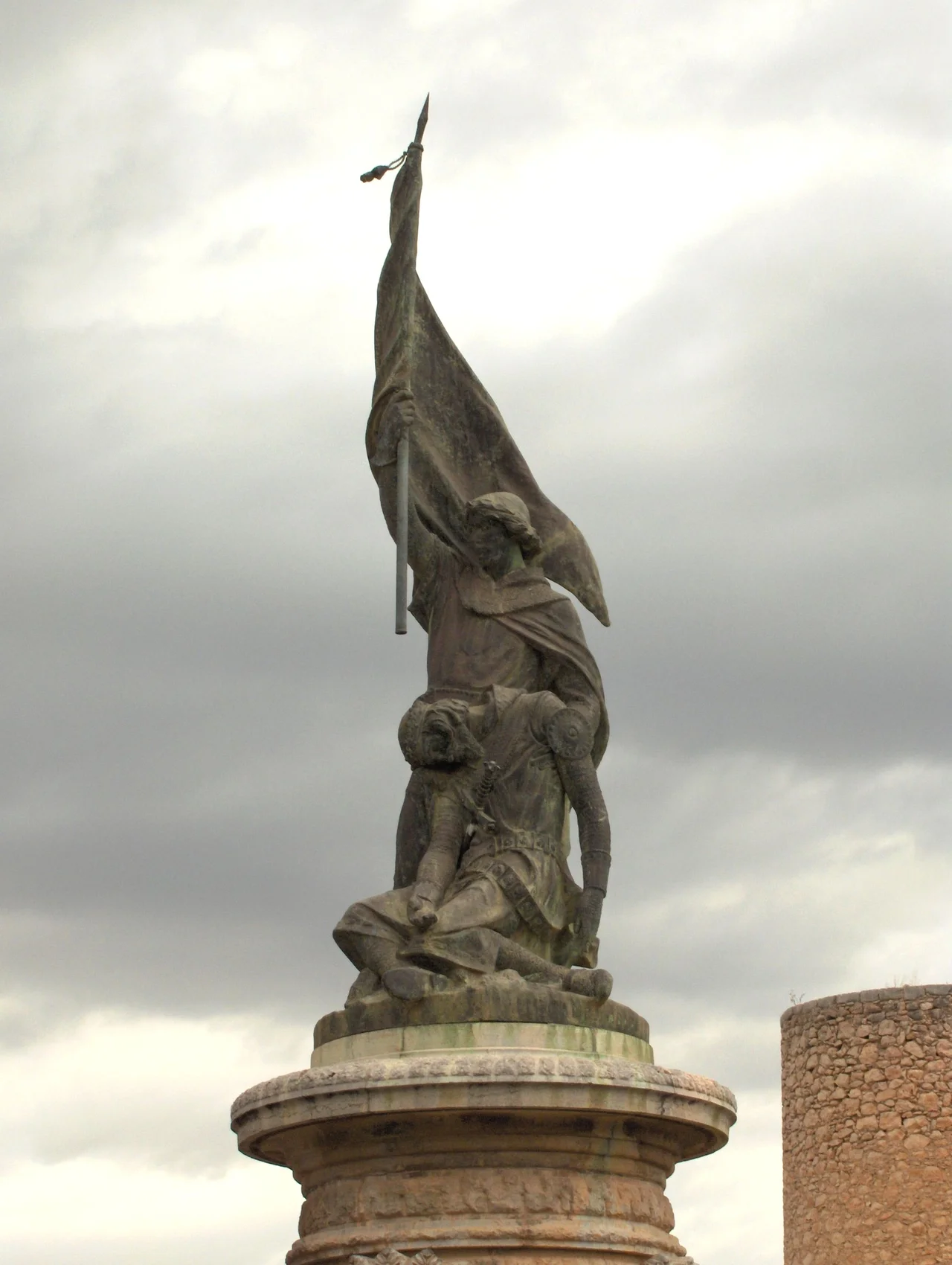

Battle of Llucmajor
A king with nothing left to lose is a dangerous thing. By the autumn of 1349, James III of Majorca had lost almost everything — his islands, his mainland counties, his standing among the crowned heads of Europe. Only the Lordship of Montpellier remained, and he sold even that to the French crown to raise an army. With the proceeds, and a dowry from his second marriage, he gathered 3,000 foot soldiers and 400 horsemen and sailed for the island he still called his own. On the plain outside Llucmajor, in the flat farmland of southern Mallorca, he would make his final stand — and there he would die.
A Quarrel Among Kinsmen
The two men who fought over Mallorca were bound by blood and marriage. James III of Majorca and Peter IV of Aragon were cousins and brothers-in-law, which made their feud a family affair as much as a political one. At its heart lay a single word: vassalage. Peter IV insisted that the King of Majorca owed him homage; James III chafed under it. From 1341 the Aragonese king began stacking up grievances designed to strip his kinsman of his lands — minting Barcelona coin in Perpignan, allowing French currency to circulate in Roussillon, failing to appear when summoned to the Barcelona court. When James III traveled to Barcelona in 1342, he came away convinced Peter had meant to imprison him. He returned to Mallorca enraged, his wife and children held behind as hostages. By 1343 he had been tried, found guilty, and stripped of everything he held.
The First Fall
Sentence pronounced, Peter IV moved to enforce it. In 1343 his fleet crossed to Mallorca, and at Santa Ponsa his troops broke the forces of James III; the islands submitted almost at once. James fled north to his County of Roussillon, but there was no refuge there for long. Over two campaigns in 1343 and 1344, broken by an uneasy truce, Peter IV took Roussillon and Cerdanya as well. In July 1344 James III surrendered, asking only that his life and liberty be spared. The request was granted, and it was nearly all he had left. Of a kingdom that had once spanned islands and mainland counties, only the Lordship of Montpellier still answered to him — a single French town, and a bitter reminder of everything else that was gone.
One Last Gamble
James III refused to accept the loss as final. For years he pressed his case, but the mediation of the Pope and Philip VI of France came to nothing, and two armed incursions — into Cerdanya in 1344 and Conflent in 1347 — failed to redraw the map. So he staked everything on a single throw. He married Violante of Vilaragut, whose dowry helped fund the effort; he sold the Lordship of Montpellier to the French king for ready coin; and he secured the backing of Pope Clement VI. With his fleet assembled — 3,000 infantry and 400 horse — he set course for Mallorca in 1349, determined to win back by force the crown he had lost in court.
A Morning on the Plain
Waiting for him was Gilabert de Centelles, governor for the Crown of Catalonia-Aragon, stiffened by reinforcements ferried from Sardinia by Riambau de Corbera. The two forces met near Llucmajor. The fighting lasted the whole of one morning, and when it ended the Majorcan army had been destroyed. James III himself was killed on the field. His son and heir, James IV, was taken prisoner; his illegitimate brother, Pagà de Mallorca, fell among the dead, along with many others. Queen Violante and her sister Elisabet were seized once the fighting stopped. In the span of a single morning, the house of Majorca lost its king, its heir, and its last hope of return.
The End of a Kingdom
The Battle of Llucmajor did more than end a life; it ended a country. With James III dead and James IV a captive, the independent Kingdom of Majorca ceased to exist, folded permanently into the Crown of Aragon. The islands would keep their own institutions and identity for centuries to come, but never again their own king. Today Llucmajor is a quiet town on the road south of Palma, ringed by the same flat farmland that once made good ground for a battle. No dramatic monument marks the spot where a kingdom died — only fields, and the long Mediterranean light, and the knowledge that on one October morning in 1349 the map of the western Mediterranean was redrawn here for good.
From the Air
Set near 39.48°N, 2.88°E, on the flat southern plain of Mallorca inland from the Bay of Palma. Best viewed from roughly 3,000–5,000 feet, where the grid of farmland around the town of Llucmajor stands out against the darker rise of the Serres de Llevant to the northeast. Palma's international airport (LEPA) lies about 15 km west-northwest; Menorca (LEMH) sits across open water to the northeast. In the clear, dry light typical of a Mallorcan autumn, the whole southern coast is visible in a single sweep from altitude.
Nearby Stories
- Andratx 13 km away
- Santuari de Lluc 14 km away
- Hypogeum of Torre del Ram 40 km away
- Cala Galdana 65 km away
- Illa de Tagomago 72 km away
- Cala de Sant Vicent 121 km away
- Illa Grossa 153 km away
- Shipwreck of Dellys 256 km away