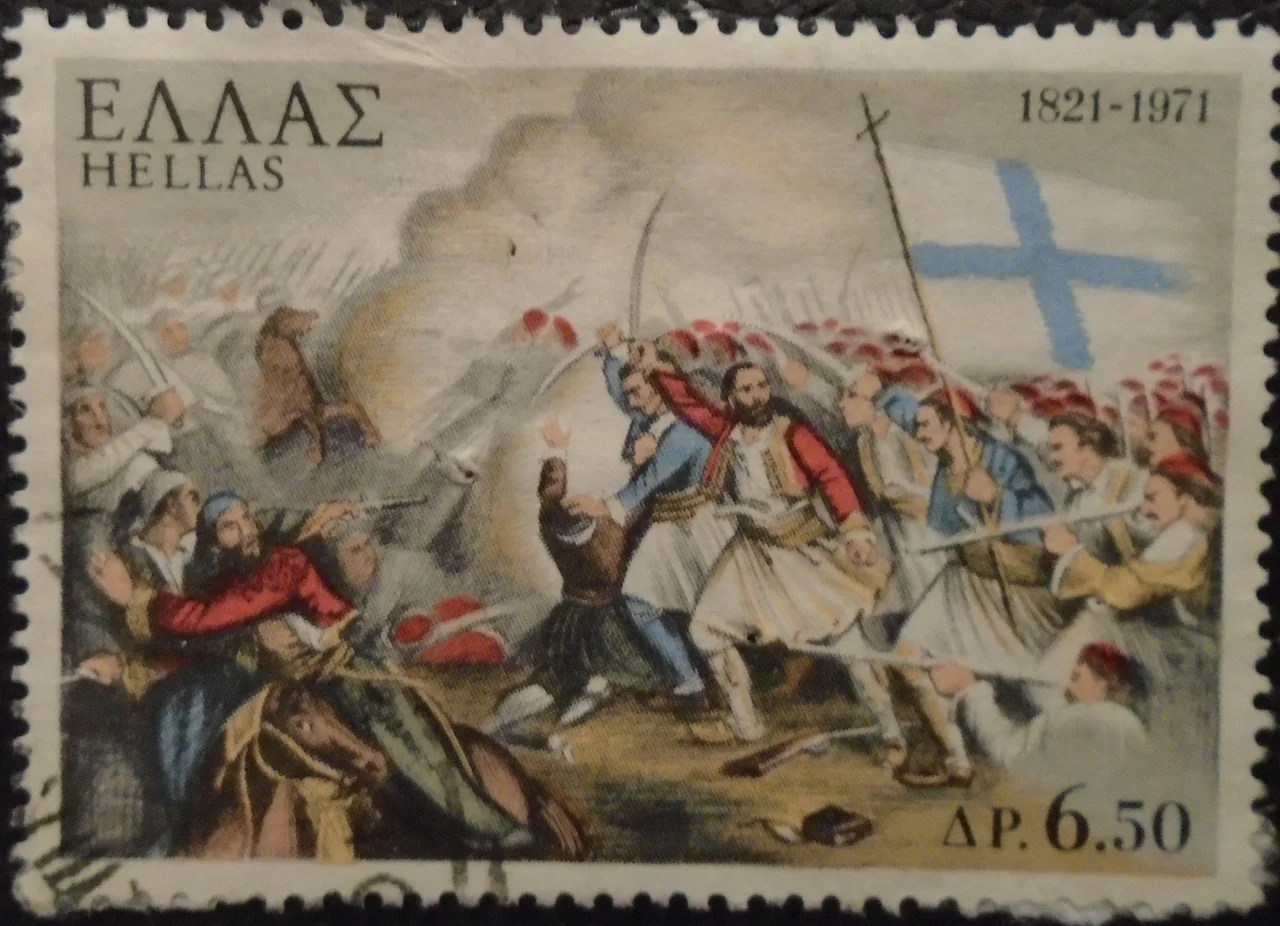

Battle of Maniaki
Grigorios Papaflessas was a priest — an archimandrite, in fact — who had been expelled from his monastery for conduct that involved his restless temperament as much as any formal offense, before he became one of the most passionate agitators for Greek independence. He was not a trained military commander. On 20 May 1825, on a hillside near the village of Maniaki in the hills east of Gargalianoi, he chose a position on the slopes of Mount Malia, gathered the men who would stay with him, gave a speech that is said to have moved those who heard it to remain, and then waited for Ibrahim Pasha's Egyptian army. He knew what was coming. He waited anyway.
The Collapse of the Campaign
By May 1825, the Greek War of Independence — which had begun in March 1821 — had entered a crisis. Ibrahim Pasha of Egypt, commanding a formidable modern army on behalf of the Ottoman Empire, had landed in the Peloponnese in February 1825 and began systematically dismantling Greek positions. In early May, Greek forces were defeated at Sphacteria, and Neokastro — the fortress overlooking Navarino Bay — fell on 11 May. Pylos and its surrounding region came under Egyptian-Ottoman control.
In this context, Papaflessas's decision to march south with approximately 3,000 soldiers and take the offensive against Ibrahim's army appears, in retrospect, to have been more symbolic than strategic. He positioned his force near Mount Malia to give them sight-lines across the plain toward Navarino. It was a defensible location but not, ultimately, a defensible position against the scale of what was coming.
The Stand at Mount Malia
When Ibrahim's forces arrived and the engagement began, the Greek line held — for a time. Papaflessas's force was outmatched in numbers and military discipline. By the time the battle was decided, roughly half his original 3,000 had either fled or withdrawn before the Egyptian advance reached them. Those who remained fought from their entrenched position until they were overwhelmed.
When the fighting was over, between 800 and 1,000 Greek fighters were dead, including Papaflessas himself and his co-commander Pieros Voidis. Approximately four hundred Egyptian soldiers also died. The battle was a decisive Egyptian victory. It left the Peloponnese largely under Ibrahim's control for the next two years — until the Battle of Navarino in October 1827 changed the international equation entirely.
How Ibrahim Pasha Honored His Enemy
What happened after Papaflessas fell has become the most-told detail of the battle. His head and body were recovered by Egyptian forces. Rather than displaying them in dishonor — the expected gesture of a conquering army — Ibrahim Pasha reportedly treated them with respect, placing them upright as a mark of recognition for a valiant opponent. It is said that Ibrahim kissed his head and remarked: 'If all Greeks were like him, I would not have taken charge of this campaign.'
The attribution is traditional rather than formally documented, but it has survived because it contains something true about Papaflessas — that even his enemies recognized in him something unusual. A turbulent archimandrite who turned revolutionary, a man without military training who understood that what he was doing mattered beyond the outcome of any single engagement: his death at Maniaki made him exactly the kind of figure that defeated causes need.
Defeat as Foundation
The battle of 20 May 1825 was lost. The Greek cause in the Peloponnese was at its lowest point when the guns fell silent at Maniaki. And yet the defeat had an effect that a victory might not have produced. Papaflessas's willingness to stand and fight — and to die in that fight — became a story that circulated through the Greek independence movement and stiffened resolve at precisely the moment when resolve was most needed.
He was quickly described as a martyr, and the description stuck. The Greek Orthodox tradition he had grown up in had a framework for understanding what he had done: sacrifice for a cause greater than oneself, in the knowledge that the cause would outlast the person. Whether that framing is historically accurate or whether it is a story the movement told itself in order to keep going is, perhaps, less important than the fact that it worked. Greece achieved independence, eventually recognized internationally in 1830. Papaflessas did not live to see it. His name is on it anyway.
The Hillside Near Maniaki Today
A monument to Papaflessas stands near the village of Maniaki, in the hills east of Gargalianoi in the municipality of Pylos-Nestor. The site is visited on anniversaries and by those making their way through the historical landscape of the Greek War of Independence. The battle that took place here is taught in Greek schools as one of the pivotal moments of the independence struggle — not because it was won, but because it demonstrates what the struggle cost.
The hills are quiet. The plain toward Navarino that Papaflessas positioned his men to overlook is visible from the slopes of Mount Malia on a clear day. Two hundred years of agriculture and weather have softened what happened here. The monument is the most direct reminder that the ground under those olive trees was once a killing field, and that the people who died on it believed, correctly, that what they were doing would be remembered.
From the Air
The village of Maniaki lies at approximately 37.076°N, 21.773°E in the inland hills of Messenia, about 12 km east of Gargalianoi and roughly 22 km northeast of Pylos. From the air, the area presents as gently rolling agricultural and hill terrain, characteristic of inland Messenia. Mount Malia is a visible elevated feature in this landscape. The nearest airport is Kalamata International (LGKL), approximately 35 km to the northeast. Viewing altitude of 2,500–4,000 ft gives good appreciation of the tactical landscape — the hillside position overlooking the plains toward Navarino Bay that Papaflessas chose in May 1825.
Nearby Stories
- 1986 Kalamata Earthquake 2.8 km away
- Peloponnese 20 km away
- Kalamakia Cave Site 21 km away
- Lepreum 22 km away
- Strofades 29 km away
- 2018 Ionian Sea Earthquake 55 km away
- Apidima Cave 67 km away
- Valletta 597 km away