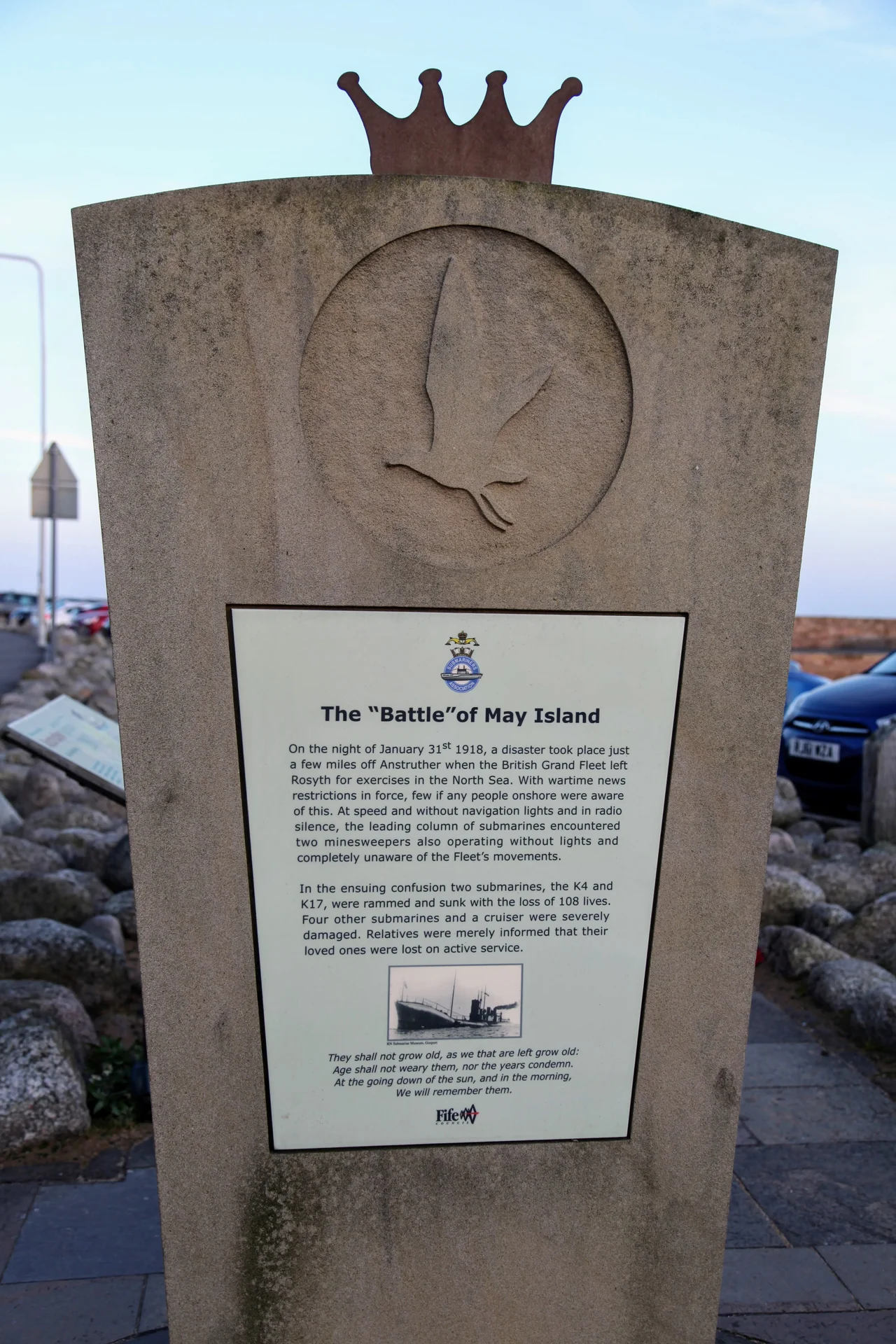

Battle of May Island
There was no enemy. That is the first thing to understand about the Battle of May Island. On the night of 31 January 1918, around forty Royal Navy vessels left Rosyth for fleet exercises off Orkney, and within seventy-five minutes off the Isle of May, the column had collided with itself five times. Two K-class submarines sank. Four others and a light cruiser were damaged. One hundred and five British sailors died, most of them in the freezing water off K17, run down by destroyers that never saw them. The Royal Navy called it the Battle of May Island as a kind of grim regimental shorthand. The men who survived used other words.
The K-Class
The K-class submarines were a strange compromise of an idea. The Admiralty wanted submarines that could keep up with the surface fleet at battle-speed, which meant 24 knots, which meant steam turbines. The boats came out 339 feet long, with steam plant, retractable funnels, and a habit of failures at every level of the system. They had a reputation among their own crews. K stands for Kalamity, the joke went. The two flotillas that left Rosyth that January night were the 12th, led by Captain Charles Little in the light cruiser HMS Fearless, and the 13th, led by Commander Ernest Leir in the destroyer HMS Ithuriel. Each flotilla led four submarines in column at twenty knots. The night was clear and the sea calm. The moon had not yet risen.
Seventy-Five Minutes
At about seven in the evening the battlecruiser Courageous passed the Isle of May at the firth's mouth and a low bank of mist settled. The 13th Flotilla, passing the island next, sighted two unidentified lights ahead, possibly minesweeping trawlers. The column swung sharply to port to clear them. K14's helm jammed for six minutes. She drifted out of line. Behind her, K22 lost sight of the column in the mist and veered too. At 19:17, K22 struck K14 in the bow, killing two men in the forward mess and breaching both hulls. The submarines stopped to assess. The rest of the flotilla continued out to sea, unaware. Fifteen minutes later, the 2nd Battlecruiser Squadron came up behind. K22 fired a red Very flare. Three battlecruisers avoided the wreck. The fourth, HMS Inflexible, struck K22 a glancing blow that bent her bow at right angles and crushed her ballast tanks until only the conning tower stood above water. Meanwhile Commander Leir, by then on the way back to help, sent a coded message warning the rest of the fleet. The transmission was delayed forty minutes by the wartime cypher procedures.
The Men in the Water
While Leir's warning was still being deciphered somewhere astern, the 5th Battle Squadron, three battleships with their destroyer screen, came through the area unaware. By then K17 had also been struck. Her crew of fifty-seven had got onto the casing and into the water. The destroyers screening the battleships, blacked out for war steaming, ran straight through them. Some of the propellers cut men down where they swam. When the count was finally made, only nine of K17's fifty-seven men were still alive, and one of those died of his injuries soon afterwards. Forty-seven men of K17 were lost, with one of the few survivors dying of injuries shortly afterward. Total deaths from the night came to one hundred and five. They were stokers, signallers, telegraphists, ratings, the youngest perhaps eighteen. Most of them never saw the destroyer that ran them down.
The Silence and the Service
The Royal Navy did not want this known. The court martial was kept quiet. The case of negligence against Commander Leir for the loss of K17 was found not proved, the Scottish verdict that means neither guilty nor innocent. The full records were not released until 1994, seventy-six years later, when most of the survivors and witnesses were gone. The wrecks of K4 and K17 lie about a hundred metres apart on the seabed off May Island, around fifty metres down, and have been surveyed by divers from the marine consultants EMU. Each year the Submariners' Association holds a memorial service for the men lost. The K-class continued in service through the war. The name was retired afterwards. So was the design.
From the Air
Battle of May Island wrecks: approximately 56.186 N, 2.558 W, the seabed about 18 miles east of the Isle of May at the mouth of the Firth of Forth. The Isle of May lighthouse marks the area, visible from cruise altitude in clear weather. Best aerial perspective from 3,000-5,000 ft AGL overflying the Firth toward the open North Sea. Nearest airport is Edinburgh (EGPH), 40 nm west; RAF Leuchars (EGQL) is 22 nm north-west across the Firth. The waters of the outer Firth are heavy shipping and naval-exercise lanes; check NOTAMs.
Nearby Stories
- Edinburgh City Bypass 1.4 km away
- Eyemouth Lifeboat Station 3.3 km away
- Yester Castle 4.7 km away
- Fingask Castle 5.6 km away
- Kirkcaldy 5.7 km away
- Carnoustie Golf Links 9.3 km away
- Eyemouth Disaster 30 km away
- River Dee Ferryboat Disaster 79 km away