
Battle of Minorca (1756)
Voltaire gave the affair its epitaph before most of Europe had finished arguing about it. In Candide, watching an English admiral shot on his own quarterdeck, the narrator is told that in this country it is thought wise to kill an admiral from time to time "to encourage the others." The admiral was John Byng, and the country's failure had a location: the blue water east of Port Mahon, where on 20 May 1756 two fleets met in the first sea battle of the Seven Years' War. Menorca would change hands over it. Byng would lose his life.
A Fleet Sent Too Late
Britain had held Menorca since 1708, seized during the War of the Spanish Succession and prized for the deep, sheltered harbour at Mahon. By 1756 the empire was stretched thin, already at war with France in the North American colonies and nervous about invasion closer to home. When the long-expected French move on Menorca finally came, London acted late and half-heartedly. It dispatched ten ships of the line from Gibraltar under Byng, freshly promoted to admiral for the occasion. The government knew a strong French fleet was fitting out at Toulon. Even so, the vessels handed to Byng were in poor repair and short of crews. He was sent to relieve a siege with tools chosen almost as if for their inadequacy.
The Line That Never Closed
Byng reached Menorca on 19 May to find the island already overrun, only the garrison of St. Philip's Castle still holding out above the harbour mouth. A French squadron of twelve ships of the line and five frigates stood between him and the shore. The next morning he formed his twelve largest ships into a single line of battle, held the weather gage, and ordered them to bear down and engage their opposite numbers. Then the century's crude signalling betrayed him. Confusion and delay rippled down the line. The British van closed and took a fearful pounding from heavier French guns, while the rear, Byng's own flagship among it, never came within effective range. Several ships were badly mauled. The French lost none.
The Council and the Retreat
That evening Byng convened a Council of War. Every senior officer present agreed: the fleet could neither cripple the French nor break through to the garrison. Byng ordered a return to Gibraltar. It was a defensible decision by a cautious commander who had done what his damaged ships allowed, and it was also, unmistakably, a French victory. St. Philip's Castle surrendered soon after. Menorca fell. The strategically vital harbour, the anchorage the whole campaign had been about, passed into French hands, and the British public, hungry for a hero and finding a scapegoat instead, turned on the man who had sailed away.
To Encourage the Others
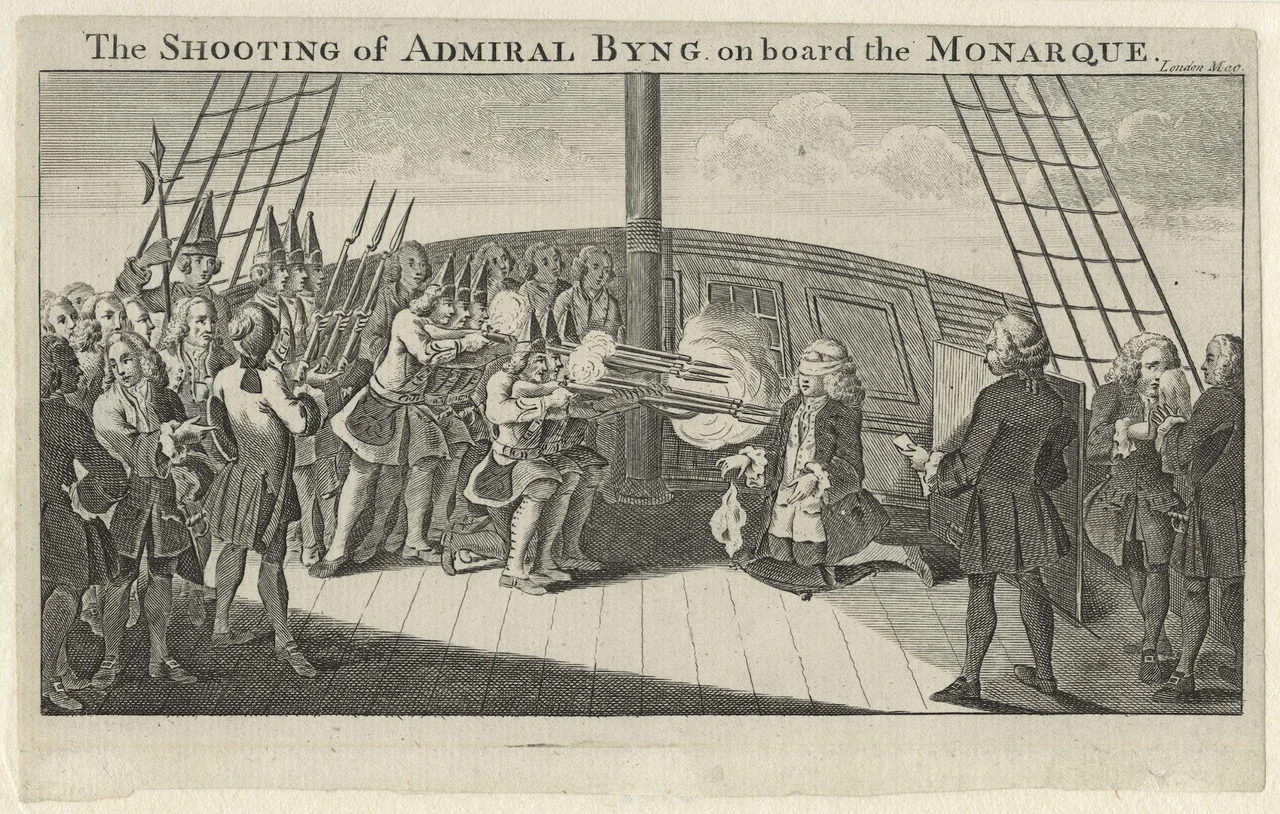
The Admiralty, arguably keen to bury its own unpreparedness, charged Byng under the Articles of War with failing to do his utmost to relieve the garrison. He was court-martialled and found guilty. The sentence was death. Pleas for clemency came from many quarters, but they went unanswered, and on 14 March 1757 Byng was shot by a firing squad on the deck of a warship in Portsmouth Harbour. He met the volley calmly. Across the Channel, Voltaire, who had tried to help save him, folded the execution into Candide, and the mordant line about killing an admiral "pour encourager les autres" has outlived every ship in both fleets.
A Pawn Traded Back
For all William Pitt's eagerness to reclaim the island, no British expedition was sent to retake Menorca for the rest of the war. It came back to Britain not by force but by ledger, returned under the 1763 Treaty of Paris in exchange for the French West Indies and Belle-Île. Menorca had become a bargaining chip, won and lost and traded across the map of empire. Fly the eastern approaches to Mahon today and the sea gives nothing away. Yet somewhere beneath those calm swells a fleet once maneuvered for a harbour, and a man was made to answer for a nation's excuses.
From the Air
Centered near 39.89 N, 4.35 E, in the open Mediterranean just east of the mouth of Port Mahon on Menorca's eastern coast. The battle unfolded offshore here; the natural harbour of Mahon and the ruined outline of Fort St. Philip mark the objective the fleets fought over. Menorca Airport (LEMH) lies about 12 nm west-southwest across the island. A viewing altitude of 3,000-4,500 ft over the coast gives the best sense of the deep harbour inlet and the open water where the lines of battle formed. Visibility is typically excellent in summer; watch for the northerly Tramuntana wind that funnels across the island.
Nearby Stories
- Ciutadella 21 km away
- Cuevas del Drach 46 km away
- Coves dels Hams 92 km away
- Llobregat Delta 200 km away
- Somorrostro 235 km away
- Porto Flavia 300 km away
- Nuraghe Seruci 307 km away
- Cosquer Cave 350 km away