.jpg)
Battle of Montevideo (1807)
There is a street in Montevideo's old city called Brecha, which simply means "breach." The name is a scar. It marks, more or less, the spot where British cannon battered a hole through the city's defensive wall in the winter of 1807, and where soldiers and defenders died in the dark trying to hold it or get through it. Montevideo was a Spanish stronghold then, a walled town on a peninsula at the edge of empire, and for a few violent hours one February morning it became a battlefield in a war whose center lay an ocean away in Napoleon's Europe.
The British at the Gates
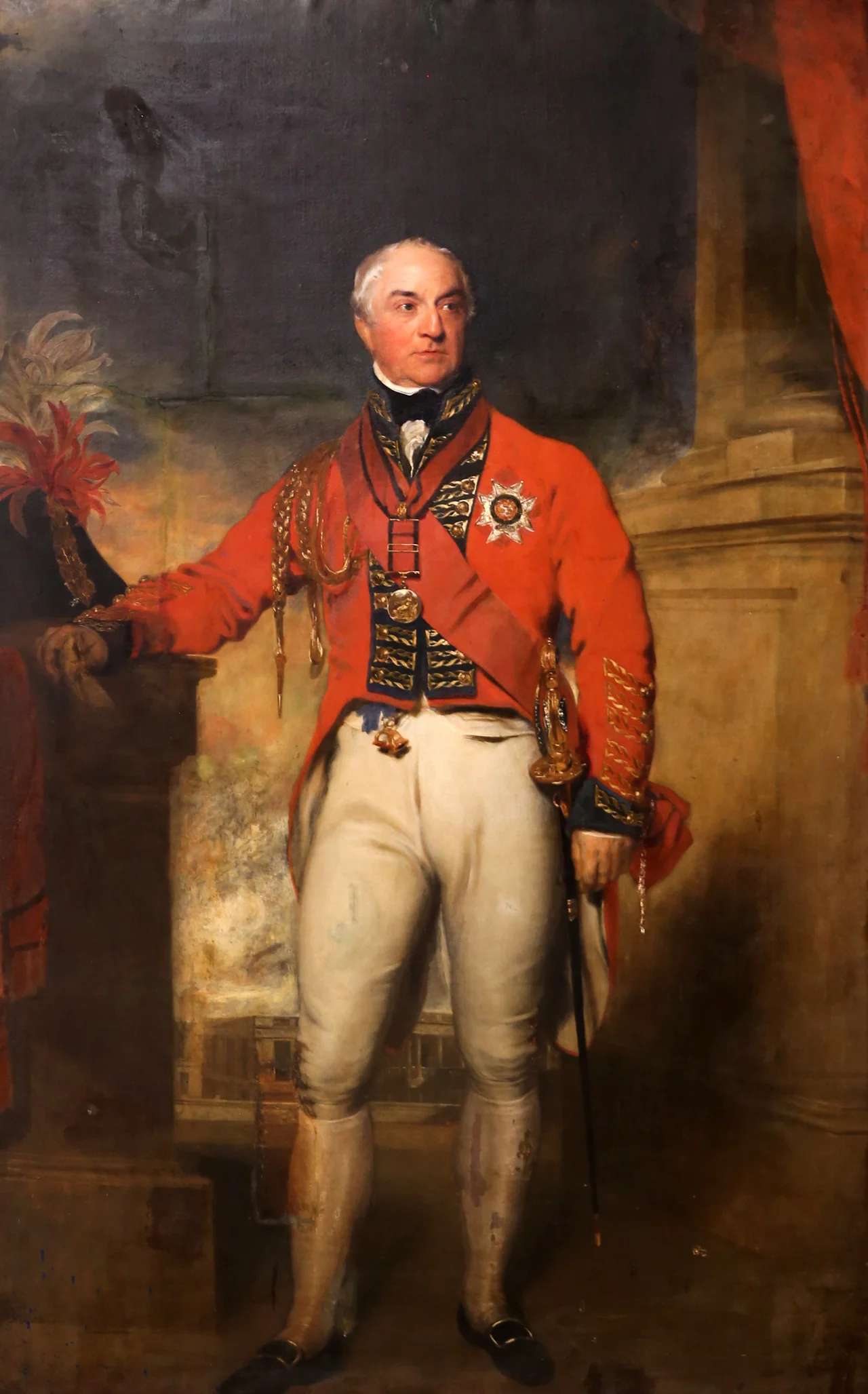
The assault was part of the British invasions of the River Plate, an opportunistic campaign to seize Spanish territory in South America while Spain stood allied with Napoleonic France. With Europe at war and Spain's Atlantic empire suddenly fair game, a large expedition crossed the ocean, troops under Brigadier General Sir Samuel Auchmuty supported by a naval squadron under Rear-Admiral Charles Stirling. On 20 January 1807, two weeks before the main attack, a clash outside the town, the Battle of Cardal, went badly for the defenders. Around eight hundred local combatants became casualties, most of them ordinary townsmen and militia rather than professional soldiers, and roughly two hundred of them were killed. British losses that day numbered only about 150, a lopsided toll that foretold what was coming. The road to Montevideo's walls now lay open, and the city braced behind its stone for the bombardment everyone knew would follow.
Through the Breach
For days, British guns hammered the weakest stretch of wall, near where the Anglican cathedral stands today. The final assault began around two in the morning on 3 February. The breach was a killing ground: defenders had stuffed it with hides to slow the attackers, and two bastions poured crossfire into the gap. Captain Renny of the 40th Foot found the opening and was shot dead trying to pass it. Lieutenant Harry Smith of the 95th, a young man on his first campaign who would one day become a famous general, was close behind. The attackers took heavy losses pressing through, and senior British officers fell mortally wounded inside the walls, but the defense could not hold the gap.
The Defenders' Stand
Montevideo did not fall quietly. On the far side of the peninsula, the 87th Foot grew impatient waiting at the San Pedro gate; hearing the fighting inside, they scaled the wall and struck the defenders from behind, capturing a flag still kept today in a regimental museum in Northern Ireland. Defending the breach itself were men under Hipolite Mordeille, a French privateer whose corps, in Auchmuty's own words, was "very nearly annihilated" in the fight. Mordeille was killed. The Spanish governor, Ruiz Huidobro, surrendered around five in the morning. Even in victory, Auchmuty praised those who had "defended the town and citadel of Monte Video with great spirit," an acknowledgment that the city's defenders had sold it dearly.
Eight Months and a Memory
The British occupation lasted only until September 1807. A second thrust against Buenos Aires failed disastrously that July, and under the terms of surrender the redcoats withdrew from the River Plate entirely, leaving Spanish South America to its own approaching revolutions. The invaders carried home battle honors; four British regiments were awarded the name "Monte Video," passed down through their successor units. Uruguay carried home something subtler. The episode left the old city marked with names like Ciudadela, for the long-dismantled citadel, and Brecha, for the wound in the wall. Walk Ciudad Vieja today and the colonial fortress is gone, but its outline survives in the street signs, and the breach has never quite healed over in the city's memory.
From the Air
The 1807 siege unfolded across the Ciudad Vieja peninsula at roughly 34.91 degrees south, 56.20 degrees west, where Montevideo's walled old city juts into the Bay of Montevideo at the mouth of the Río de la Plata. From the air the peninsula and its sheltered bay are unmistakable, the historic grid hemmed by water on three sides, the port on the bay side and the open estuary beyond. Carrasco International Airport (ICAO: SUMU) lies about 20 km east along the coast; Ángel S. Adami Airport (ICAO: SUAA) sits inland to the northwest. The flat terrain and broad estuary make for excellent visibility on clear days, with the old city's spires and the Cerro de Montevideo across the bay as the principal landmarks.
Nearby Stories
- Piriápolis 24 km away
- Minas 40 km away
- Tronador (rocket) 67 km away
- Nueva Helvecia 69 km away
- La Plata Museum 122 km away
- Battle of Sarandí 126 km away
- Mundo Marino 145 km away
- South Georgia Island 2584 km away