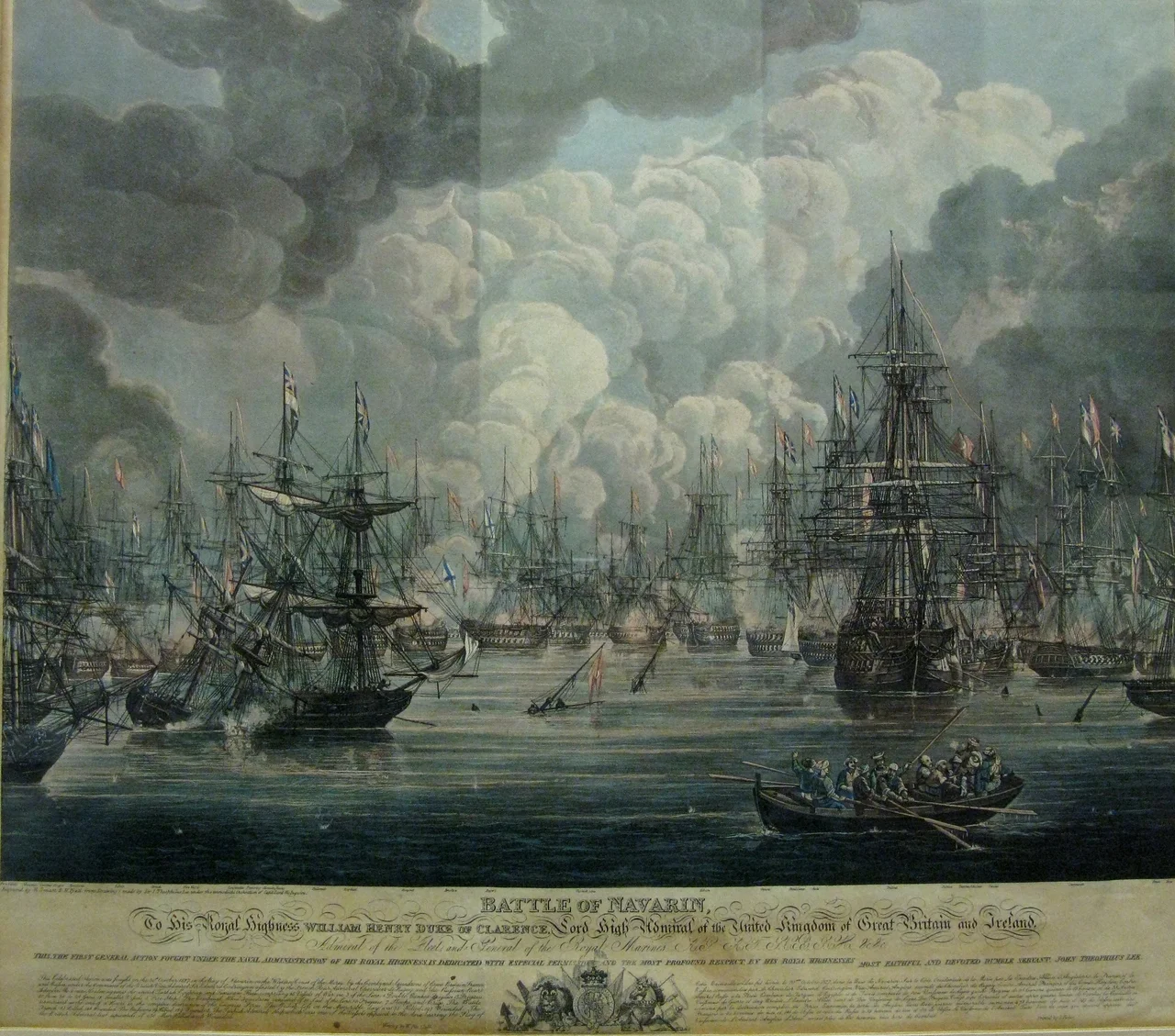
.jpg)
Battle of Navarino
The band was playing when the shooting started. Vice-Admiral Edward Codrington had ordered a brass ensemble to perform on the deck of his flagship HMS Asia as his squadron filed into Navarino Bay on the afternoon of 20 October 1827 — a deliberate signal of peaceful intent. Within minutes, that intent was irrelevant. A musket flash near the entrance ignited a chain of fire that spread ship to ship across the crowded anchorage, and by dusk, the largest Ottoman fleet in the Mediterranean lay wrecked or burning on the sheltered waters of what is now Pylos Bay. Roughly three to four thousand men from the Ottoman and Egyptian forces were killed or wounded in those few hours — sailors and soldiers trapped in burning vessels, some found afterward shackled to their posts. One hundred and eighty-one Allied sailors died as well. What had begun as a show of force intended to coerce, not destroy, ended the era of the sailing warship as an instrument of great-power conflict.
A Revolution on the Brink
Greece had been fighting for its independence since 1821, but by 1825 the rebellion was failing. The Ottoman Sultan had called in Muhammad Ali Pasha, the powerful autonomous wali of Egypt, and in February of that year Ibrahim Pasha — Ali's son — landed sixteen thousand Western-trained troops on the Peloponnese. His army swept through the western peninsula. His scorched-earth campaign left villages in flames visible from Allied ships offshore; a British landing party reported that Messinia's population was close to mass starvation. The Greek provisional government, bankrupt and commanding fewer than five thousand regular troops against forty thousand Ottoman and Egyptian soldiers, was running out of time. Public opinion in Britain, France, and Russia had long sympathized with the Greeks. The question was whether the governments of those Great Powers would act before the revolution collapsed entirely.
The Treaty That Set the Stage
Britain, France, and Russia signed the Treaty of London on 6 July 1827, agreeing to demand an immediate armistice and to enforce it if necessary. The man chosen to command the British squadron was Vice-Admiral Sir Edward Codrington, a Trafalgar veteran who had spent forty-four years at sea. He was, by every account, the wrong choice for a mission requiring tact. Impetuous, contemptuous of diplomacy, and openly sympathetic to the Greek cause — he had subscribed to the London Philhellenic Committee — Codrington was a fighting sailor placed in a diplomat's role. His French counterpart, Admiral Henri de Rigny, regarded him with exasperated wariness. Through September and early October, Codrington attempted to coerce Ibrahim into respecting the armistice while Ibrahim's forces continued burning the countryside. By mid-October, with winter approaching and the Allied blockade growing untenable, Codrington made his fateful decision: he would sail the combined Allied fleet directly into Navarino Bay and anchor face-to-face with the Ottoman armada.
Inside the Horseshoe
Navarino Bay is a large natural harbour on the southwest Peloponnese, about five kilometres long and three wide, sheltered from the open Ionian Sea by the narrow island of Sphacteria. The Ottoman-Egyptian fleet — 78 vessels in all, 2,180 guns — was anchored in an elaborate horseshoe formation inside the bay, designed by the French adviser Letellier to maximize defensive fire. Against them, Codrington led 22 Allied ships carrying 1,258 guns. On paper, the disparity looked overwhelming. In practice, the Allied vessels were manned by combat veterans of the Napoleonic Wars, firing heavier and more accurate guns, commanded by captains who had spent a decade at war. The Ottoman fleet carried many men who had been impressed into service; some, as the aftermath revealed, had been literally chained to their stations. At 2:00 p.m. on 20 October, Codrington's flagship Asia led the Allied line through the southern entrance, the band still playing.
Four Hours of Fire
The battle began with a musket shot — whose, exactly, remained disputed — near a fireship on the Ottoman left flank. Within moments the engagement was general, and Codrington's twice-given ceasefire signals were lost in the smoke. The fighting was close, intense, and largely at anchor: ships blasting each other at near point-blank range with broadsides that dismasted or gutted vessels in minutes. The French Scipion very nearly burned to the waterline when a fireship jammed under her bowsprit; men threw themselves onto the flames to keep them from the powder magazine. Codrington's own Asia was simultaneously engaged with two Ottoman flagships and suffered severe casualties. The Russian Azov took 153 hits, several below the waterline, while sinking or disabling four enemy vessels. By 4:00 p.m., all three Ottoman ships of the line and most of the large frigates were gone. The smaller vessels of the second and third lines — corvettes and brigs that had been Letellier's cleverly conceived reserve fire — were now defenceless. The guns fell silent at dusk. Of 78 Ottoman-Egyptian ships, eight remained seaworthy.
Victory No One Wanted to Own
Church bells rang through the night across the Peloponnese. Bonfires blazed on mountaintops from Messinia to Mount Parnassos. For the Greeks, the meaning was unmistakable: the Ottoman Mediterranean fleet was gone, and with it any realistic chance of crushing the rebellion from the sea. Independence was not immediate — it required the Russo-Turkish War of 1828–29 and a French military expedition to the Peloponnese to finally clear Ottoman forces from the mainland — but Navarino was the turning point. In London, however, the reception was decidedly cooler. King George IV reportedly described the outcome as "this untoward event." Codrington was relieved of his Mediterranean command in June 1828, honoured with the Grand Cross of the Bath for public consumption and then given no further operational command. He had won one of history's decisive naval engagements — and paid for it with his career. Today, the town of Pylos still holds annual commemorations in Three Admirals' Square, where a three-sided marble monument bears the profiles of Codrington, de Rigny, and van Heiden, the commanders who, intentionally or not, freed a nation.
From the Air
Navarino Bay (modern Pylos) lies at approximately 36.94°N, 21.69°E on the southwest coast of the Peloponnese, visible from the air as a large sheltered harbour backed by hilly terrain. The narrow island of Sphacteria runs along the bay's western edge, clearly distinguishable from altitude. The town of Pylos sits at the southern tip of the bay. Approach from the northeast offers a panoramic view of the entire anchorage where the battle unfolded. Nearest airport: LGKL (Kalamata International), approximately 50 km northeast. Recommended viewing altitude: 3,000–5,000 feet for the full bay geography; lower passes reveal the tight confines that made the anchorage so deadly. Weather over the Ionian coast is generally clear in autumn, though sea haze can soften visibility in the morning hours.
Nearby Stories
- 1986 Kalamata Earthquake 2.8 km away
- Peloponnese 20 km away
- Kalamakia Cave Site 21 km away
- Lepreum 22 km away
- Strofades 29 km away
- 2018 Ionian Sea Earthquake 55 km away
- Apidima Cave 67 km away
- Valletta 597 km away