
Battle of Pitgaveny
Shakespeare set it in a castle, in the dead of night, with a knife in the dark. The real death of King Duncan happened almost six hundred years before the play was written, on open ground near a place called Bothnagowan - modern Pitgaveny, just outside Elgin - on a summer's day in 1040. There was no whispered scheming, no spotless king. There was an army from the south, an army from Moray, and a battle that Duncan lost.
Two Kings, One Crown
Duncan I had inherited the Scottish throne in 1034 through his mother, a sideways move that bypassed the older male line descending from Kenneth MacAlpin. Many nobles thought the crown should have gone elsewhere - perhaps to Macbeth, the dux of Moray, a powerful war-leader whose family had ruled the northern province with a measure of independence for generations. Moray was cut off from the rest of Scotland by the Mounth, the great granite wall of the Cairngorms, and its rulers were used to going their own way. Macbeth had his own claim through his mother and his wife. For six uneasy years the two men shared a kingdom they both believed they should hold alone.
A King's Bad Decade
Duncan's reign went badly almost from the start. He tried to reclaim Caithness and Sutherland from Thorfinn the Mighty, the Viking Earl of Orkney, and was beaten. In 1038 he invaded Northumbria in retaliation for English raids on Cumberland and was beaten again, this time at the siege of Durham. Each defeat cost lives and weakened his standing. By 1040 the discontent in Scotland had a focus - Macbeth, the unbeaten lord of the north. Whether Duncan marched on Moray to break a rival or to head off rebellion no longer mattered. He crossed the Mounth at the head of an army and rode down toward the Laich of Moray, the low coastal plain around Elgin, looking for a fight he was confident of winning.
Pitgaveny, 14 August 1040
He found one. The chronicles are sparse - this is the eleventh century, and surviving accounts give us a date, a name, and a result. On 14 August Duncan met Macbeth's forces at Bothnagowan, near Elgin. The fighting went against him. Some sources say Duncan was killed outright on the field. Others say he was carried wounded to nearby Elgin Castle and died there of his injuries. Either way, the man who fell at Pitgaveny was no aged sleeping king but a young ruler in his prime, perhaps in his thirties, cut down in a war he had himself begun. Macbeth, the victor, was crowned King of Scots. He would rule for seventeen years.
The Long Aftermath
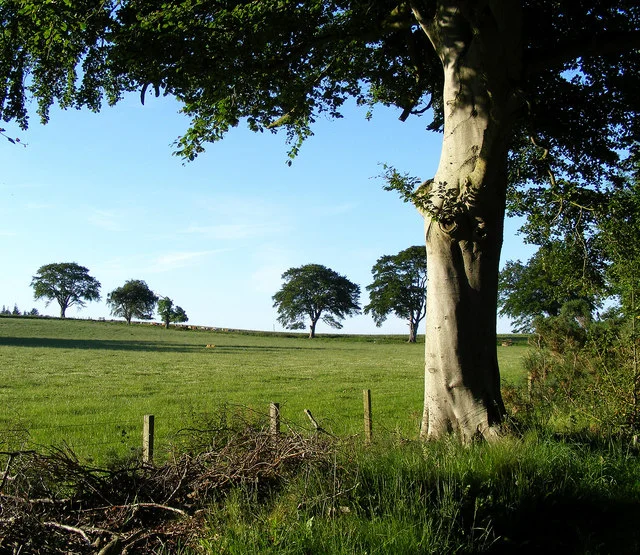
History after Pitgaveny became the rough material from which Shakespeare would carve his tragedy. Duncan's sons fled - Malcolm Canmore to England, Donald Ban into the islands. In 1045 Macbeth killed Duncan's father Crinan, abbot of Dunkeld, in battle. He held the throne through invasion in 1054, when Siward of Northumbria fought him at Dunsinane Hill. Three years later Malcolm returned at the head of an army and killed Macbeth at Lumphanan, in Aberdeenshire. Eighteen weeks after that, Macbeth's stepson Lulach also fell to Malcolm, who took the crown as Malcolm III. The cycle of killings ran on for another generation. Today Pitgaveny is a quiet stretch of farmland - a country house, low fields, the distant glint of the Moray Firth. Only the name survives to mark the day a king died here.
From the Air
Pitgaveny lies at 57.67 N, 3.28 W, on the coastal plain just north-east of Elgin in Moray. From the air the battlefield site is unmarked countryside between Elgin Cathedral and Lossiemouth Bay - look for the patchwork of farmland on the Laich of Moray bounded by the Lossie River. RAF Lossiemouth (EGQS) is two nautical miles north; Inverness Airport (EGPE) sits about 30 nautical miles west. The Cairngorms rise to the south - the same Mounth that once kept medieval Moray semi-independent. The wide, flat coastal plain is best seen from low cruise altitudes on clear summer days when the Moray Firth shimmers to the north.
Nearby Stories
- Cardhu Distillery 1.5 km away
- Clynelish Distillery 1.8 km away
- Hilton of Cadboll Chapel 3.1 km away
- Huntly Castle 3.4 km away
- Findlater Castle 6.3 km away
- Culloden Viaduct 12 km away
- Helmsdale 23 km away
- HMS Exmouth (H02) 39 km away