
Battle of Sphacteria
Cleon had made a promise in front of the Athenian assembly that no sane man would have made: within twenty days, he would either kill or capture the Spartans stranded on Sphacteria. The crowd, which had laughed at his bluster, had then called him on it. Nicias, the general, offered to step aside and let Cleon take command. Cleon tried to back down. The assembly wouldn't let him. He went to Pylos carrying his impossible promise, and — astonishingly — he kept it. The Battle of Sphacteria, fought in the summer of 425 BC, produced what Thucydides said "shook the Greek world": Spartans, the warriors who had been raised since childhood to die rather than surrender, threw down their shields and asked for terms.
The Long Wait on an Island
After the Battle of Pylos, around 440 Spartan soldiers — including 120 men of the elite Spartiate class — found themselves stranded on Sphacteria, unable to leave and watched constantly by the Athenian fleet. Demosthenes had initially planned simply to starve them out. It proved harder than expected. Desperate Spartans on the mainland offered freedom to Helots and money to free men who would carry food across to the island by night; some swam underwater towing bags of provisions during storms, approaching from the seaward side. The Athenians, meanwhile, found themselves short of rations and dependent on a single spring for fresh water. Weeks stretched into months. In Athens, the mood soured. Cleon, who had been the loudest voice against making peace with Sparta when the opportunity had existed, now faced the political consequences of a blockade that seemed to be going nowhere.
The Promise and the General
The political theatre at Athens was as high-stakes as anything happening on the ground at Pylos. Nicias's gambit — offering command to the man who had criticized the handling of the siege — put Cleon in an impossible position. The crowd roared its approval; Cleon could not refuse without humiliating himself. He named Demosthenes as his co-commander and set out with a force of Athenian sailors and allied peltasts and archers. Crucially, Cleon almost certainly knew that Demosthenes was already planning an assault — his acceptance of the command, once forced upon him, was not as reckless as it appeared. When Cleon arrived at Pylos, he found a situation that accident had made more favourable than he deserved. Spartan sailors, cooking outside the cramped confines of the island, had accidentally set fire to Sphacteria's vegetation. The island was now stripped bare, and Demosthenes could see exactly where the defenders were positioned.
The Night Landing
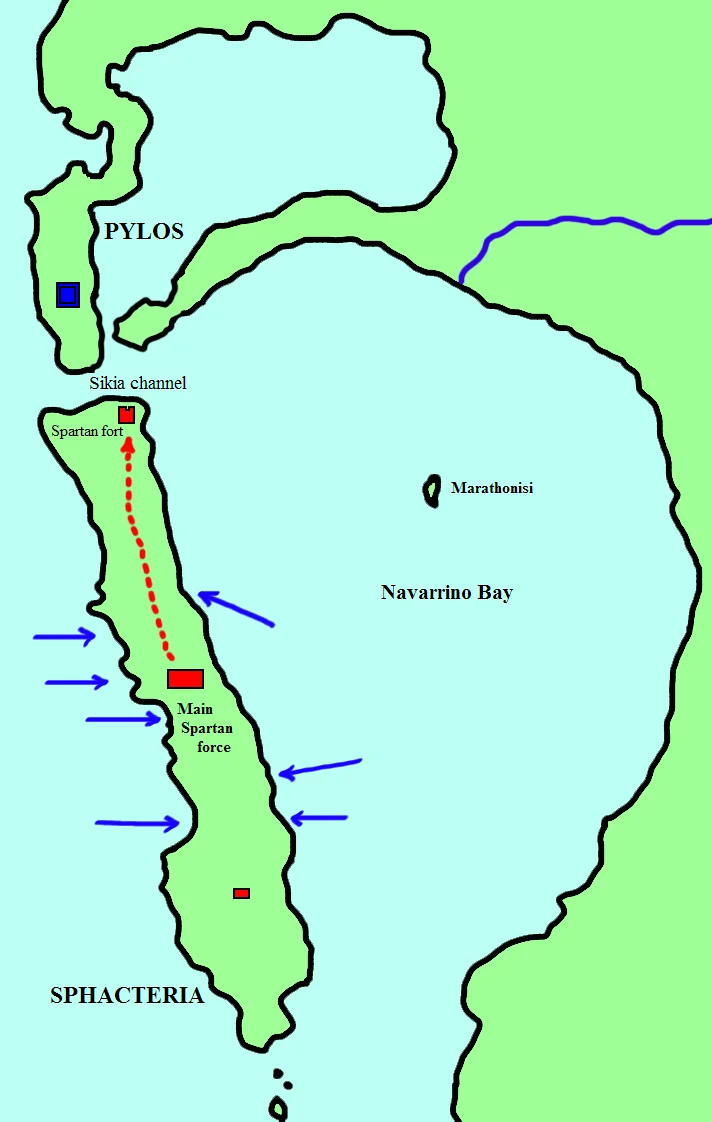
Demosthenes moved first in darkness. He saw that only thirty Spartans guarded the island's southern end — the end farthest from Pylos — and he landed 800 hoplites there under cover of night. The Spartan garrison, assuming the Athenian ships were merely mooring at their usual watch positions, was caught off guard. At dawn, the full force streamed ashore: some 2,000 light infantry (psiloi) and archers, plus around 8,000 rowers from the fleet armed with whatever weapons could be found. The numbers were overwhelming. The Spartans' commander, Epitadas, tried to push the Athenian hoplites back to the beach in the fashion Spartan tactics demanded — direct engagement, shield to shield — but Demosthenes had deployed his light troops in rotating companies of about 200, harassing from high ground and retreating when the Spartans charged. Dust and ash from the burned vegetation, stirred up by the fighting, further blinded the defenders. Unable to close with their tormentors, the surviving Spartans fell back to fortified positions at the island's northern end.
Comon's Path
Stalemate threatened to extend the battle indefinitely — until Comon, the commander of the Messenian contingent, asked Demosthenes for troops and promised to bring them through terrain the Spartans had left unguarded because it appeared impassable. His request was granted. Comon's men picked their way through the rough ground along the island's shore and emerged behind the Spartan position. When the Spartans realized their rear was taken, their defenses collapsed. Cleon and Demosthenes halted the attack — they wanted prisoners, not a massacre. A herald offered terms. The last message from the Spartan mainland told the men on the island to make their own decision, so long as they did nothing dishonorable. Commander Styphon, the third man in the chain of command (both Epitadas and his designated successor had been killed or left for dead), negotiated the surrender. Of the 440 Laconians who had crossed to Sphacteria, 292 survived to give up their shields. One hundred and twenty were Spartiates.
What Surrender Changed
"The outcome shook the Greek world," Donald Kagan has written, and the word shook is precisely right. Spartans did not surrender. It was one of the foundational assumptions of Greek military culture — and now 120 of them had. Athens held the prisoners and issued an ultimatum: any invasion of Attica would mean their execution. The annual Spartan raids, which had burned Athenian farmland every year since the war began, stopped. Athenian farmers could tend their crops in safety for the first time in years. Cleon, his mad promise vindicated, was granted the honour of free meals at public expense in the prytaneum — the same reward given to Olympic champions. Athens went on the offensive across the theater of the war. It would take a string of later defeats to erode what Sphacteria had given, and the Peace of Nicias in 421 BC to finally bring both exhausted sides to the table. Sparta, Thucydides wrote, did not shake off the shame of the island until the Battle of Mantinea in 418 BC — seven years later.
From the Air
Sphacteria lies at approximately 36.93°N, 21.67°E in Navarino Bay (modern Pylos), running north–south as a narrow wooded island along the bay's western edge. From altitude, the island's elongated shape makes legible the tactical situation: the northern end, where the surviving Spartans made their final stand, is visible as a rougher, higher section of terrain. The Pylos promontory (site of Demosthenes' 425 BC fortification) lies at the southern end of the bay to the east. Nearest airport: LGKL (Kalamata International), approximately 48 km northeast. A low pass at 2,000 feet over the island gives a clear sense of the broken terrain where Comon found his unguarded path.
Nearby Stories
- 1986 Kalamata Earthquake 2.8 km away
- Peloponnese 20 km away
- Kalamakia Cave Site 21 km away
- Lepreum 22 km away
- Strofades 29 km away
- 2018 Ionian Sea Earthquake 55 km away
- Apidima Cave 67 km away
- Valletta 597 km away