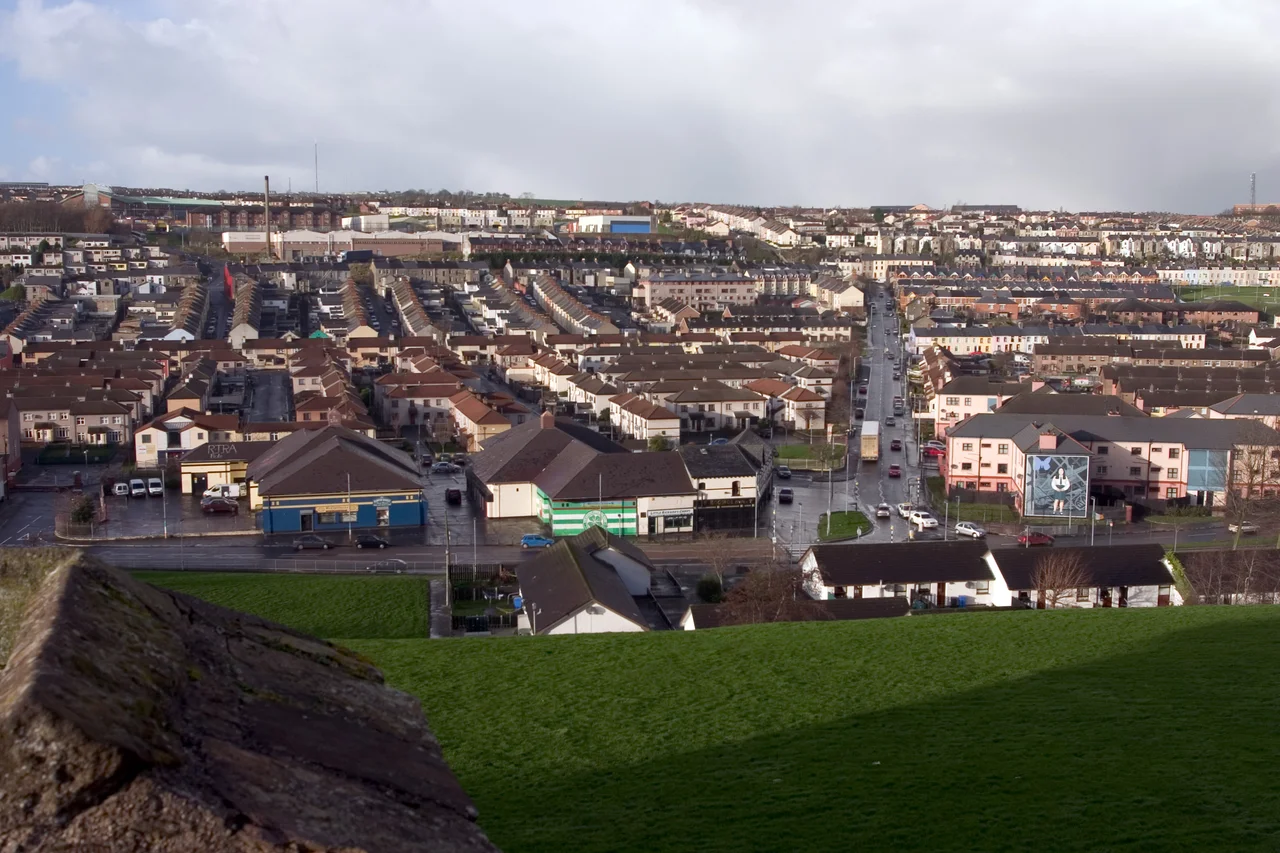

Battle of the Bogside
By 14 August 1969 the Royal Ulster Constabulary was sleeping in doorways. Almost the entire Bogside had been mobilised against them. A radio transmitter was broadcasting calls to resistance. Petrol bomb workshops were producing crates of bottles. Volunteer first aid posts were treating tear gas victims. The slogan You Are Now Entering Free Derry, painted on a gable wall on Lecky Road in January by a local activist named John Casey, had become a literal political fact. After two days of continuous fighting the police, drafted in from across Northern Ireland, were exhausted. At about five o'clock that afternoon the Prime Minister of Northern Ireland did something no prime minister of Northern Ireland had ever done: he asked Britain to send the army. By evening soldiers of the Prince of Wales's Own Regiment of Yorkshire were on Derry's streets. The Battle of the Bogside was over. The Troubles had begun.
How Derry Was Built to Riot
To understand the Battle, you have to understand the city it happened in. Derry was, after partition in 1921, a majority Catholic city under permanent Protestant political rule, achieved through a careful piece of cartographic engineering. Electoral wards were redrawn so that Catholic voters were concentrated in two enormous constituencies while Protestant voters were spread across three smaller ones. Only owners or tenants of dwellings and their spouses could vote in local elections, which excluded many adult children still living at home. The result, by 1969, was a city where Catholics made up 61.6 per cent of parliamentary voters and only 54.7 per cent of local electors, while the unionist Ulster Unionist Party held twelve seats on the council to the nationalists' eight. The city council controlled public housing. Houses were allocated in ways that kept Catholics inside their existing wards. The Bogside, the working-class Catholic neighbourhood at the foot of the medieval walls, grew steadily more crowded.
Marches, Batons, and Free Derry
In March 1968 Eamonn McCann and a few activists founded the Derry Housing Action Committee. By October a civil rights march through Derry's centre, organised in defiance of a government ban, was baton-charged by the RUC. The Westminster MP Gerry Fitt, his head and shirt covered in blood, appeared on television sets across Britain. Four thousand people demonstrated in Guildhall Square the next day. Fifteen thousand demonstrated on 16 November. In January 1969 a People's Democracy march from Belfast to Derry was ambushed at Burntollet Bridge by off-duty B-Specials and loyalist sympathisers while the RUC stood by. That night police broke into Bogside homes and beat residents, including the unprotesting Catholic Samuel Devenny, whose injuries killed him six months later. After Burntollet, the Bogside built barricades and posted vigilante patrols. John Casey took out his paint. You Are Now Entering Free Derry went up on the side of a house at the corner of Columbs Street, a sentence that would still be readable on that gable wall fifty-five years later.
The Apprentice Boys March
The Apprentice Boys of Derry march every 12 August to commemorate the relief of the Siege of Derry in 1689. Their route does not pass through the Bogside, but it passes the junction of Waterloo Place and William Street at the Bogside's edge. In 1969 some loyalists on the city walls threw pennies down onto Catholics in the Bogside below. Catholics fired marbles back with slingshots. As the parade reached its closest point, stones and nails came out, then bricks. When the disturbance became serious, the RUC charged into the Bogside to disperse the Catholic crowd. They came with batons and tear gas and behind them came loyalists, breaking the windows of Catholic homes. The residents barricaded the streets and threw petrol bombs from rooftops. Police fired CS gas at British civilians for the first time in UK history. The chemical drifted into living rooms and into the cathedral, where Bishop Neil Farren and curates were trying to calm the crowd. The Bogside did not fall.
Three Days, Three Nights
What followed was a riot organised like a small war. Bernadette Devlin, the twenty-two-year-old MP for Mid Ulster and the youngest woman ever elected to Westminster, walked the barricades urging people to fight. The Derry Citizens' Defence Association coordinated supplies of stones, petrol bombs, milk for tear-gassed eyes. A pirate radio station broadcast appeals for help and contradictions of loyalist rumours. On 13 August, with the police pressing hard against the barricades, the Taoiseach Jack Lynch went on television in Dublin and said his government could no longer stand idly by; he ordered field hospitals to the border and called for UN intervention. Catholic Belfast heard the speech as a promise that the Irish Army was coming. Catholic Derry heard the speech as proof that the world was watching. The RUC heard it as a foreign provocation. False rumours spread on the third day that St Eugene's Cathedral had been attacked by loyalists. Almost every able-bodied Bogsider went to the barricades. The police could not press further.
Five O'Clock on the Fourteenth
At five o'clock on the afternoon of 14 August, soldiers of the 1st Battalion of the Prince of Wales's Own Regiment of Yorkshire moved into position on Derry's streets. They had been on standby at HMS Sea Eagle, the naval base nearby. They took over from the RUC. Bogside residents handed them tea and sandwiches. The Battle of the Bogside was over without a single death inside the neighbourhood. Across the province, however, the riots called in solidarity with the Bogsiders were turning Belfast's Falls and Shankill into a war. Seven died there in three days. The Battle that ended without fatalities sparked the wider riots that did not. By December 1969 the IRA had split, and the Provisionals were arming for a new generation of conflict. The slogan painted on Casey's gable wall in January had become the prophecy of the next thirty years. You Are Now Entering Free Derry stayed up. The walls around it changed.
From the Air
The Battle of the Bogside took place in the Bogside neighbourhood of Derry, at roughly 55.00 degrees north, 7.33 degrees west, immediately below the medieval city walls on the west bank of the River Foyle. From cruise look for the bend of the Foyle, the walled hilltop of the old city, and the dense terraced grid of the Bogside spreading west and south from it. The Free Derry Corner mural still stands on Lecky Road. The nearest controlled airport is City of Derry (EGAE) just outside the city; Donegal Airport (EIDL) lies west across the border in the Republic. Belfast International (EGAA) is roughly 100 km east. Lough Foyle stretches north from the city; the Inishowen peninsula rises on the far side.
Nearby Stories
- Portrush Lifeboat Station 1.9 km away
- Main Street, Letterkenny 2.1 km away
- Inishowen 6 km away
- Rosguill 6.3 km away
- County Tyrone 7.1 km away
- St Patrick's College, Maghera 9.6 km away
- St Patrick's Purgatory 11 km away
- Coalisland Canal 17 km away