
Battle of the Green Islands
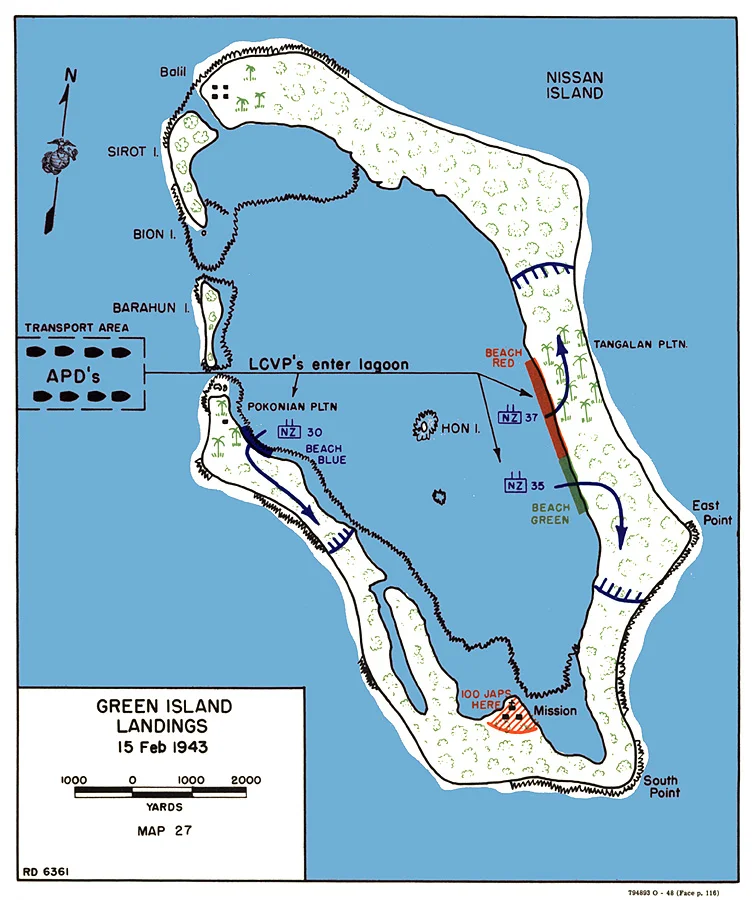
The codename was Operation Squarepeg, and the planners meant it literally. The Green Islands are a ring of low coral atolls around a wide interior lagoon, and the only way to use them as an Allied airbase was to cut an airstrip into a place that had never really wanted one. On 15 February 1944, 5,800 men - more than 4,200 of them New Zealanders - waded ashore on Nissan Island, the crescent-shaped anchor of the atoll chain. The fighting was brief. The occupation lasted eighteen months. Somewhere in the middle of all that, a young US Navy lieutenant named Richard Nixon ran air transport out of a Quonset hut.
The Ring of Atolls
The Green Islands sit about 150 miles from Rabaul, halfway between Bougainville and New Ireland. Nissan is the main island, a west-facing crescent closing off a lagoon four nautical miles across, with smaller islets sealing the ring. At the time of the battle around 1,200 Melanesians lived there, part of the Australian Territory of New Guinea. For the Allies, the appeal was geographic rather than strategic in any local sense - the atolls lay just within fighter range of the airbase at Cape Torokina, and within striking range of Rabaul in the other direction. As a stepping stone in Operation Cartwheel, which aimed to isolate rather than capture the great Japanese base, Nissan was a logistical proposition. Cut an airstrip, put fighters on it, and Rabaul's remaining reach shrinks by that much.
Reconnaissance First, Then the Tide
On 30 January 1944, the New Zealanders came quietly. Three hundred troops from the 30th Battalion, with American and New Zealand intelligence and communications personnel, slipped ashore under escort of destroyers and motor torpedo boats. Their job was to count the Japanese, pick landing beaches, and decide whether an airstrip was feasible. The Japanese garrison was thin - twelve naval watchkeepers and around eighty army personnel from General Hitoshi Imamura's Eighth Area Army, landed by submarine only days before. Reinforcements brought the total to perhaps 120. When the main landing came on 15 February, Admiral William Halsey commanded the operation and Rear Admiral Theodore Wilkinson led the naval task force. The force staged out of Vella Lavella and the Treasury Islands, crossing open water toward an objective the Japanese could not hope to hold.
Sharp at Sea, Brief on Land
The heavier resistance came in the air. As the convoy closed, Japanese aircraft from Rabaul found the task force. The landing craft and transports came through unhurt, but the cruiser USS St. Louis, part of the southern covering force, took a hit that killed 23 men and wounded 28. Later, Japanese dive bombers appeared over the landing craft as they formed up west of the islands. AirSols fighters out of Cape Torokina met them and broke up the attack; twelve Japanese aircraft went down that day. On the ground the fight was short but not without weight. A group of about seventy Japanese soldiers was caught near a Catholic mission at Tanaheran between patrols from the 30th and 35th Battalions, supported by Valentine tanks of the 3rd NZ Division Special Army Tank Squadron. Sixty-two Japanese were killed there, and three New Zealanders died. On 23 February, fourteen Japanese survivors withdrew to the small island of Sau and refused to surrender. They were destroyed in a firefight that left four New Zealanders wounded. Allied casualties for the whole operation came to 13 killed and 26 wounded. Almost the entire Japanese garrison died.
Building Faster Than Fighting
The real work was the Seabees. The 33rd, 37th, and 93rd Naval Construction Battalions turned Nissan into an Allied base with the methodical violence the Seabees were known for. A 450-foot coral seaplane ramp went in. Three moorings with concrete anchors and oil-drum buoys. A fuel pier. A full PT boat base with camps, workshops, a steel warehouse, and a T-shaped pontoon pier. A naval base hospital took shape under four Quonset huts. Marine fighters and bombers moved onto the airstrips and began flying missions against Rabaul and Kavieng; New Zealand fighters used the field as a refueling stop. By July 1944 base construction was declared complete, and the maintenance battalions began taking it apart again before most of the aircrews who flew from there had finished their tours.
The Lieutenant in the Quonset Hut
The South Pacific Combat Air Transport Command - SCAT - ran cargo and mail into forward bases and carried wounded men back out. On the Green Islands in early 1944, the officer in charge of that detachment was Lieutenant Richard Nixon, then a young Navy reservist whose postwar career was still twenty-five years from the presidency. Nixon never talked much about the atoll, and the atoll has not remembered him particularly either. Construction Battalion Maintenance Unit 553 was the last to leave, in August 1945. The airstrips they had carved out of coral were already softening back into jungle, and the Melanesian villagers who had lived there before the war resumed what they had been doing, on islands that had been, for a few strange months, the edge of a global conflict.
From the Air
The Green Islands (Nissan Island) are centered near 4.5 degrees S, 154.17 degrees E, between Bougainville to the southwest and New Ireland to the northeast. Nissan forms a roughly west-facing crescent around a 4 nmi-wide lagoon with smaller islets closing the atoll ring. Recommended viewing altitude 4,000-8,000 ft to see the full atoll shape and the remains of WWII-era coral airstrips, which are still visible from the air as straight lines cutting across the northern island. Nearest airports: Buka (AYBK) on Buka Island roughly 80 nm southwest, and Kavieng (AYKV) on New Ireland roughly 180 nm north. Weather in this area is trade-wind maritime with rapid convective buildups in the afternoon.
Nearby Stories
- Operation RY 56 km away
- Carteret Islands 78 km away
- Battle of Porton Plantation 117 km away
- USS John A. Bole 119 km away
- Duke of York Islands 131 km away
- Battle of Bita Paka 148 km away
- Lihir Island 211 km away
- Paramushir 6072 km away