
Operation RY
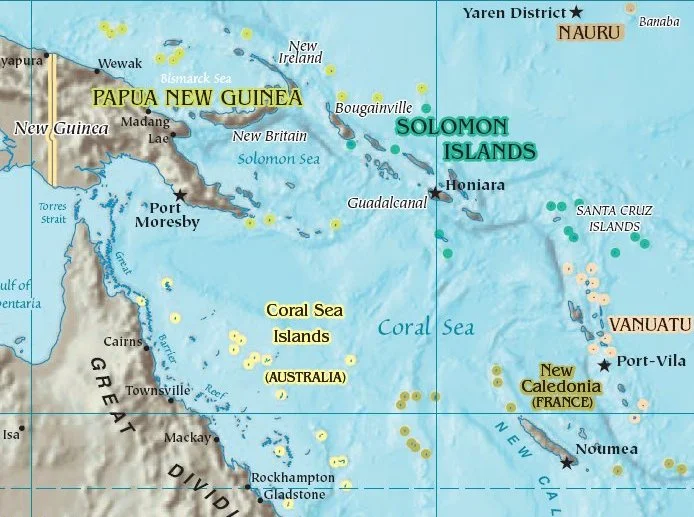
On the afternoon of 11 May 1942, off the western shore of Buka Island in what was then Japanese-held Bougainville, Rear Admiral Shima Kiyohide watched his flagship sink. The minelayer Okinoshima had been torpedoed at 04:52 that morning by the American submarine USS S-42, and despite the best efforts of her sister ships, she capsized under tow at 06:40 in St. George's Channel. Shima transferred his flag to the destroyer Yuzuki and pushed on. He was commanding Operation RY, Imperial Japan's plan to take Nauru and Ocean Island for their phosphate, and he had already lost his flagship and a repair ship, and now, as his reconnaissance aircraft reported, two American aircraft carriers were steaming toward him with no air cover of his own. Four days later, Tokyo cancelled the whole thing.
Rocks Worth Taking
Nauru and Ocean Island, known to its own people as Banaba, are tiny specks in the central Pacific, but they sat on top of phosphate deposits of extraordinary richness, the guano of millions of years of seabirds, laid down in concentrations that could be scraped up with a shovel and shipped straight to factories that turned it into fertilizer or, in wartime, into ammunition and explosives. The deposits had been identified around 1900. Since 1919, the Melbourne-based British Phosphate Commissioners had been running both islands as a single mining operation under the Nauru Island Agreement, with the local populations largely pushed aside. For Imperial Japan in 1942, riding a wave of victories that had carried its forces from Pearl Harbor to Singapore to Java in four months, phosphate was ammunition and ammunition was war. The islands looked like a small operation. They were not.
The Setup from Rabaul
On 11 May 1942, just three days after Operation MO against Port Moresby had been turned back at the Battle of the Coral Sea, the invasion force departed Rabaul on New Britain. Shima commanded the near force from the minelayer Okinoshima, with destroyers and transports carrying Special Naval Landing Force troops from the 6th SNLF and the Kashima SNLF. Vice Admiral Takeo Takagi covered them from a distance with the 5th Cruiser Division, heavy cruisers that had just fought through the carrier battle in the Coral Sea. The weather was foul. Rain sheeted down on the grey sea. Okinoshima had already been damaged by aircraft from USS Yorktown during the invasion of Tulagi on 4 May, and she was labouring. Lieutenant Commander Oliver G. Kirk's submarine S-42, an old boat commissioned in 1924, was waiting off New Ireland.
The Bluff That Worked
Kirk hit Okinoshima with four torpedoes just before 05:00. The escorts depth-charged the area for six hours and drove S-42 off, damaged but alive. Okinoshima capsized at 06:40. That should have been the worst of it. Then, as the rest of the force pressed on toward Nauru, a Japanese reconnaissance plane from Tulagi spotted the American aircraft carriers Enterprise and Hornet steaming toward the area. Admiral Nimitz in Pearl Harbor, working from decoded Japanese radio traffic, had sent them as a feint, a pure bluff. The carriers were actually needed elsewhere and could not afford a battle. But Takagi did not know that. All he knew was that his operation had no air cover against two enemy fleet carriers. On 15 May, Tokyo cancelled Operation RY. The Japanese ships returned to Rabaul. Nauru and Ocean Island, which had been largely evacuated by a Free French destroyer in February, sat empty under their lonely phosphate cliffs for three more months.
The Second Try, Unopposed
After the disaster at Midway in early June, the Japanese finally returned to Operation RY with less ambition and less opposition. A small force left the great anchorage at Truk on 26 August 1942. It consisted of a cruiser, five destroyers including Yuzuki which had carried Shima's flag three months earlier, and a single transport, the Hakozaki Maru. The troops landed on Nauru on 29 August and on Ocean Island the next day. No one shot back. The phosphate mines were intact. For the rest of the war, Japan held both islands, but as the Pacific tide turned and American bombers ranged further and further, the occupation became a kind of slow-motion siege. American aircraft bombed Nauru's facilities repeatedly. Supplies stopped arriving. On Ocean Island, in what became one of the grimmest chapters of the Pacific war, Japanese troops facing starvation in 1945 massacred almost all of the remaining Banaban civilians, though that horror came after Operation RY's own story was over.
A Sinking Off Buka
The lasting artefact of Operation RY is the wreck of Okinoshima, somewhere on the floor of St. George's Channel southwest of Buka. She was a purpose-built minelayer, not a warship of the first rank, and her loss barely registered in a war about to erupt into the much larger battles of Midway and Guadalcanal. But she took with her the career of an operation and the reputations of admirals who had let a two-carrier bluff turn them around. The submarine S-42 made it back to Brisbane's Moreton Bay. Oliver Kirk survived the war. The Banaban people, evacuated before the Japanese arrived, were later resettled on Rabi Island in Fiji and never returned to live permanently on Ocean Island. The phosphate that had drawn everyone's attention is now nearly gone, leaving behind a landscape of coral pinnacles where the topsoil used to be.
From the Air
The first Operation RY force sortied from Rabaul (4.20S, 152.17E) and moved through St. George's Channel, where Okinoshima sank somewhere near 4.5S, 152.8E on 11 May 1942. Target coordinates for this story are approximately 5.10S, 153.80E in the waters southwest of Buka Island. Cruise at 3,000-6,000 ft over the channel for best views of New Ireland to the east and New Britain to the west. Tropical convective weather is common; morning flights are best. Nearest major airports are Tokua (AYTK) at Kokopo on New Britain and Kavieng (AYKV) at the northern tip of New Ireland. Buka's airport (AYBK) is at the southern end of the story's area.
Nearby Stories
- Buka Island 34 km away
- Battle of Porton Plantation 48 km away
- Battle of the Green Islands 61 km away
- USS John A. Bole 75 km away
- Japanese cruiser Sendai 99 km away
- Carteret Islands 118 km away
- Battle of Bita Paka 123 km away
- Landing at Jacquinot Bay 198 km away