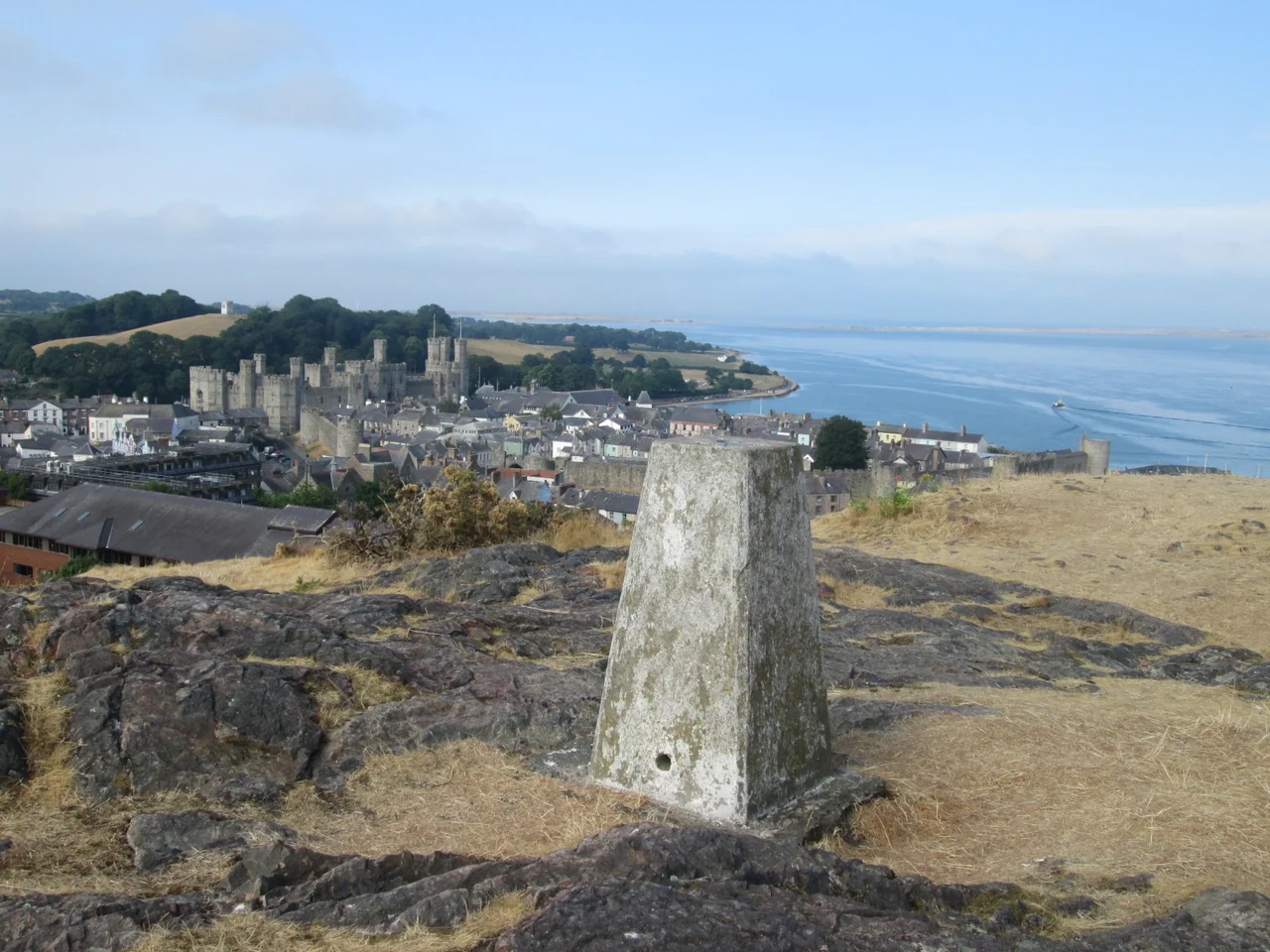

Battle of Tuthill
Owain Glyndwr had been at war for just over a year when he marched on Caernarfon. The summer before, at Mynydd Hyddgen high in the Cambrian Mountains, his small band had routed an English force and turned a regional grievance into a national rising. On 2 November 1401 - the morrow of All Saints, with hard frost coming in off the Menai Strait - he stood in front of the most intimidating castle Edward I ever built in Wales, raised a banner of a golden dragon on a white field, and ordered the assault.
A Banner from Legend
The dragon was not the red wyvern that would later become Wales's flag. It was Uther Pendragon's standard, lifted from the legendary chronicles of Geoffrey of Monmouth and Nennius. Glyndwr was a literate man steeped in the old British histories, and at this stage of his revolt he reached for myth as freely as he reached for steel. His letters that year to the kings of Scotland and Ireland brimmed with the same vocabulary - prophecy, Merlin, the old British inheritance about to be reclaimed. The golden dragon over Tuthill was a declaration, not a tactical flag. Within a few years he would put it down and adopt instead the four lions of the House of Gwynedd, the plainer arms of the last native princes. Pragmatism was catching up with prophecy.
The Walls Held
Almost nothing of the battle itself survives in writing. The only contemporary account comes from Adam of Usk, a Welsh-born cleric travelling through troubled times, who summarised the day in a single brisk Latin sentence. Glyndwr intended to lay siege to Caernarvon. He raised his standard. The garrison sallied out. Three hundred of his men were killed, and he was driven off. That is the whole record. The site itself, a low rise called Tuthill just outside the medieval town walls, is now buried under modern Caernarfon - housing, a school, a quiet residential street. There is no marker, no obvious slope to identify. The dead vanished into the ground beneath what is now suburban Gwynedd.
Why It Mattered Anyway
By the cold arithmetic of battle, Tuthill was a defeat. By the longer arithmetic of revolt, it was something else. The very fact that Glyndwr could march openly on the largest royal castle in north Wales, in broad daylight on a feast day, showed that the rebellion had teeth. Edward I had built Caernarfon to prove that English power was permanent in Gwynedd. Seeing a Welsh army gathered beneath its walls - even briefly, even unsuccessfully - undid some of that proof. Within three years Glyndwr held most of Wales, summoned parliaments at Machynlleth, and corresponded as a sovereign prince with the kings of France and Scotland.
The Castle That Wouldn't Fall
Caernarfon Castle did not surrender to Glyndwr. It held out through repeated sieges between 1401 and 1404, defended by a garrison sometimes reduced to a few dozen men behind banded stone walls modelled, some scholars think, on the walls of Constantinople. The town was burned more than once. The castle never broke. By 1409, with English reinforcements pouring into Wales and the rebellion losing ground, Glyndwr himself disappeared from the historical record. No one is certain where or when he died. He was never captured, never executed, never displayed in a London cage. He simply walked out of view, leaving the golden dragon to be picked up centuries later by people who had heard the story and wanted it to mean something.
From the Air
The battle site at Tuthill lies at 53.14 degrees north, 4.27 degrees west, immediately south-east of Caernarfon's medieval walled town on the eastern shore of the Menai Strait. From the air, look for the distinctive polygonal towers of Caernarfon Castle at the mouth of the River Seiont. Best viewed at 1,500-3,000 feet. Caernarfon Airport (EGCK) is four nautical miles south-west; RAF Valley (EGOV) lies 15 miles north-west on Anglesey - watch for fast-jet training activity and restricted airspace.
Nearby Stories
- Wakestock 1.7 km away
- Trefriw 3.8 km away
- Irish Sea 8.7 km away
- Irish Sea Bridge 20 km away
- East–West Interconnector 30 km away
- Machynlleth 36 km away
- HMS Tyler 41 km away
- New Brighton Lifeboat Station 54 km away