.jpg)
Battle of Y Dalar Hir
The two armies meeting near Llandegai had agreed on almost everything by accident. Both used field-words that began with the same letter - the Royalists' "Resolution," the Parliamentarians' "Religion." Neither side wore scarves or sashes to distinguish themselves. On a misty shore of the Menai Strait, two forces who could not be told apart by sound or sight rode at each other anyway. Half an hour later, a Parliamentarian trooper named Edward Taylor had broken his sword over a Welsh knight's skull, dragged him off his horse, and ended the Second Civil War in North Wales.
A War That Refused to End
Charles I had been beaten in 1646 and the First English Civil War was supposedly over. Then the New Model Army stopped getting paid and the king stopped negotiating in good faith. By the spring of 1648, his Scottish allies were preparing to invade, John Poyer was holding Pembroke Castle against Parliament, and a chain of revolts ran from south Wales to Kent. Sir John Owen of Clenennau, a Caernarfonshire landowner who had been Royalist governor of Conwy in the first war, saw his opening. He began recruiting in Merioneth in May, drawing in former officers from the Welsh hill country - men who had sworn never again to bear arms but who had not been paid either, and who remembered their old loyalties. By early June he had perhaps 300 horse and foot. It was not much, but in the thinly garrisoned north it was enough to start a war.
The Siege at Caernarfon
On 3 June Owen clashed with local militia near Llandwrog and captured the High Sheriff of Caernarvonshire, William Lloyd, who was badly wounded and died days later. Owen then drove the Parliamentarian commander Thomas Mytton inside Caernarfon Castle and laid siege. The castle was Edward I's great fortress, by then 350 years old and still imposing; Mytton's garrison was small enough to worry. Word went east to Denbigh, where Colonel George Twisleton scraped together fewer than 200 men, dragged two field guns over the hills with him, and started west along the old Roman road over Bwlch-y-Ddeufaen toward the coast. When Owen heard the relief column was coming, he raised the siege at Caernarfon and marched to meet it. Two days later, on the shore at Y Dalar Hir, north-east of Llandegai, the two forces saw each other across a stretch of salt grass.
A Half-Hour Fight on the Foreshore
The opening cavalry charge favoured the Royalists. Owen led the second wave himself, driving Twisleton's horse back in disorder, and for a few minutes it looked as if the rising might survive the day. Then Owen committed all his strength against the Parliamentarian reserve - and the reserve held. For half an hour the two lines stayed locked, and at the end of it the Royalist cavalry broke and ran. In the retreat, Captain Edward Taylor singled Owen out, closed with him, and broke his own sword across the knight's head. Stunned but alive, Owen was hauled from his saddle and taken prisoner. The fight ended within minutes of his capture. Thirty Royalists were dead; sixty more were prisoners. Some accounts claimed barely four Parliamentarian dead, others as many as forty on both sides. Ugly stories followed the survivors: three Royalist prisoners shot during the fighting, the death of the wounded sheriff blamed on "neglect and ill-usage."
What Defeat Confined
Owen went first to Denbigh Castle. Sixty of his men tried to scale the walls one night in July with two ladders; they were spotted and most were captured. Two of his officers came back later that month, fired their pistols in front of the castle in a futile bravado, and rode away. The prisoner himself ended up in London charged with treason, the violation of his articles of surrender, and the murder of William Lloyd. At his trial in February 1649 - barely weeks after Charles I lost his own head - Owen was condemned to death. Then, by some combination of Cromwell's intervention, Ireton's, foreign ambassadors, and the Royalist captain who kidnapped Griffith Jones of Castellmarch as a hostage, he was reprieved. The Scots invasion was crushed at Preston that August. Without Owen, the North Wales rising shrank to a handful of garrisons on Anglesey, and by October Mytton had crossed the strait with 1,500 men to mop them up.
The Quiet Shoreline Now
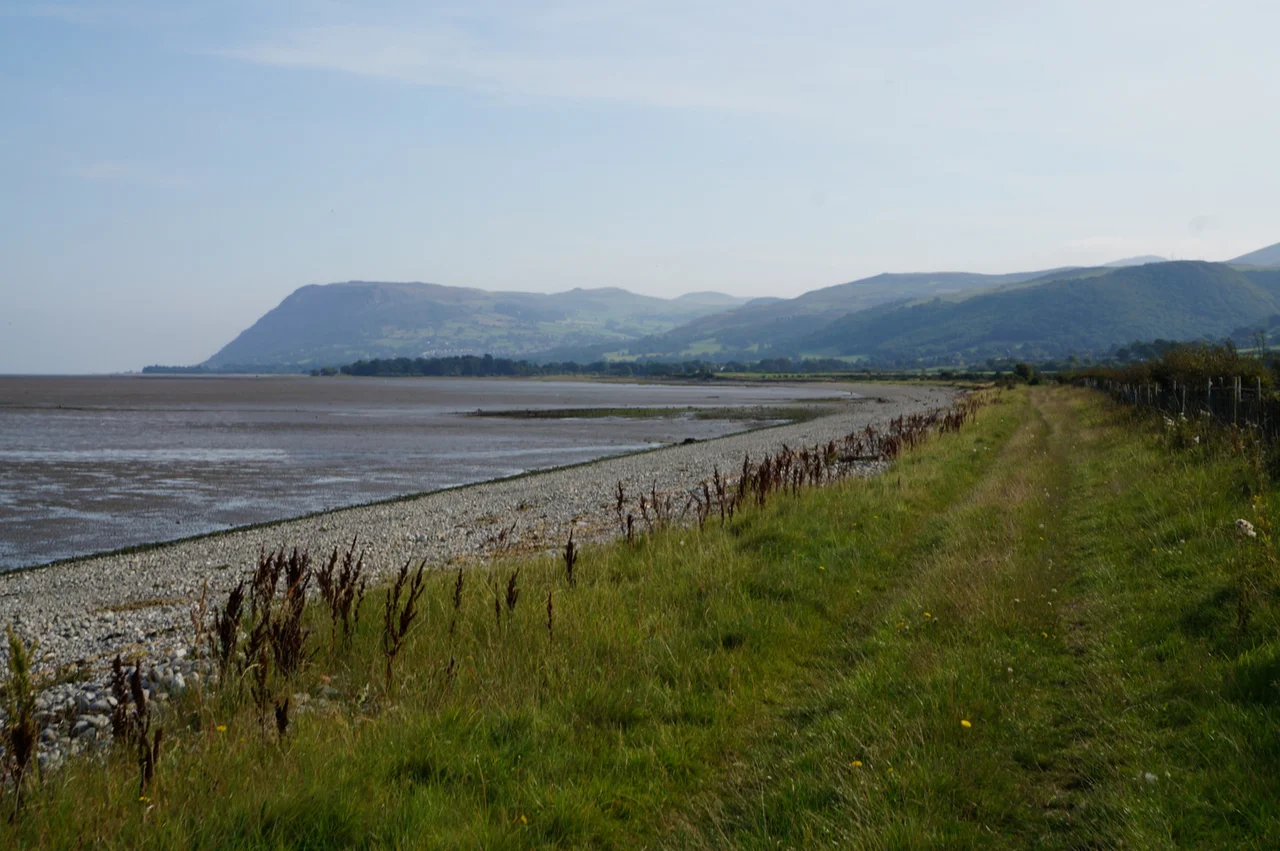
Y Dalar Hir was never the kind of battle that built monuments. The site - a strip of foreshore north-east of Llandegai, looking across the strait toward Beaumaris - is now grazing land and woodland. The Edge of Coed Gyfynys runs down to the water about where the cavalry charged. From the air the coastline looks suburban, with the A55 running past and Bangor's terraces a few miles southwest. But it was here that the last Welsh Royalist rebellion in the field was extinguished in half an hour, by a colonel who had marched all night with two field guns and a trooper who had the presence of mind to swing his sword over a knight's head when his own arm was tired.
From the Air
Located at 53.23°N, 4.06°W on the mainland shore of the Menai Strait north-east of Llandegai, between Bangor and Aber. Best viewed from 2,000-3,500 ft AGL on tracks paralleling the strait. The Britannia and Menai Suspension Bridges lie 3 nm to the southwest. Nearest airports: EGCK (Caernarfon Airport) 12 nm SW, EGOV (RAF Valley) 22 nm WNW. Watch for venturi acceleration of westerly winds through the Menai Strait at low level.
Nearby Stories
- Tudweiliog 3.6 km away
- Denbigh Castle and Town Walls 6.4 km away
- Rhoscolyn Lifeboat Station 7.6 km away
- Butlin's Pwllheli 20 km away
- East–West Interconnector 20 km away
- New Brighton Lifeboat Station 31 km away
- Battle of Oswestry 31 km away
- Celtic Array 44 km away