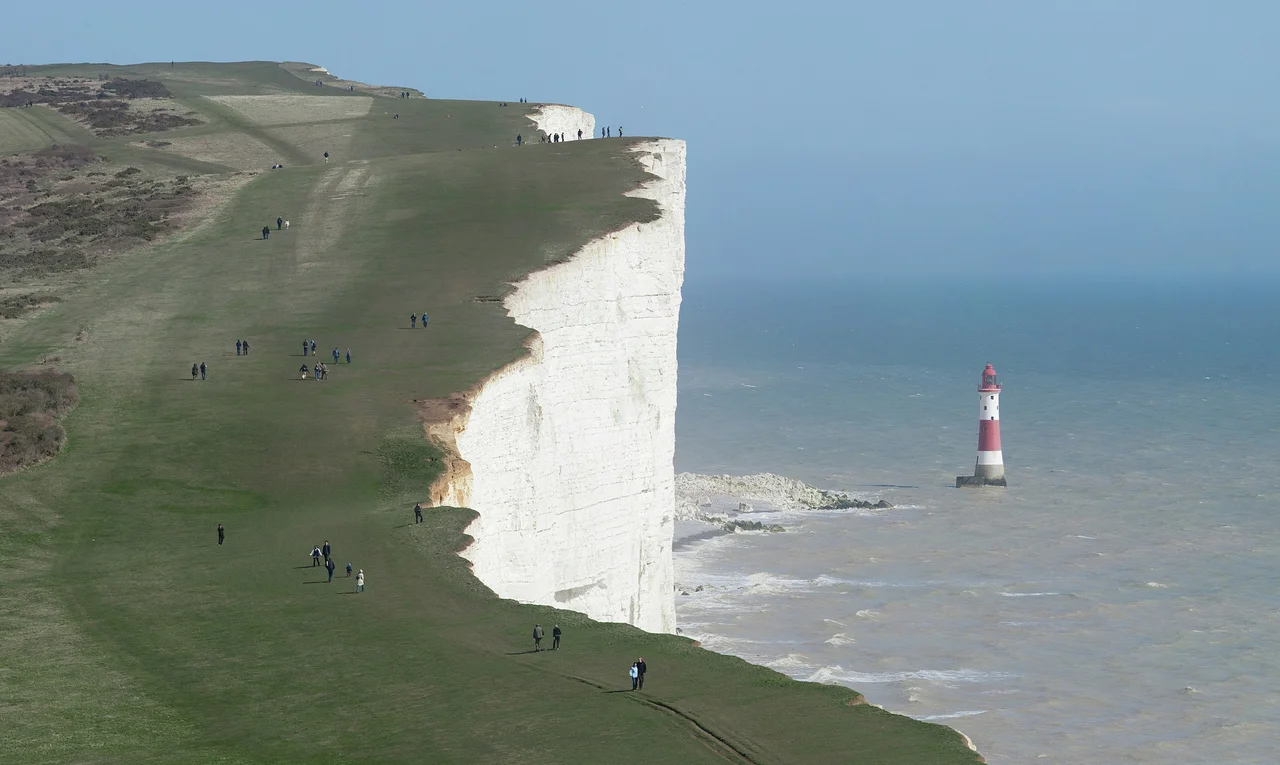

Beachy Head Lighthouse
The cliff above it is white. The lighthouse below it is striped, red and white, like a stick of seaside rock dropped at the bottom of a 162-metre drop. Trinity House built Beachy Head Lighthouse between 1900 and 1902 because the older Belle Tout lighthouse, perched on the cliff top three hundred metres away, kept disappearing into the sea mists that roll up out of the English Channel. The solution was almost a different kind of question: don't build it where you can be seen from the cliff, build it where you can be seen from the sea. They moved the light 165 metres out, set it on an iron platform at the water's edge, and went on to build, in 3,660 tons of Cornish granite, the last wave-washed masonry lighthouse Trinity House ever made.
The Cable Car Over the Cliff
Construction began under Sir Thomas Matthews, Trinity House's Engineer-in-Chief, in 1900. The site was the trickiest a Victorian engineer could reasonably ask for: a wave-battered tide platform at the foot of a chalk cliff with no road access, exposed to the full fetch of the English Channel from the south. Matthews's solution was straight out of the heroic age of British civil engineering. A temporary aerial ropeway - effectively a cable car - was rigged from the cliff top down to the construction site, slung on iron stanchions over the surf. Granite blocks quarried in Cornwall, shipped to Eastbourne, and hauled up to the cliff edge by horse and cart were then sent rattling down the cable to be set in place. The masonry itself was assembled course by course in the brief windows when the sea allowed. By October 1902 the tower was standing - finished, lit, and disconnected from the cliff once the cable car was struck down.
Explosives on the Gallery
The original light was a first-order revolving catadioptric optic made of three double panels, throwing two white flashes every twenty seconds across the Channel. The source was a paraffin vapour burner of Matthews's own design - kerosene mantled like a giant pressure lamp. But it was the fog signal that was strangest. Mounted on a jib on the lighthouse gallery, the apparatus held small explosive charges. When fog rolled in, the keepers would attach a charge with a detonator to each arm of the jib, winch it out into the wind, and trigger it electrically from inside the lantern. Every five minutes, an explosion. The point was simple: in dense fog, a bang carries when a horn does not. Ships in the Channel could hear Beachy Head before they could see it. The system continued until 1951, when both the explosive fog signal and the original black-and-white paint scheme were discontinued.
Stripes Worth Saving
When the colour scheme changed in 1951, the lighthouse got the red and white bands that gave it its postcard identity. For sixty years the stripes were repainted on a regular cycle, an obligation Trinity House discharged as part of the basic upkeep of British coastal aids to navigation. In 2011, with funding pressures mounting and modern ships relying on GPS rather than day marks, Trinity House announced that the painting programme would end. The lighthouse would be allowed to weather back to its natural granite grey. Eastbourne would not have it. A sponsored campaign - 'Save the Stripes' - launched in October 2011 raised the required £27,000 to repaint the tower. The work was completed within the same month, executed by abseilers swinging from ropes against the white cliff backdrop. Five coats went on the copper lantern at the top, three on each band. The stripes survived. The campaign quietly demonstrated that lighthouses are now as much landmarks of identity as of navigation.
The Brighter Sister
Beachy Head's role changed once more in 2018. When Trinity House decided to demolish the Royal Sovereign Lighthouse - a 1970s concrete tower on a shoal seven miles east, no longer viable to maintain - the Beachy Head light was strengthened to compensate for the loss. Its nominal range was extended to 16 nautical miles, covering ground the Royal Sovereign had previously held. The lighthouse you see today is, in effect, doing two jobs. From the cliff path above it, the tower looks small against the scale of the chalk wall behind. From the sea, with the cliff invisible in haze, it looks exactly the size you need it to be. Trinity House operates it now as an automatic, unmanned station. The keepers who once attached explosive charges to a jib are long gone.
A Cameo and a Falling Car
Some lighthouses earn their fame on the postcards. Beachy Head earned a piece of its from the cinema. In the 1968 film *Chitty Chitty Bang Bang*, when the magical car finally takes off, the cliff it drives off is Beachy Head and the lighthouse appears in the shot below as Caractacus Potts and his children sail away into the air. It also turns up in episodes of *The Prisoner* - 'The Girl Who Was Death' and 'Many Happy Returns'. None of which mattered to Sir Thomas Matthews, who simply needed a light that would not be lost in the mist. He built one out of Cornish granite, set it where the sea would wash its base every tide, and gave Eastbourne a striped landmark that the town fought to keep painted more than a century later. The stripes are still being repainted. The lights still flash. The chalk still falls.
From the Air
Coordinates 50.7338 N, 0.2415 E, in the surf at the foot of Beachy Head, about 2 nautical miles west-southwest of Eastbourne. The tower sits 165 metres seaward of the base of the chalk cliff and is unmistakable from any direction. Nearest airports: Brighton City Shoreham (EGKA) 19 nautical miles west, Lydd (EGMD) 22 nautical miles east-northeast. Recommended viewing altitude 1,500 to 3,500 feet AGL - the red and white stripes against white chalk give one of England's most photographed sea views. The Belle Tout lighthouse on the cliff top to the west and Birling Gap further along provide complementary landmarks.
Nearby Stories
- Ashdown Forest 12 km away
- Battle of Dungeness 21 km away
- Amberley Museum & Heritage Centre 25 km away
- Camber Castle 25 km away
- Charterhouse School 31 km away
- German Auxiliary Cruiser Komet 116 km away
- Cléon 128 km away
- D-Day: The Longest Day 138 km away