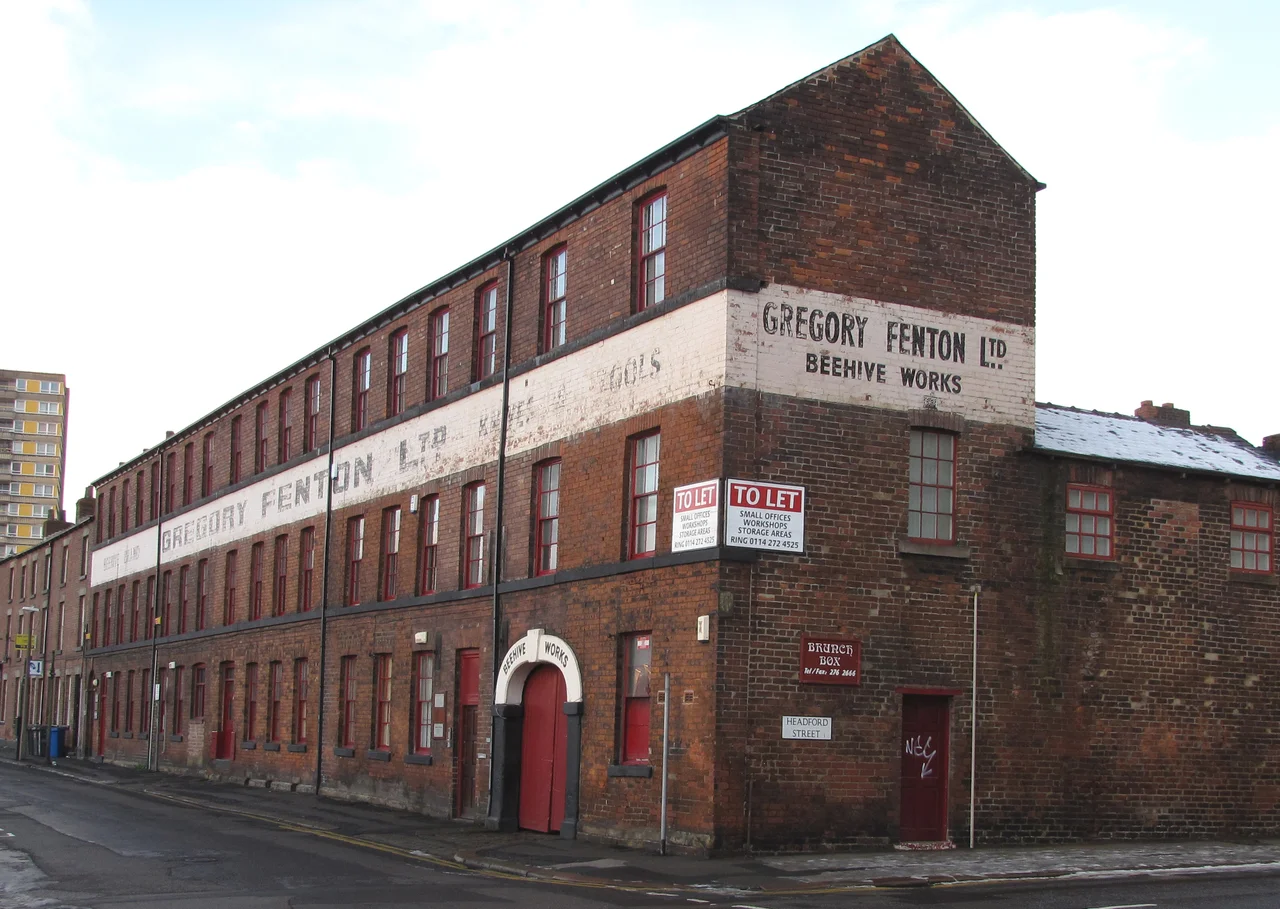

Beehive Works
Sheffield's cutlery industry was, for most of its history, not really an industry at all. It was a swarm. Tens of thousands of independent craftsmen - grinders, forgers, hafters, polishers - worked in tiny one-room workshops scattered across the city, each man master of one trade and one trade only. They were called little mesters, and they made the steel that travelled the world. The Beehive Works on Milton Street, in the Devonshire Quarter, was a purpose-built hive for them. Three storeys high and eighteen bays long, the building was put up in stages from the late 1850s, with a courtyard, a steam engine to drive the wheels, and external stairs leading separately up to each upper-floor workshop. The little mesters rented their space, paid for their power, and kept their independence. Their painted sign, 'Beehive Brand - Gregory Fenton Ltd - Knives and Tools', still runs along the upper storey today.
Steel City
By the second half of the nineteenth century Sheffield was the world's leading producer of crucible steel and the cutlery and tools made from it. The city had iron ore, coal, grindstone from the local Hallamshire sandstones, and water from the steep brooks running down from the Pennines - everything needed to make sharp things. It also had the trade structure: each task in turning a steel ingot into a finished knife was performed by a different specialist, often working alone in his own small shop. Bringing all those specialists under one roof, while leaving them independent, was the architectural problem the Beehive Works solved. The building's external stairs are the giveaway. Every workshop on the upper floors could be entered from outside without crossing anyone else's space. The little mesters were tenants, not employees.
Atkinson Brothers, In Mind
The first known occupants of the new works, in the early 1860s, were B. Mathewman and Sons, who called the building the Milton Works. By 1888 the Atkinson Brothers had taken over, making steel, cutlery, files and electroplated ware under the trade mark 'In Mind' - a punning rebus, presumably aimed at customers who would remember the brand. The Atkinsons did well. They expanded the works through the 1880s and 1890s, adding more grinding wheels, more forges, and enlarging the steam plant to drive them. They exhibited at the 1894 Antwerp International Exposition, a major shop window for European industrial goods, and floated as a registered company on the stock exchange in 1897. They stayed at the Beehive into the twentieth century. Their name disappeared eventually, but their architecture remained.
Bricks, Sashes and Stone
The building visible from Milton Street today is essentially as the Atkinsons left it. Red brick walls, eighteen bays long, three storeys plus cellars, ashlar stone dressings around the windows and doors, a slate roof. The windows are mostly twelve-pane sash, which lets in a usable amount of north light - critical for skilled handwork at the bench. An arched double-door cart entrance, with 'Beehive Works' carved into the lintel, leads off the street into the internal courtyards. Inside the yard, four-storey and three-storey workshop ranges stand with large casement windows on their lower floors and those telltale external stairs climbing the brick. The building is Grade II* listed, English Heritage citing it as a special architectural and historical example of Sheffield's metal trades. Next door stands Taylor's Eye Witness Works, another listed cutlery building of similar vintage. Together, the two make Milton Street the best surviving impression of what Sheffield's industrial heart looked like.
Gregory Fenton and the Quiet Survival
Atkinson Brothers gave way in time to other firms, and in 1968 a new company, Gregory Fenton Ltd, was formed by the merger of Gregory Brothers and Joseph Fenton. They took over the Beehive Works and made knives and tools there for decades. By the time the wider Sheffield cutlery industry collapsed in the late twentieth century, Gregory Fenton had shrunk to a small operation but still occupied part of the building, and still does today, though in much reduced capacity. The painted Beehive Brand sign on the frontage is theirs. The rest of the building is now subdivided into small offices, workshops and storage units - a magazine office, a corporate finance firm, a takeaway food shop, a metal-finishing service. It is not a museum. It is a working address. People come and go through the arched gateway as they have for a century and a half.
What the Quarter Holds
The Devonshire Quarter around Milton Street has remade itself in recent decades into one of Sheffield's most active independent districts - bars, music venues, vintage shops, restaurants, small studios - much of it occupying the city's old metal-trades buildings. Beehive Works is one of the survivors that gives the neighbourhood its bones. The cutlery industry that built it is mostly gone, but enough of the buildings remain that you can still read the working pattern: the courtyards, the external stairs, the painted signs, the cast-iron window frames. Stand on the cobbles outside the cart entrance and you can imagine the noise of a hundred grinding wheels and the smell of hot iron and oil, with the steam plant rumbling somewhere out of sight. The little mesters are gone. The building they shared is still standing, still in use, still wearing the brand of the firm that bought it in 1968 and refused to leave.
From the Air
The Beehive Works stand at 53.3757°N, 1.4793°W on Milton Street in the Devonshire Quarter of central Sheffield. From the air, this is the dense red-brick grid of central Sheffield, immediately west of the modern city centre and south of Sheffield railway station. The building is a long three-storey range with a slate roof, set among other Victorian industrial buildings. Recommended viewing altitude is 1,500 to 2,500 feet AGL; the ground is around 300 feet AMSL with the city's hills rising to around 600 feet to the west. Sheffield City Heliport (EGSY) lies about 1 nautical mile east, Doncaster Sheffield (EGCN) about 17 nautical miles east-southeast, East Midlands (EGNX) about 35 nautical miles south. Built-up urban airspace requires care; the Peak District boundary begins about 4 nautical miles west.
Nearby Stories
- Rochdale Pioneers Museum 3.4 km away
- Adlington Hall 4 km away
- National Coal Mining Museum for England 4.2 km away
- Sneyd Colliery Disaster 6.6 km away
- Southwell Minster 6.8 km away
- Belper North Mill 9 km away
- Selby Rail Crash 13 km away
- RAF Finningley 15 km away