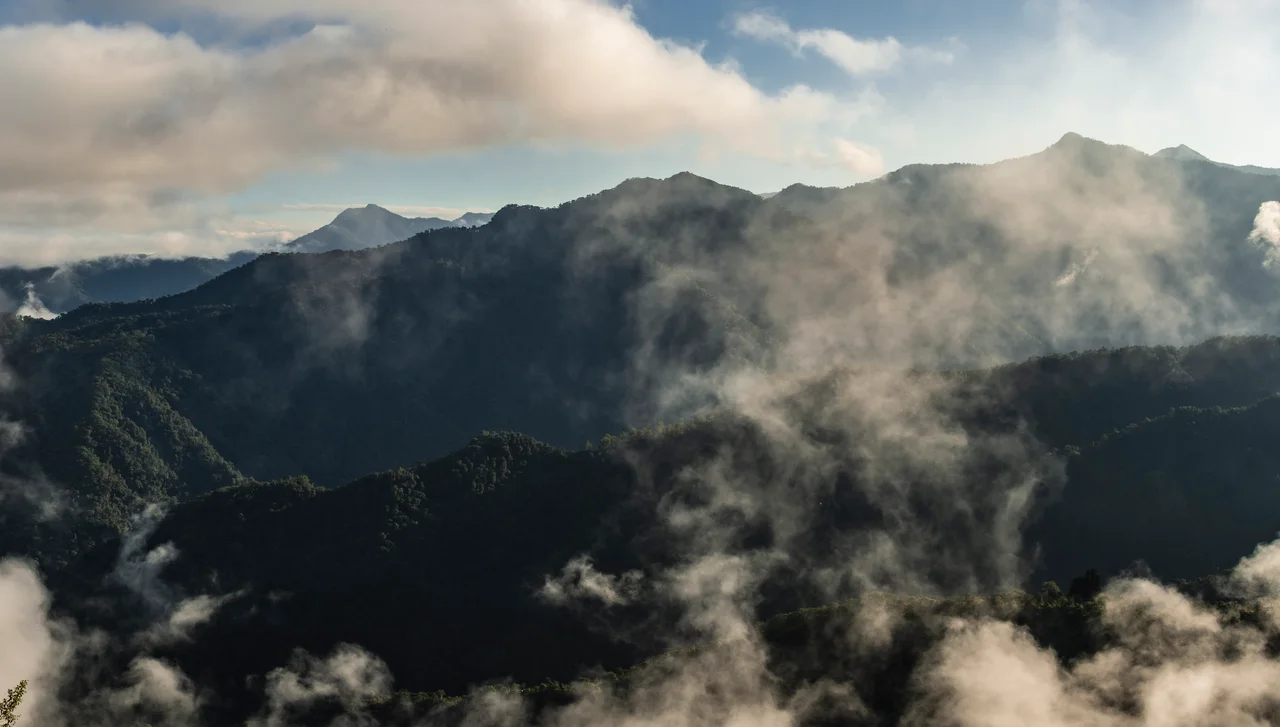

Bellavista Cloud Forest Reserve
Richard and Gloria Parsons bought their first 136 acres of cloud forest in 1991, built a geodesic dome by hand with local architects, and hoped birdwatchers would come. Thirty-five years later, their reserve has grown to 2,000 acres, hosts more than 330 bird species, and has won the Audubon Christmas Bird Count for the Americas three times. The experiment in private conservation worked. What none of them could have predicted was how much of the surrounding forest would need their protection to still exist.
Clouds That Walk
Cloud forest is a particular kind of ecosystem. Unlike the lowland Amazon, which runs wet and hot, or the alpine paramo, which runs dry and cold, cloud forests occupy a band between 900 and 2,500 meters where moisture comes not mainly from rain but from cloud that moves through the canopy as a persistent mist. At Bellavista, perched at 2,000 meters on the northwestern slopes of the Andes in Pichincha Province, the clouds are often thicker than rain. They drift through the branches, condense on leaves, drip from moss, and saturate the air. The result is biodiversity of extraordinary density. The New York Botanical Gardens has noted that cloud forests of Ecuador, Colombia, and Peru hold more epiphyte diversity - air plants growing on other plants - than anywhere on the planet.
The Orchid Math
Ecuador contains more than 4,200 identified orchid species. That figure represents more than ten percent of all orchid species worldwide, packed into a country smaller than the state of Nevada. Bellavista sits within one of the richer pockets. Orchids here grow as epiphytes on tree trunks, on mossy rocks, and at ground level in dappled shade. Many are tiny - a single blossom smaller than a fingernail. Others hang in festoons from branches high overhead. The reserve belongs to the Choco-Andean biodiversity hotspot, which stretches from southwestern Colombia into northwestern Ecuador and ranks among the most biologically rich regions on Earth. In 1997, BirdLife International designated the Mindo area as the first Area of International Importance for Birds in South America. Bellavista sits on its southern edge.
The Hummingbird Parade
Hummingbirds in the cloud forest are not a glimpse but a constant presence. Feeders at Bellavista attract a parade: lesser violetears, sparkling violetears, buff-tailed coronets, gorgeted sunangels, Andean emeralds, purple-bibbed whitetips, speckled hummingbirds, white-booted racket-tails with their distinctive tail shafts trailing behind them like kite tails, violet-tailed sylphs, and purple-throated woodstars. All share space within a few square meters, hovering and diving and chittering in territorial skirmishes. Beyond the hummingbirds are the tanager-finch, giant antpitta, swallow-tailed nightjar, plush-capped finch, beautiful jay, white-faced nunbird, plate-billed mountain-toucan, and toucan barbet. Nearby leks gather the Andean cock-of-the-rock - a bird so brilliantly scarlet it seems to have been painted on.
The Dome
The four-story geodesic dome that anchors the reserve is itself a peculiar landmark. Richard Parsons designed it with local architects in 1991, and the construction proved harder than expected - precise wood fittings, carefully measured glass panels, all of it fitted together by hand. The structure contains a restaurant, viewing platforms, and further accommodation. Guesthouses have been added over the years: the German House, the Trailhead House, Gloria's Honeymoon House. Ten kilometers of trails radiate from the central lodge through forest dense enough that the sun rarely reaches the ground. The reserve has been certified through Rainforest Alliance and Smart Voyager as an eco-lodge. It is a founding member of the Network of Private Protected Forests of Ecuador.
Science on the Edge of Understanding
Bellavista also serves as a research base. The Payamino Project, launched in 2002 in partnership with the San Jose de Payamino indigenous community in the Ecuadorian Amazon and Aalborg Zoo in Denmark, brings students and scientists from Glasgow, Manchester, Aarhus, and Aalborg universities. Their surveys have documented more than 330 bird species in the area and at least 60 native frog species. Mammals recorded in the reserve include the endangered spectacled bear, the puma, the Andean coati, and the tayra - a sleek black mustelid that looks like a cross between a weasel and an otter. Much of what grows and moves here remains formally unstudied. Cloud forests are not places where inventories are ever truly complete.
From the Air
Coordinates 0.02 S, 78.68 W. Elevation 2,000 meters. Located 52 km northwest of Quito on the western slopes of the Andes, within the Choco-Andean biodiversity hotspot. Frequent cloud cover limits aerial visibility; best viewed between 9,000-13,000 feet on clear mornings. Nearest major airport: Mariscal Sucre International (SEQM) east of the reserve.
Nearby Stories
- History of Ecuador (1830-1860) 7.8 km away
- Baeza 22 km away
- Illiniza 38 km away
- Quinindé Canton 45 km away
- Guandera Biological Station 60 km away
- Sumaco Napo-Galeras National Park 64 km away
- La Mana 67 km away
- Jatun Sacha Foundation 85 km away