
Ben Het Camp
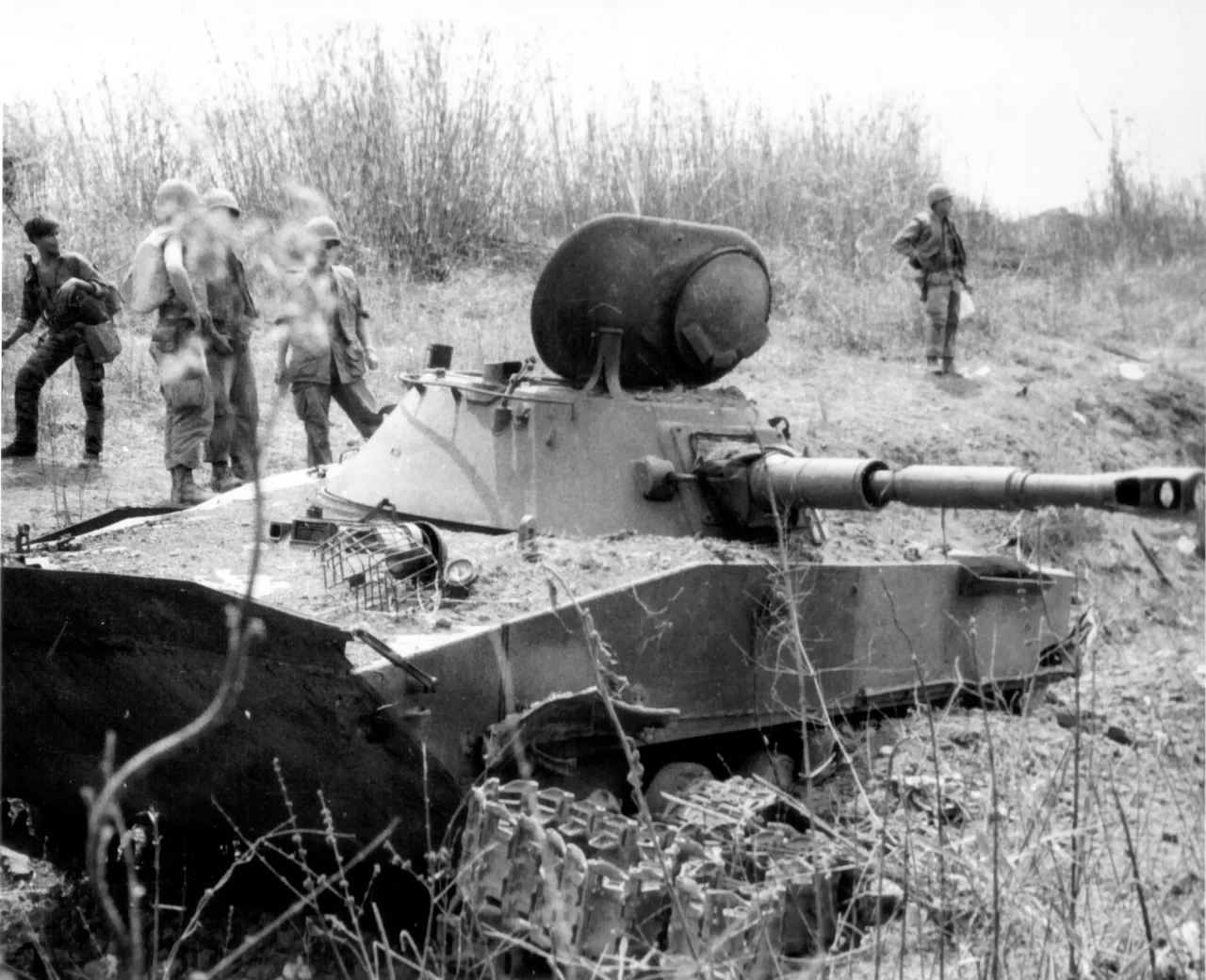
On the night of 2–3 March 1969, two North Vietnamese PT-76 amphibious tanks rolled out of the jungle toward the perimeter wire at Ben Het Camp. Waiting for them, in the dark, were American M48 Patton tanks from the 1st Battalion, 69th Armor. What happened next was unique in the entire Vietnam War: a tank-versus-tank battle, two mechanized forces exchanging direct fire on ground that had once been a hill tribe village. Two PT-76s were destroyed. The engagement lasted less than an hour. But those few minutes cemented Ben Het's place in history as the only location in Vietnam where U.S. and North Vietnamese armor met in direct combat — a single sharp moment at the end of a very long road from the Laotian border, thirteen kilometers away.
Hill Tribe Village to Special Forces Outpost
Ben Het's transformation from indigenous settlement to military base began in the early 1960s, when 5th Special Forces Group Detachment A-244 established a presence here to watch the Ho Chi Minh Trail. The location was chosen with cold precision: it sat 13 kilometers from the point where Vietnam, Laos, and Cambodia meet, directly astride infiltration routes that North Vietnamese logistics units used to push supplies south. The hill tribe people who had lived here — Montagnard communities who the Special Forces recruited and trained as Civilian Irregular Defense Group fighters — became both the base's first residents and its first defenders. By early 1969 the camp held roughly 440 CIDG personnel, 511 ARVN soldiers, 207 artillery troops, and 25 American advisers. They all knew the North Vietnamese were probing the perimeter. What they could not know was how they would come.
The Night the Tanks Came
North Vietnamese armor had been spotted near the camp as early as November 1968, when a helicopter pilot from the 7th Squadron, 17th Cavalry Regiment reported four unidentified tanks to the west. The report went unconfirmed. The 4th Infantry Division filed it and kept watching. Then in early 1969 the PAVN's 202nd Armored Regiment moved into position, and on the night of 2–3 March the attack came. PT-76 tanks — Soviet-designed, lightly armored but highly mobile — crossed the defensive wire. The M48 Pattons from the 1/69th Armor, stationed at the camp specifically because armor attacks had been anticipated, met them head-on. Two PT-76s were destroyed by the Pattons; a third was taken out by M72 LAW rockets fired by infantry. The engagement was brief and decisive. It was also, in the broader context of the war, almost freakishly rare: the landscape of Vietnam — its rice paddies, its jungle ridges, its narrow mountain roads — was hostile to armor, and the two sides simply had not met tank-to-tank anywhere else.
Siege, Survival, and Eventual Fall
Ben Het's story did not end with the 1969 engagement. For months afterward the camp endured sustained siege conditions: rocket attacks, mortar barrages, and constant probing by PAVN infantry. Over 100 airstrikes, including B-52 strikes, supported the garrison. The camp held. When U.S. forces withdrew and the base passed to the ARVN 85th Border Rangers, the defenders inherited both the fortifications and the threat. In early October 1972, the PAVN 320th Division turned its attention to Ben Het. On 12 October a barrage of approximately 1,500 rounds of artillery, rockets, and mortars struck the camp in a single day — destroying the defenders' artillery, ammunition reserves, and food supplies. The 300-man garrison took 60 dead and 120 wounded in the initial assault alone. Radio contact was lost that night. The following morning, friendly aircraft spotted approximately 140 survivors moving southwest through the jungle. Airstrikes destroyed what equipment remained. Ben Het, after a decade of resistance, was abandoned.
A Field Where Something Unprecedented Happened
The men who fought at Ben Het — the Montagnard CIDG fighters who had given up their village, the South Vietnamese border rangers, the American tankers who rolled their Pattons into the dark — were caught up in a war whose geography and nature made their particular engagement almost impossible to replicate. Tanks were not supposed to fight here. The jungle was not built for armored warfare. And yet for a few minutes in March 1969, on a piece of ground that had been a village within living memory, the war's two largest military forces met in the oldest kind of combat: machine against machine, crew against crew. The camp today is farmland and housing, the perimeter wire long rotted away. The two destroyed PT-76 tanks have been photographed, studied, and written about. The men who crewed the Pattons have given interviews. The hill tribe families who lived here before any of it started left fewer records.
From the Air
Ben Het Camp sits at 14.688°N, 107.661°E in western Kon Tum Province, approximately 53 km northwest of Kon Tum city and 15 km northwest of Đắk Tô. The site is 13 km from the Vietnam-Laos-Cambodia tri-border area — one of the most strategically sensitive corners of mainland Southeast Asia. At 5,000–8,000 feet, look for the flat former base footprint amid hilly forested terrain; the former airfield is visible as cleared agricultural land. The nearest airports are Pleiku (VVPK, ~95 km south) and Attapeu Airport in Laos to the northwest. The Ho Chi Minh Trail corridor runs through the hills immediately to the west.
Nearby Stories
- Operation MacArthur 5.1 km away
- Măng Đen 8.7 km away
- Kon Ka Kinh National Park 13 km away
- Virachey National Park 27 km away
- Ngọc Linh 28 km away
- Battle of Hill 488 44 km away
- 2018 Laos Dam Collapse 68 km away
- Veun Sai-Siem Pang National Park 91 km away