.jpg)
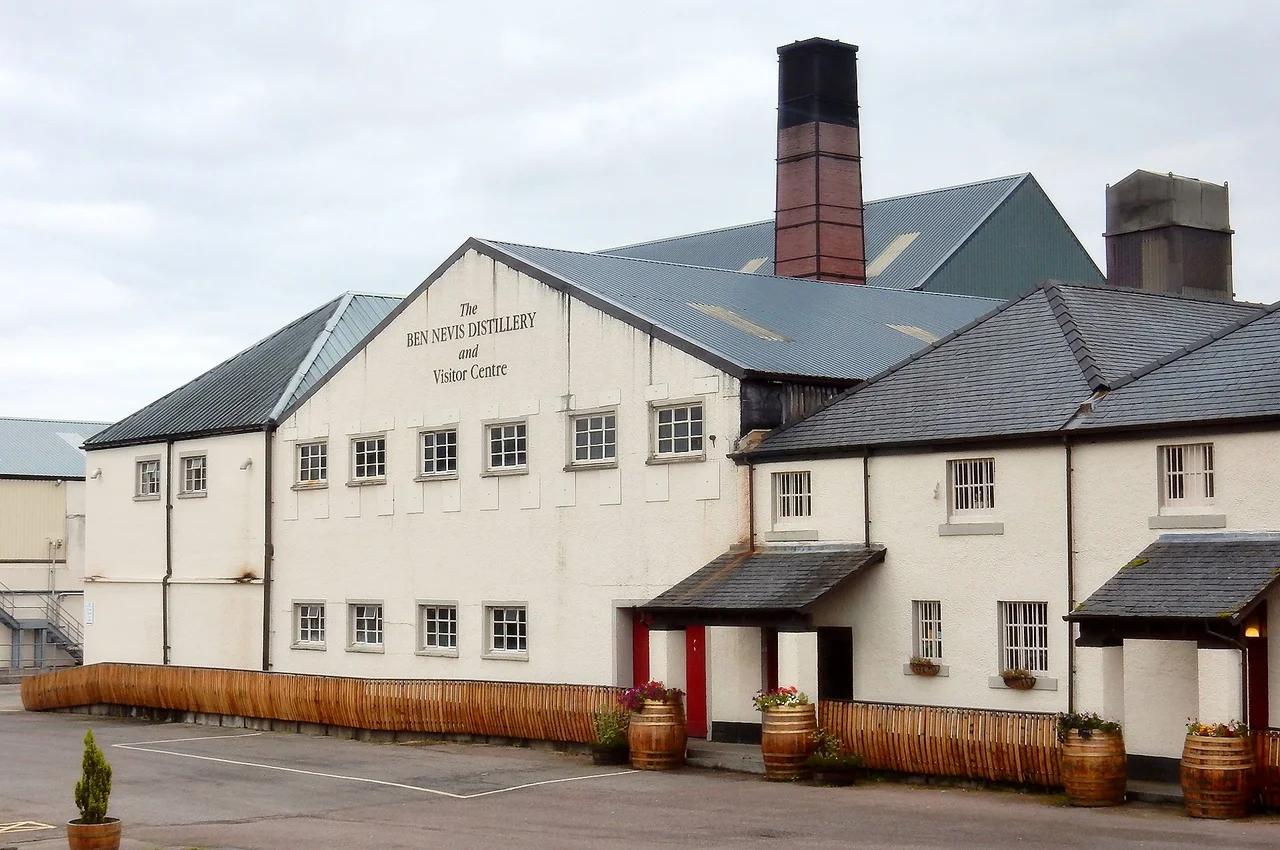
Ben Nevis Distillery
Long John McDonald stood six feet four inches tall in an era when most Highlanders did not, and the nickname stuck so thoroughly that an entire blended Scotch eventually carried it. In 1825, he founded a distillery in the shadow of Britain's highest mountain and began making whisky from snowmelt. Two centuries later, the still-houses at the base of Ben Nevis still steam in the rain. The owners now report to Tokyo. The water still comes from Coire Leis and Coire na Ciste, two pools on the north face of the mountain that drain into the Allt a' Mhuilinn. Some things change. Some things, in the Highlands, do not.
A Highlander Named for His Height
Long John McDonald claimed descent from a ruler of Argyll, the old western Scottish kingdom that once stretched from Kintyre to the Hebrides. Whether the lineage was real or polished for marketing hardly mattered: at six feet, he physically towered over his customers and competitors, and the legend grew naturally around him. He picked his ground carefully. Fort William sat at the head of Loch Linnhe, at the foot of the Great Glen, with the highest mountain in Britain rising directly behind it. The water that fell on Ben Nevis as rain and snow filtered down through a thousand metres of granite and peat before reaching his stills. He died in 1856 and passed the distillery to his son Donald. The blended Scotch named Long John, sold worldwide today, traces its name back to him.
Two Distilleries, One Roof
By 1878, demand had grown so much that a second distillery, named simply Nevis, opened next door. For a few decades, two whisky operations ran side by side at the foot of the mountain, drinking from the same burn, breathing the same damp Highland air. In the early twentieth century they merged into one. The arrangement made sense. Cooperage, warehousing, water rights, peat supply, all of it cost less when shared. Joseph Hobbs took control in 1955, the latest in a chain of owners trying to make Highland malt pay through depression, war, and the slow consolidation of the Scotch industry. In 1989, the distillery passed into a more surprising hand: Nikka Whisky Distilling of Tokyo, founded by Masataka Taketsuru, the Japanese chemist who had first studied whisky-making at Hazelburn in Campbeltown in 1919.
The Water from Ben Nevis
Coire Leis and Coire na Ciste sit high on the north face of Ben Nevis, two glacial pools fed by snowmelt and the relentless Atlantic rain that defines the western Highlands. From them, water drops through the Allt a' Mhuilinn, a burn running down the mountainside toward Fort William and Loch Linnhe. The distillery still draws from this stream, just as Long John did. The water arrives soft and slightly peaty, having passed through layers of moss and granite. It is the kind of provenance that whisky marketing departments now build entire campaigns around, but at Ben Nevis it is simply how the place works. The mountain rains. The water comes down. The barley waits.
From Cask to Cafe
A visitor centre opened in 1991, a modest concession to the tourist economy that Fort William had been building since the railway arrived in 1894. The ten-year-old single malt remains the heart of the range, supplemented by cask-finishes, limited editions, and independent bottlings from outfits like Blackadder and Douglas Laing that buy casks young and release them years later under their own labels. The whisky is rich, slightly oily, with the maritime character that Western Highland malts often carry from sea-air-aged warehouses. Coach parties on the A82 stop in for a tasting before driving north to Inverness or south to Glencoe. The cafe sells tablet and shortbread. Somewhere upstairs, casks sleep in the dark, waiting their decade out.
From the Air
Ben Nevis Distillery sits at 56.8351 degrees North, 5.0739 degrees West, on the outskirts of Fort William at the foot of Ben Nevis, whose summit at 1,345 metres (4,413 feet) is Britain's highest point. The nearest airport is Oban (EGEO) about 40 nautical miles south, though most visiting traffic uses Glasgow (EGPF) about 100 nautical miles south. Inverness (EGPE) lies 60 nautical miles northeast at the other end of the Great Glen. Best viewed at 3,000 to 5,000 feet AGL to see the distillery, Fort William, and Ben Nevis together; in clear weather the snow-streaked north face is visible from much higher. Western Highland weather is famously wet, with low cloud frequent year-round.
Nearby Stories
- Morvern 4.8 km away
- Gavin Maxwell 5.7 km away
- Lochaber 6.5 km away
- Ben Alder 8.6 km away
- Meggernie Castle 13 km away
- Battle of Glen Shiel 14 km away
- Foyers hydropower schemes 16 km away
- Castle Stalker 18 km away