
Birao
The name of the disciplinary cells in Ngaragba Prison was Birao. That was not a coincidence. For decades under Jean-Bédel Bokassa, the Central African ruler of the 1960s and 1970s, Birao was a word that meant exile - a place so far from Bangui, so cut off from roads and news and allies, that sending a person there was a kind of erasure. When Bokassa's rival Alexandre Banza tried to overthrow him, Birao is where Banza's wife and nine children were sent, to be monitored until 1970. When Bokassa himself fell and his execution sentence was commuted, the government considered sending him to Birao, precisely because the town's remoteness would keep him from his political allies.
A Post on the Far Edge
The French colonial government founded Birao on November 6, 1918, as its northernmost outpost in Ubangi-Shari - the territory that would become the Central African Republic. You can still see the logic in the geography. Birao sits in Vakaga prefecture, roughly equidistant between the borders with Chad and Sudan, on a hot semi-arid plain that has more in common with N'Djamena and Niamey than with the forested south of the country. Every month here has an average maximum over 30 degrees Celsius. In March and April, before the wet season breaks, highs average 39.7 degrees. The town was always going to be difficult to reach, and that difficulty has shaped everything that came after.
Burned Down
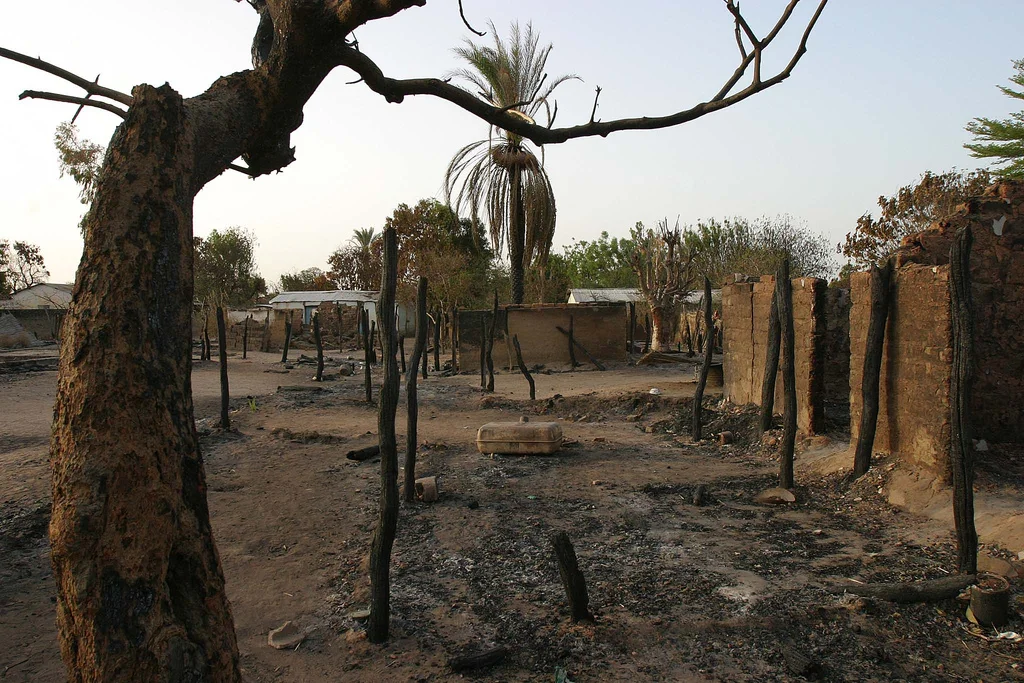
In March 2007, Birao was almost completely burned down. The Union of Democratic Forces for Unity had attacked French and Central African forces holding the town. The French had been bombing the area since December 2006 with Mirage F1 fighters and helicopter gunships. A Spokesman described the raids as 'in line with international calls to stabilise the region.' Rebel reports described the raids' effect on civilians. An archival photograph from the following year shows a boy standing beside a scorched lamp, the caption noting only that the town was almost completely burnt down. He is the grandson of no general, the subject of no dispatch. His home was the news.
The Militia Years
A peace agreement signed in Birao in April 2007 did not end the cycle. The Convention of Patriots for Justice and Peace took the town later that year. International forces left in June 2014 under ultimatum from the FPRC. In July 2019, clashes between MLCJ and FPRC fighters killed at least four militiamen and saw two detainees executed. In September, MLCJ captured the town at a cost of 23 FPRC and eight of their own fighters. Two weeks later, a counter-attack killed another 37 FPRC and 11 MLCJ. In February 2020, 12 FPRC militants died attacking MINUSCA peacekeepers. In March 2022, Russian mercenaries from the Wagner Group entered briefly. By December 2022, they had established a permanent base. Each line of this history is a number. Behind each number, residents who kept living here, between militias, between agreements, between the arrival of outsiders who called themselves solutions.
Donkeys in the Rain
The roads into Birao are terrible, and rebel presence along them is the main reason they never get fixed. In the wet season, from May to September, even the tracks that exist become impassable. Donkeys and horses are the main transportation within town. Residents prefer donkeys because they are cheap and easy to care for. The town has primary and secondary schools, but too few teachers and too few classrooms for the children who want to attend. Central African armed forces are present but logistically limited. Most townspeople own personal weapons, because the security situation leaves them no other reliable option. To read these dry notes is to understand that Birao is a town where daily life has been reorganized, over decades, around the absence of the state - and, as often, around the predations of whichever armed group currently claims to represent it.
A Town That Persists
And yet people live here. They grow up, marry, bury their dead, send their children to school when there is a school, trade across the nearby Sudanese and Chadian borders when the borders allow it. The Mbomou and the Chari watersheds meet not far from here; the caravan routes that once brought traders from Tripoli to Bangassou still ghost across the plains. Birao has been a colonial garrison, an exile town, a battlefield, a humanitarian emergency, a proxy ground for the geopolitics of Darfur, a Wagner Group base. What it has never stopped being, through all of this, is a home. The children in the archival photographs grew up. Some stayed. Some left. The lamp that the boy stood beside is gone. The town, stubborn and battered, is still here.
From the Air
Birao sits at 10.29°N, 22.78°E in northeastern Central African Republic, approximately 800 km northeast of Bangui and 120 km south of the Chadian border. The landscape below is hot semi-arid savanna in the dry season, green and flooded in the rains. Cruising at 15,000 feet reveals the unpaved tracks radiating out from the town, the seasonal streams that cut through the plain, and - in clear conditions - the nearby borders that have shaped so much of Birao's history. Nearest airport: Birao Airport (ICAO: FEFI), a basic strip used by humanitarian flights. Larger hubs: Bangui M'Poko International (ICAO: FEFF) to the southwest; Abéché (ICAO: FTTC) across the Chadian border.
Nearby Stories
- Central African Republic–Chad border 48 km away
- Ouanda Djallé 125 km away
- Manovo-Gounda St. Floris National Park 183 km away
- Zakouma National Park 275 km away
- Marrah Mountains 291 km away
- Liffi 310 km away
- 2025 Tarasin landslide 333 km away
- Central African Republic 421 km away