.jpg)
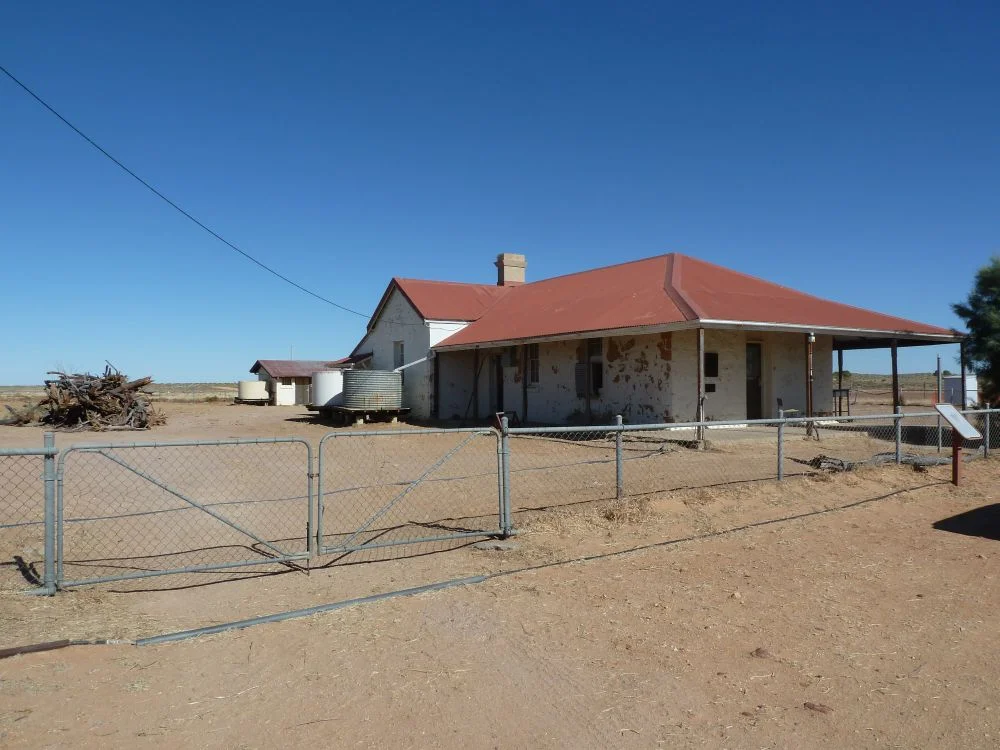
Birdsville Courthouse
Twice the desert tried to erase this place by force. In 1904 a violent storm left the police station 'completely wrecked,' and on a February day in 1954 a whirlwind tore the old cell block to the ground. In between, prisoners were simply chained to a post in the yard. The little stone courthouse on Adelaide Street absorbed all of it and stood. Built between 1888 and 1890, it was Queensland's attempt to fix the rule of law to a corner of the continent so remote that the law often had to be carried in on the back of a camel.
A Border Post at the End of the Map
Before Federation knitted the Australian colonies together in 1901, the lines between them were real economic borders, walled by tariffs and watched by customs men. Birdsville - first known as Diamantina Crossing, sitting at a permanent waterhole on the stock route between Queensland and South Australia - became one of fourteen pre-Federation border posts. Duties were levied on cattle and goods crossing into the colony, and that money needed an officialdom to collect it and courts to enforce it. The township was gazetted in 1885; the courthouse and its police complex followed by 1890, built of local stone cut in blocks because there was almost no timber to be had. It survives as one of only three masonry buildings left from old Birdsville, alongside the Birdsville Hotel and the former Royal Hotel.
Justice by Camel
Policing a beat the size of a small country demanded unusual transport, and in 1886 camels arrived in Birdsville to do the work horses could not. The first six came from India in poor condition - only four survived the early months - but the survivors proved their worth, carrying officers hundreds of kilometres to collect statistical returns and chase reports across waterless country. One tracker was given charge of the station's camels. The image is worth holding onto: in the 1890s, the long arm of Queensland law in this district reached out at the swaying pace of a camel, across gibber and dune, between station and waterhole, in heat that could kill the unprepared.
The Trackers
The police complex's most skilled members were Aboriginal trackers, and their record here is long and remarkable. An Aboriginal tracker was stationed with the first contingent of officers in 1884, and two men in particular gave the institution its continuity. Tracker Billy served from 1885 to 1905; Corporal Tommy served from 1905 to 1952 - nearly half a century reading country that white officers could not. These men possessed an intimate knowledge of land that was, in many cases, their own people's country - the lands of the Wangkangurru and Yarluyandi - and the colonial system depended on their expertise even as it offered them little in return. A separate tracker's hut once stood at the rear of the station; a storm destroyed it in 1985. The complex that remains is, in part, a memorial to their work.
Still Holding Court
What stands today has changed little in shape: an L-shaped stone building with the courtroom in one wing, its bench at the rear, wrapped on three sides by verandahs since enclosed against the heat. A modern police station opened next door in 1988, but the old courthouse never quite retired. For years it served as overflow accommodation during the Birdsville Races, when the town's single hotel could not hold the crowds and extra police were posted in to keep order. In one delightfully outback footnote, scientists from Nagoya University in Japan were granted permission in 1995 to install recording equipment in the surviving lockup. Frontier justice, then a guest room, then a laboratory - all in one small stone building that the desert twice tried, and twice failed, to bring down.
From the Air
Birdsville Courthouse stands on Adelaide Street at about 25.900°S, 139.348°E, near the town centre and a short walk from the Birdsville Hotel. The nearest airfield is Birdsville Airport (ICAO YBDV, IATA BVI), elevation roughly 159 ft, just west of town with a single sealed runway 14/32. Regional alternates include Windorah (YWDH) and Boulia (YBOU). From the air the courthouse reads as one of a tight cluster of pale and corrugated-iron buildings along a single main street, set where the channels of the Diamantina River thread between red Simpson Desert dunes and stony gibber plain. Best viewed in the cooler months; summer brings extreme heat, dust haze, and few services for diversion.
Nearby Stories
- Annandale Station 3.4 km away
- Eromanga Sea 11 km away
- Carcory Homestead Ruin 50 km away
- Koonchera Point Massacre 56 km away
- Munga-Thirri National Park 86 km away
- Cordillo Downs 90 km away
- Munga-Thirri–Simpson Desert National Park 99 km away
- Currawilla 154 km away