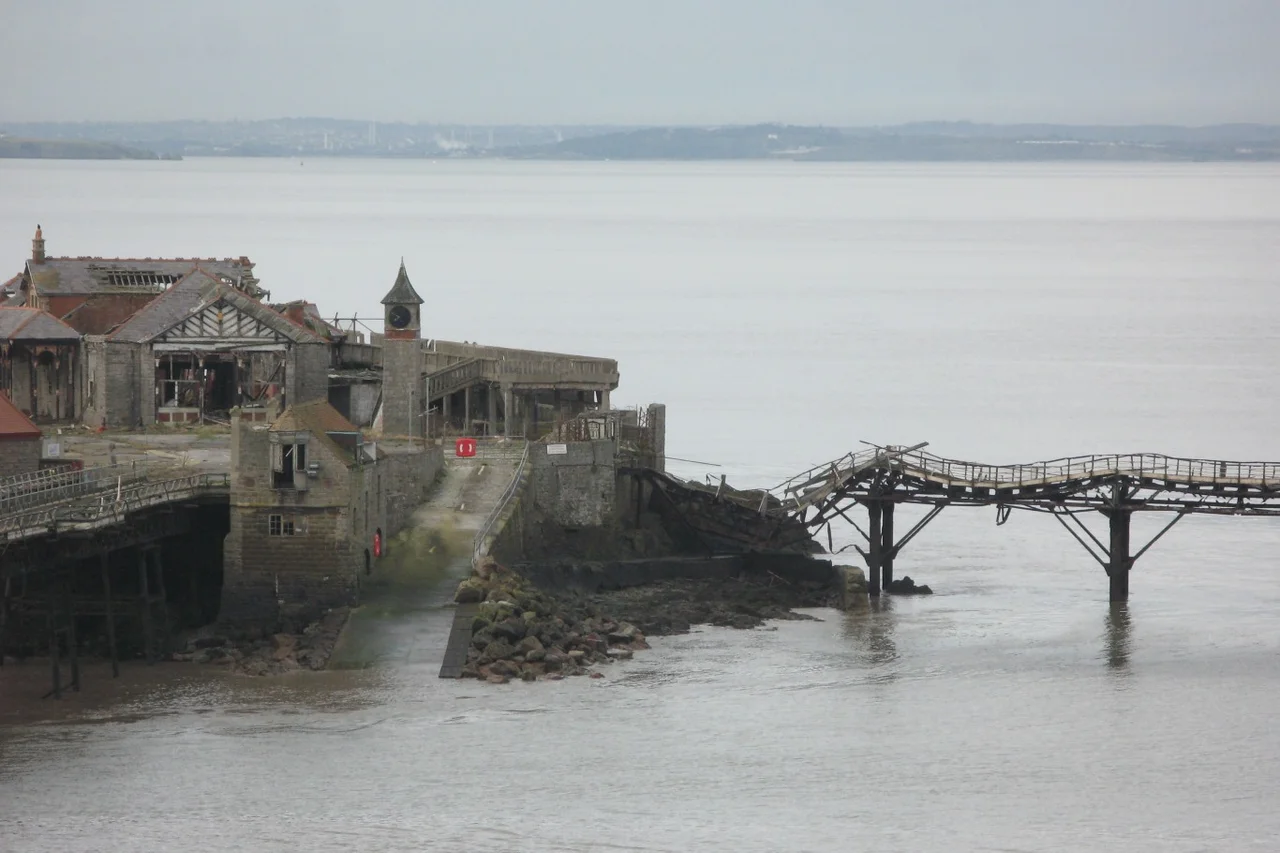

Birnbeck Pier
In May 2019, two brothers named Neil and Ryan Andrews tried to steal the clock face from the tower at the end of Birnbeck Pier. They got eighteen months each at Bristol Crown Court. The judge, sentencing them, noted that the tower and clock they had vandalised had survived a great fire in 1897, an attack by the Luftwaffe in the Second World War, and the accidental explosion of a sea mine - and that the Andrews brothers would always be remembered as the two men who finally damaged what storms and bombs could not. The clock no longer works. The pier no longer carries visitors. The lifeboat station that used to launch from the island has gone to Knightstone Harbour. But the structure still stands, mostly, 1,040 feet of cantilevered iron and lattice girder reaching out into the Bristol Channel to a 1.2-hectare lump of limestone called Birnbeck Island - the only pier in Britain that links the mainland to anywhere.
The Bridge That Came First
Long before the pier there was a plan for a bridge. Birnbeck Island sits just off Worlebury Hill on the north edge of Weston-super-Mare, accessible at low tide by a natural causeway across a band of limestone rocks. In 1845 a proposal was made to span the gap with a suspension bridge designed by James Dredge of Bath. Dredge had patented the taper principle, using chains rather than cables - an unusual short-lived phase in the history of suspension bridge engineering. Work began in 1847. Then the stonemasons went on strike. A storm hit while construction was suspended and damaged what little had been built. The scheme collapsed. For sixteen more years the island remained a curiosity, reachable only by foot at low water and only by boat at high. In 1864 a new proposal was made: not a bridge but a pier.
Eugenius Birch's Screw-Pile Innovation
The pier company raised 20,000 pounds through 2,000 shares and hired Eugenius Birch, the most prolific pier engineer of the Victorian age. Birch's signature innovation was the screw pile: instead of driving wooden piles into the seabed, he bolted iron piles with helical blades to the bottom of the channel, screwed into rock and mud like enormous corkscrews. The result was a foundation system that resisted the brutal tides of the Severn Estuary - whose tidal range, second only to the Bay of Fundy in Eastern Canada, exposes the legs of Birnbeck at low water and submerges them twice each day. Fifteen groups of piles, four piles per set, X-braced together with iron crossbars, supported a continuous lattice girder deck 1,150 feet long and 20 feet wide. The foundation stone was laid on 28 October 1864 by Cecil Hugh Smyth Pigott, the four-year-old son of the lord of the manor. The town declared a public holiday and held a banquet at the town hall.
Steamers and Sideshows
The pier opened on 5 June 1867, again with the now seven-year-old Cecil Hugh Smyth Pigott officiating. The toll was a penny, raised quickly to two pence under the General Pier and Harbour Act 1861. In the first three months 120,000 people paid to walk it. A tramway carried passenger luggage. A landing jetty extended off the western side of the island to allow paddle steamers to disembark day-trippers from Cardiff, Newport and Bristol - the White Funnel fleet of P and A Campbell operating the busiest service. Most visitors never left the pier itself. The island held a cafe, a pavilion, a funfair, a shooting gallery, mutoscopes that flicked photographs into moving images for a penny, a merry-go-round, a theatre of wonders and a licensed bar. A fire on Boxing Day 1897 destroyed most of it; local architect Hans Price designed the replacement buildings, including the gothic toll house, the pier-head buildings and the clocktower that the Andrews brothers would later try to steal. In 1891 the pier got a telephone, six months after the first one in town. Bands marched on the pier on opening day and oscillated the structure so alarmingly that a law was passed banning marching.
HMS Birnbeck
In 1941 the Admiralty took over the pier. It was commissioned as HMS Birnbeck - a stone-frigate, in naval parlance, a shore establishment with a ship's name. The Directorate of Miscellaneous Weapons Development used it as a research and storage facility for prototype weapons, including the famous bouncing bomb developed by Barnes Wallis. The bouncing bomb itself was tested across the bay at Brean Down Fort, where the geography allowed safer trials than the pier could host. After the war the pier reopened as a tourist attraction, but the world had changed. The Grand Pier in the centre of Weston, which opened amusement arcades in 1946, captured most of the day-tripper trade. The opening of the Severn Bridge in 1966 made it easier for visitors to drive past Weston to bigger destinations further west. Cheap foreign holidays did the rest. Regular steamer services ceased in 1971. The final pleasure-steamer excursion docked at Birnbeck on 19 October 1979.
Closed, Collapsed, For Sale at a Pound
The pier closed to the public in 1994. It went onto Historic England's Buildings at Risk Register. In 2006 it was sold to Manchester developers Urban Splash, who launched a design competition with the Royal Institute of British Architects in 2007 - 95 entries from around the world, a winning scheme of luxury apartments and a 50-room hotel. The recession killed it. Urban Splash put the pier back up for sale in 2010. CNM Estates bought it in 2014. Part of the north pier collapsed during storms on 30 December 2015. In February 2020 North Somerset Council started a compulsory purchase order. In July 2023 the council bought the pier, with funding promises from the RNLI, the National Heritage Memorial Fund, Historic England and the National Lottery. Work began on the island in October 2024. Then in June 2025 the RNLI withdrew from the project, citing funding concerns - leaving a £5 million shortfall. In September 2025 a National Lottery Heritage Fund grant of £5.54 million rescued the restoration, and specialist marine contractor Mackley was awarded the pier structure contract, with work due to start by the end of 2025. The pier stands. After decades of stalled attempts, the restoration is finally underway. The lifeboat station has moved to Knightstone, but the island is still out there, reached by a pier that may yet be saved.
From the Air
Birnbeck Pier sits at 51.3565 degrees north, 2.9945 degrees west, on the northern edge of Weston-super-Mare in North Somerset. From the air the pier appears as a thin steel needle reaching west from the headland of Worlebury Hill out to the small limestone island. Bristol Airport (EGGD) is about 14 nautical miles east-northeast; Cardiff Airport (EGFF) is about 18 nautical miles west across the Bristol Channel. The pier is closed to the public and is unsafe to walk. The vast brown tidal range of the Severn estuary - second only to the Bay of Fundy - exposes mudflats at low water that completely surround the pier's legs, making the structure look stranded when the tide is out.
Nearby Stories
- Berkeley Castle 1 km away
- Tower Colliery 5.9 km away
- Battle of Sedgemoor 5.9 km away
- Royal Victoria Park 7.1 km away
- Ewenny Priory 8.9 km away
- Crumlin Viaduct 10 km away
- Stourhead 11 km away
- Exmoor 16 km away