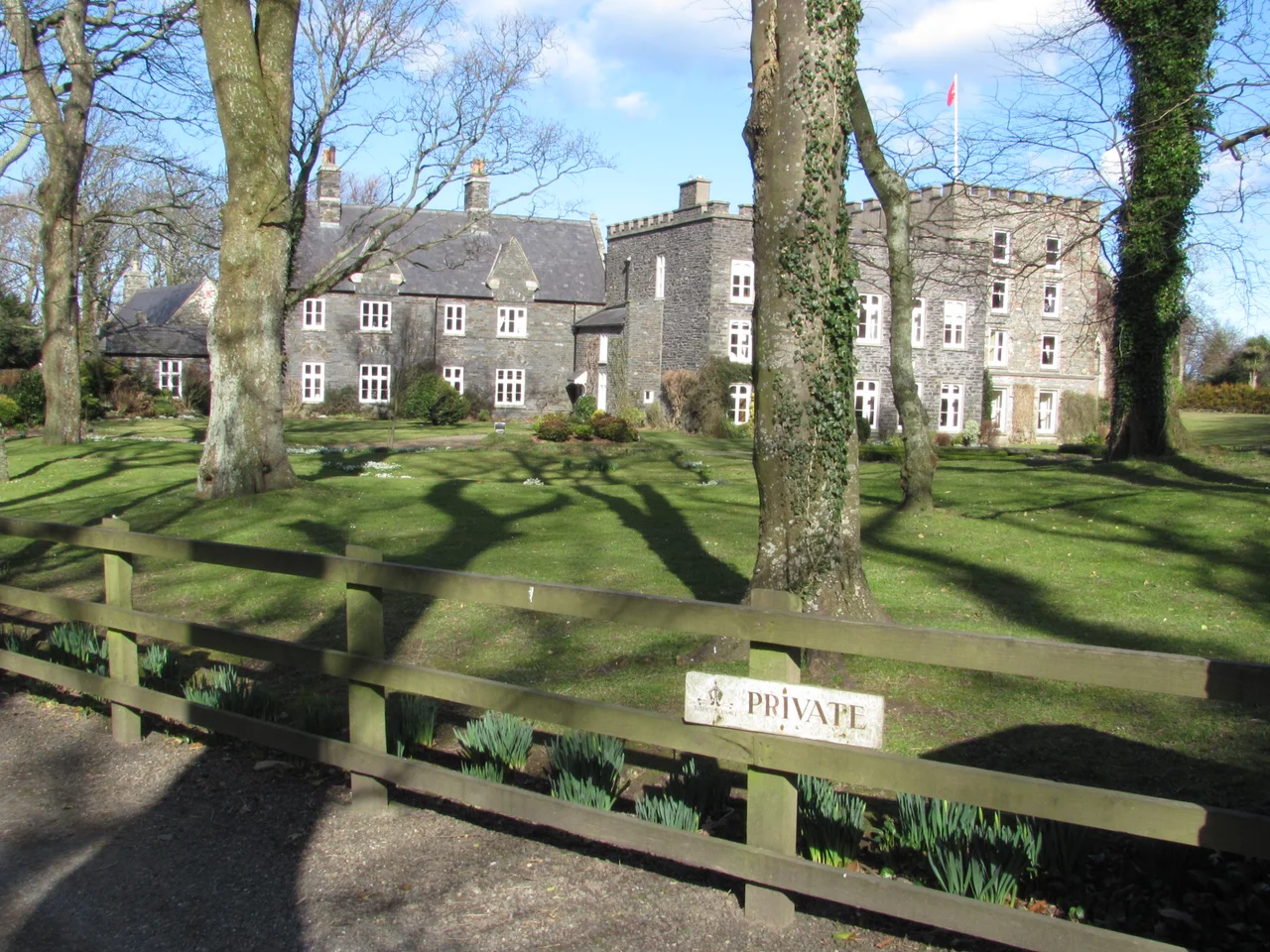

Bishopscourt, Isle of Man
Every June, motorcycles tear past Bishopscourt at speeds approaching two hundred miles an hour. The Snaefell Mountain Course - the 37.7-mile public road circuit that hosts the Isle of Man TT - runs straight along the A3 here, between Kirk Michael and Ramsey, and Bishopscourt sits adjacent to the sixteenth-milestone marker. Spectators line the verges. Helicopters track the bikes from overhead. The course commentary names Bishopscourt as a landmark, and for most of the people who hear it, that is what it is - a fast section, an aural cue, a point on a circuit. But Bishopscourt itself is something else entirely: the former palace of the Bishops of Sodor and Man, a castellated baronial residence with bones going back to the seventeenth century and roots going back much further. The TT bikes are the newest layer of a very old story.
The Bishop in the Palace
Bishopscourt was the official residence of the Bishop of Sodor and Man for centuries, occupying a site originally called Ballacurry. The current mansion dates to the 17th century, though Bishop Thomas Wilson - one of the longest-serving bishops in the history of the British church, appointed in 1697 - had to rebuild much of it after 1698. He found the house in ruins, with nothing but a sentient tower and chapel remaining entire, as the records put it. The 'sentient tower' was King Orry's Tower, named for one of the legendary Norse rulers of Mann, and Wilson kept what was usable while rebuilding the rest in the castellated baronial style that still defines the silhouette. Bishop Claudius Crigan enlarged the house from 1784, restoring King Orry's Tower and noting in his correspondence that the renovation cost a very severe expense - the polite ecclesiastical understatement for budgetary disaster. The chapel beside the tower, dating from 1651, was demolished around 1815 and replaced by a Georgian chapel; that in turn was replaced by Bishop Horatio Powys with a Victorian Gothic Chapel of St Nicholas. Three chapels on roughly the same ground, each generation rebuilding to its own taste, with King Orry's Tower watching it all.
Civil War and a Summer Estate
From 1643 to 1651, while the See of Sodor and Man was vacant during the English Civil War, the palace was used as a summer estate by James Stanley, 7th Earl of Derby and Lord of Mann - a grandson of Edward de Vere, 17th Earl of Oxford. The Stanleys had held the lordship of Mann since the fifteenth century, and Bishopscourt's combination of grand house, private chapel and walled grounds suited them well. After Cromwell's forces consolidated control, the island came under Parliament's authority, and by the late 1650s James Chaloner - a Parliamentarian whose wife's cousin Lord Fairfax had been granted the island - served as Governor of the Isle of Man, with Bishopscourt as his primary residence. So a building intended for bishops housed first the rival aristocratic family that held the island, then the parliamentarian governor sent to administer it - the palace adapting to whoever held power without itself changing shape.
Fire, Royalty and Departure
A fire in 1893 destroyed the hall section of Bishopscourt House. Reconstruction followed. In 1920, King George V visited and planted a tree in the garden - the kind of small ceremonial act that bookmarks the visit of a sovereign and tends, in any house's records, to be remembered. The Chapel of St Nicholas served as the diocese's pro-cathedral from 1895 until 1976, when the estate was sold out of ecclesiastical ownership. The Bishops of Sodor and Man, who had lived here for centuries, moved elsewhere. The house went into private ownership, where it remains - eventually offered for sale at one point for around £6 million, marketed in international property pages as the Isle of Man's ancient Bishop's Palace. Whoever buys it inherits the tower, the chapel, the gardens with the king's tree, and the sound of motorcycles each June.
A Boundary Between Parishes
Bishopscourt sits north of Kirk Michael on the A3, the primary road across the northern part of the Isle of Man. The Bishopscourt Manse and the Bishop's Glen - a wooded ravine to one side of the house - mark part of the boundary between the parishes of Michael and Ballaugh. The setting is one of those quietly perfect Manx landscapes: rolling fields running down toward the Irish Sea on the western coast, hedgerows and stone walls dividing the pasture, the bulk of Snaefell rising inland. From the upstairs windows of Bishopscourt, a bishop could once survey his diocese - or at least the western slice of it - and watch the same Atlantic light that the Norse, the Stanleys, the Commonwealth governors and the modern TT riders have all seen in turn.
From the Air
Bishopscourt lies at 54.300 deg N, 4.571 deg W on the western side of the Isle of Man, north of Kirk Michael on the A3 road. From the air, the house's castellated towers and walled grounds are visible just inland from the Irish Sea coast. Ronaldsway (EGNS) is the nearest airport, roughly 20 nm south. Visual landmarks include the long curve of the western coast, the bulk of Snaefell rising inland to the east (2,036 ft - the island's highest point), and the small parish church of Kirk Michael just south of Bishopscourt. During the TT and Manx Grand Prix race weeks each year, the Snaefell Mountain Course runs the A3 past Bishopscourt at high speed.
Nearby Stories
- Ballywalter 14 km away
- Pasages (steam trawler) 15 km away
- SS Georgetown Victory 19 km away
- Celtic Array 31 km away
- Raeberry Castle 34 km away
- German submarine U-1051 36 km away
- St Bees Lifeboat Station 49 km away
- PS Rothsay Castle 73 km away