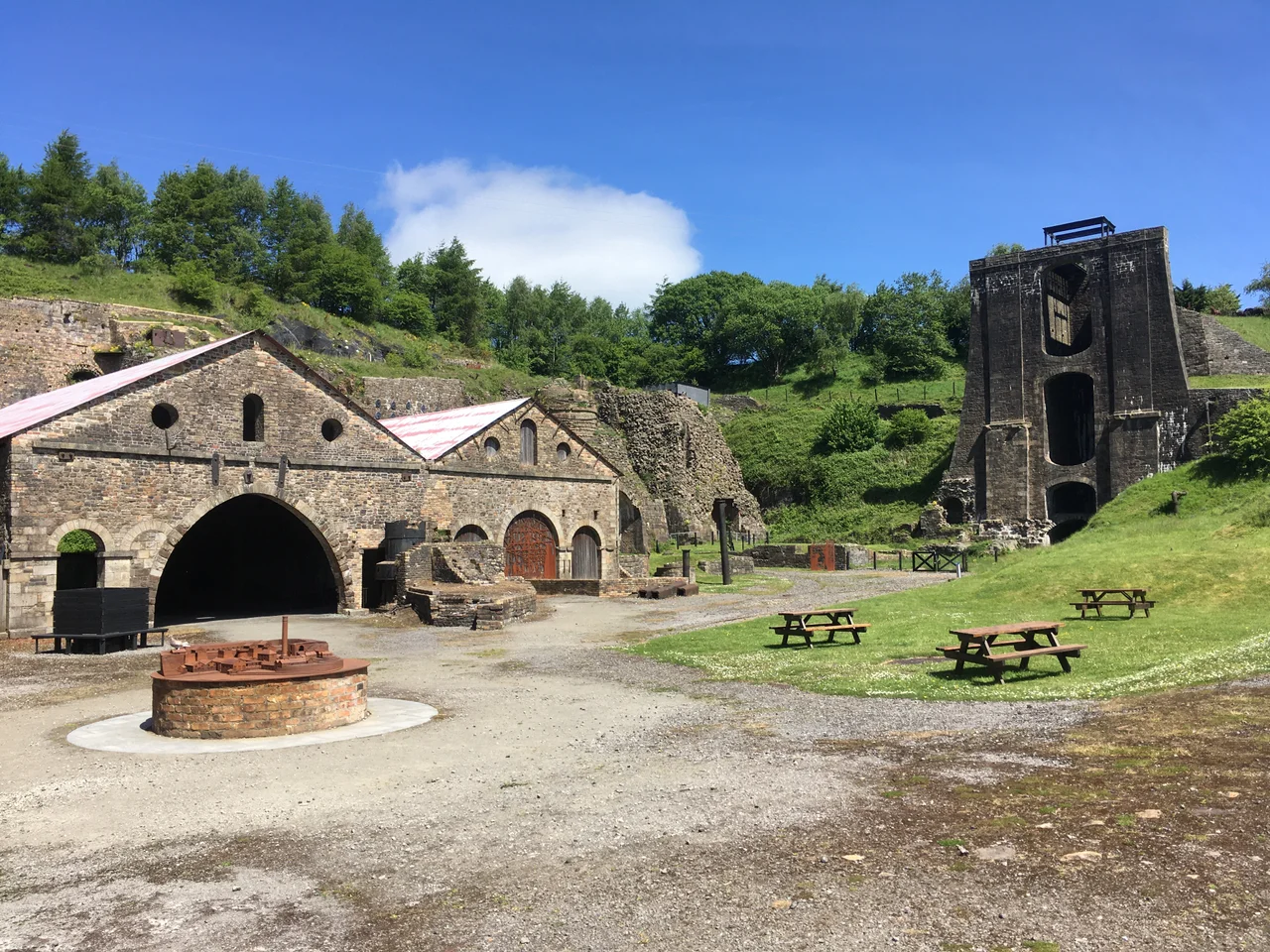

Blaenavon Industrial Landscape
Pig iron production in the South Wales valleys grew from 39,600 tons in 1796 to 666,000 tons in 1852. That sixteenfold increase in barely two generations did not just happen here at Blaenavon, but Blaenavon shows exactly how it happened. On a hillside above the source of the Afon Lwyd, every piece of the puzzle still survives in something close to its original arrangement. The blast furnaces. The water balance tower. The terraces where the workers lived. The tunnels that brought the ore in. The tramroads that carried the iron out. In December 2000, UNESCO inscribed a 33-square-kilometre patch of this landscape as a World Heritage Site, the first cultural landscape so designated in the United Kingdom.
What Coal and Iron Built
The Industrial Revolution in Britain ran on two raw materials, and the western South Wales valleys had both at the surface. Coal outcropped on the hillsides. So did iron ore and limestone, the third ingredient any blast furnace needed. You did not have to dig deep mines to find them. You could practically walk into a hillside and start hauling. That accident of geology made Blaenavon possible. In 1789 the Blaenavon Company leased 12,000 acres of Lord Abergavenny's land and started building what was then the most ambitious ironworks in Wales, designed from the outset as a multi-furnace site rather than a single experimental stack. The iron that came out of these valleys went on to build railways, factories, and engines around the world. By 1800, South Wales was the foremost iron-producing region on Earth, and Blaenavon's output trailed only Cyfarthfa, the giant ironworks at Merthyr Tydfil.
Six Furnaces and a Water Balance Tower
Walking through the ironworks today, you can still trace the choreography of 19th-century iron making. Six blast furnaces line the hillside, their stone arches dark and roofless now. Behind them stand the cast houses where molten iron ran into sand moulds, the boiler rooms, the engine houses, the ruined kilns where iron ore was roasted before charging. The most striking survivor is the water balance tower of 1839, a hydraulic lift that used the weight of water-filled trams descending in one shaft to raise loaded trams in the other. No steam needed. Just gravity and water, hauling iron up the side of a hill. Surrounding the works are Stack Square, the workers' terraces, and Ty-Mawr, the Big House Samuel Hopkins built for himself in 1791. The contrast was deliberate and unmistakable: the iron master in his mansion, the workers in their cottages a stone's throw away, all looking out at the same furnaces.
Big Pit
Up the hill from the ironworks sits Big Pit, the last deep coal mine in the area. It was sunk around 1860 and worked until 1980, then reopened in 1983 as the Big Pit National Coal Museum. Visitors descend in the original cage with a former miner as guide, and underground the air is cold and damp and the silence feels older than anyone in it. In 2005 Big Pit won the Gulbenkian Prize for British museum of the year. It deserved it. Few museums let you stand in the literal place where the work happened, with the equipment still there and someone who once swung a pick beside you explaining what it cost to fill a tram. The Big Pit's surface buildings, the head frame, the winding engine, and the pithead baths are all preserved more or less as miners knew them on their last shift.
Why the Hillside Matters
Most industrial heritage sites preserve a single building. Blaenavon preserves a whole system. You can walk Hill's Tramroad from the Pwll Du Tunnel toward the Garnddyrys Forge, following the same horse-drawn route that carried pig iron in the 1820s. You can trace the leat, the engineered watercourse, that fed the forge. You can stand at St. Peter's Church of 1804, walk down to Blaenavon Workmen's Hall of 1894, and see how the social infrastructure of an industrial town grew alongside its furnaces. Twenty-four scheduled monuments and 82 listed buildings sit inside the World Heritage boundary. About £40 million was spent in the first decade after inscription on conservation. The work continues. The point is not that Blaenavon was unique. The point is that it survived, intact, when so many other 19th-century industrial landscapes were demolished, paved over, or quietly forgotten.
After the Furnaces
The Blaenavon Ironworks closed in 1902, briefly restarted in 1924, and ceased commercial production for good after that. The Big Pit closed in 1980. The population of Blaenavon, once over 20,000, fell to a fraction of that. For decades, this hillside was simply a place that used to be important. Then, in 2000, the world looked at it again and decided it still was. The 2008 World Heritage Centre, designed by Purcell Miller Tritton and awarded the Gold Medal for Architecture at that year's National Eisteddfod, anchors the visitor experience now. A World Heritage Day every June draws people back. And on most days you can hear the restored steam railway whistle echoing up the valley, carrying the sound the workers' grandparents would have known by heart.
From the Air
51.770°N, 3.092°W, in the South Wales valleys at the head of the Afon Lwyd. Recommended viewing altitude 3,000-5,000 ft AGL to pick out the ironworks, Big Pit headframe, and Stack Square terraces against the surrounding moorland. Visual landmarks: the dark scarp of the South Wales Coalfield's northeast rim and the dual carriageway of the A465 Heads of the Valleys road threading west. Nearest airports: Cardiff (EGFF) approximately 30 nm south, Bristol (EGGD) 35 nm southeast across the Bristol Channel. Welsh weather is wet and windy; clearest flying typically in late spring and early autumn.
Nearby Stories
- Ewenny Priory 4.1 km away
- Tower Colliery 5.3 km away
- British Camp 8 km away
- Berkeley Castle 8.8 km away
- Hay Castle 11 km away
- Clevedon Pier 11 km away
- Royal Victoria Park 15 km away
- Strata Florida Abbey 35 km away