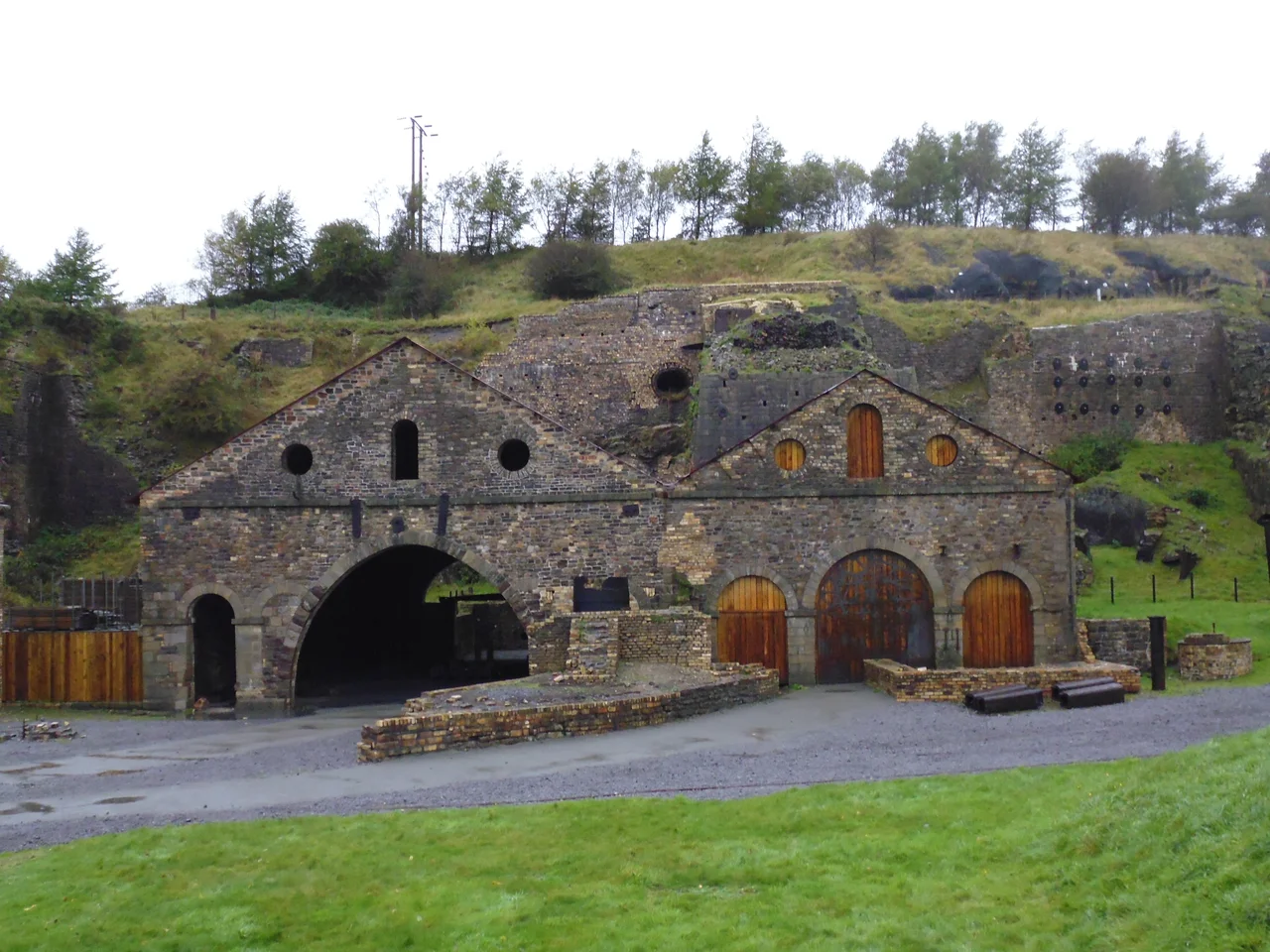

Blaenavon Ironworks
Phosphorus in iron ore was a death sentence. For most of the 19th century, the world's best ironmasters could do nothing with the high-phosphorus ores that lay under huge stretches of Europe and North America. Phosphorus made steel brittle, useless, scrap before it left the mill. Then, between 1877 and 1878, in a little works at the upper end of a Welsh valley, two cousins named Sidney Gilchrist Thomas and Percy Gilchrist worked out the answer. They lined a converter with chemically basic bricks instead of acid ones, and the phosphorus went where they wanted it to go. The basic steel process, they called it. The Gilchrist-Thomas process, the world called it. And it transformed steelmaking everywhere except, in a final cruel twist, Blaenavon itself.
Three Businessmen on a Hillside
The story starts in 1788, when Henry Nevill, the 2nd Earl of Abergavenny, renewed a lease on 12,000 acres of his upland holdings to three Midlands businessmen: Thomas Hill, his brother-in-law Thomas Hopkins, and Benjamin Pratt. What attracted them was geology. Coal, iron ore, and limestone all outcropped on the surface in these western valleys. You did not need vertical shafts and pumping engines to reach them. You walked into a hillside. The works they built were ambitious in scale. Three blast furnaces from the start, calcining kilns, workers' cottages, a company shop, all designed as a single integrated site. This was new. Earlier Welsh ironworks like the Hanbury operation at Pontypool had relied on charcoal and water power. Blaenavon used coke and steam. By 1799, when Archdeacon William Coxe visited, he saw an "opulent and increasing establishment, surrounded with heaps of ore, coal and limestone."
A Town Out of Nothing
The works demanded a workforce that the Eastern Valley of Monmouthshire simply did not have. So the workforce came to the works. Skilled men arrived from West Wales, Staffordshire, Gloucestershire, Herefordshire, Somerset, and Ireland. Unskilled men brought their families on the promise of wages. In 1800 the district counted just over a thousand people. By 1840 it held 5,115, with 61 percent speaking Welsh and the rest English, a linguistic borderland forged by industrial demand. By 1878 the company would employ 5,000 people at one stretch. The works were built around Stack Square, a tight cluster of stone cottages still standing today, restored to show life in different decades from the 1870s to the 1970s. The BBC filmed its reality series Coal House there, and the cottages remain one of the most affecting parts of the site, plain rooms where generations of families ate and slept within sight of the flames.
The Cousins' Experiment
By the 1870s Blaenavon was in trouble. Cyfarthfa at Merthyr Tydfil had long been the giant of Welsh iron, and Blaenavon ran second. The company relaunched in 1870 as the Blaenavon Iron & Steel Company and made the difficult conversion from iron to steel, one of only six South Wales works to manage it. But by 1878 the company had overreached financially. Then Sidney Gilchrist Thomas and Percy Carlyle Gilchrist arrived, and ran the experiments that would change everything. Their basic process used a lining of dolomite or limestone in the converter, which captured the phosphorus as a basic slag and left behind clean, ductile steel. Suddenly the vast phosphoric iron ores of Lorraine, the Ruhr, and the American Great Lakes were economic. The discovery saved Blaenavon for a few more years. Then it killed it. Germany and North America, now able to use their own ores, no longer needed Welsh iron.
Stones That Refused to Disappear
Iron production at Blaenavon ended in 1904. A brief restart in 1924 went nowhere. The forges helped roll steel shells through both World Wars but mainly the site was a storage yard for the National Coal Board. What saved it was a combination of remoteness and bad timing. The works sat too high up the valley to be useful for anything else, and by the time anyone might have wanted to clear them, industrial archaeology had begun to emerge as a discipline. In 1959 the novelist Alexander Cordell set Rape of the Fair Country here, and the book made the ironworks famous in a new way. Conservation began in 1974. In 2001 the 160-year-old cast iron columns at the top of the water balance tower came down for the first time since they were installed, were recast, repainted, and put back. Clive Aslet has called Blaenavon "the best-preserved industrial relic of its kind," and looking at the six blast furnaces with their dark stone arches, it is hard to disagree.
Grade I, Forever
Today Blaenavon Ironworks is in the care of Cadw, the Welsh government's historic environment service. The site holds three Grade I listings: the Cast House and Foundry, the Balance Tower, and the three Blast Furnaces. The Chain Store, Calcining Kilns, Storage Shed, Pay Office, Stack Square, and the memorial to the Gilchrist cousins all carry Grade II protection. In 2000 the whole works became part of the Blaenavon Industrial Landscape, UNESCO's first World Heritage cultural landscape in the United Kingdom, recognising the site's importance to "the pre-eminence of South Wales as the world's major producer of iron and coal in the 19th century." Stand at the water balance tower on a wet Welsh afternoon and the silence carries weight. This was the place that put phosphoric iron to work. The world that followed was built, in no small part, on what two cousins worked out here.
From the Air
51.777°N, 3.089°W, on the outskirts of Blaenavon at the head of the Afon Lwyd valley. Recommended viewing altitude 2,500-4,000 ft AGL to see the six blast furnace stacks, the water balance tower, and Stack Square in context. The works sit on the northeastern rim of the South Wales Coalfield with Big Pit visible to the north. Nearest airports: Cardiff (EGFF) approximately 30 nm south, Bristol (EGGD) 35 nm southeast across the Severn Estuary. Welsh weather brings frequent low cloud over the valleys; the clearest viewing is typically after a cold front clears through.
Nearby Stories
- Ewenny Priory 4.1 km away
- Tower Colliery 5.3 km away
- British Camp 8 km away
- Berkeley Castle 8.8 km away
- Hay Castle 11 km away
- Clevedon Pier 11 km away
- Royal Victoria Park 15 km away
- Strata Florida Abbey 35 km away