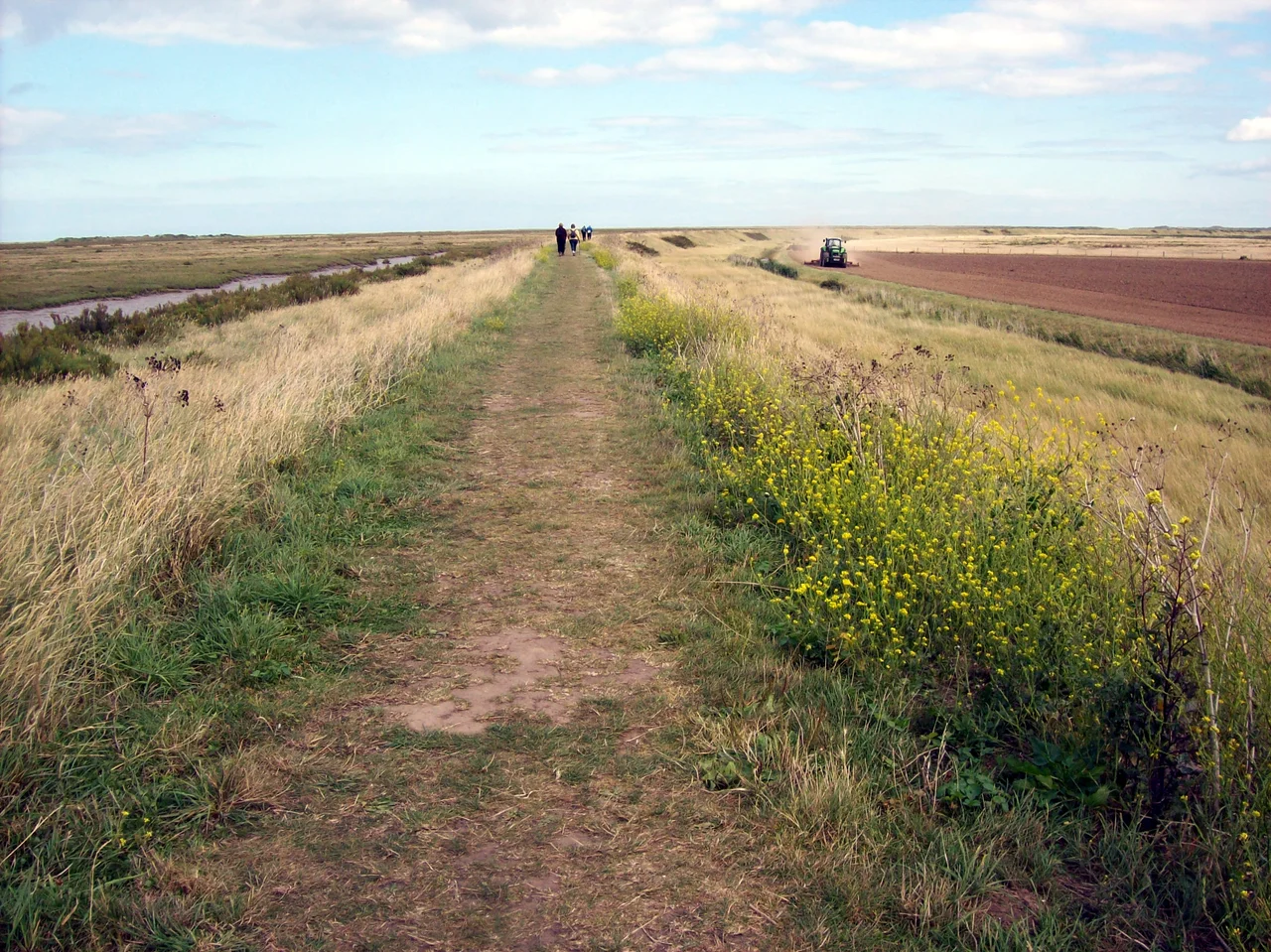

Blakeney Point
From the Cley Beach car park, the shingle stretches west for 6.4 kilometres, narrowing into a curl that ends at the Lifeboat House. Up to 500 seals haul out here at the tip - harbour seals in summer, grey seals in winter, the white-coated pups confined to dry land for their first three weeks. Walk the spit on a clear October afternoon and the sandwich terns are already gone south, but a 'fall' of migrant warblers might be passing through the marram grass. This is Blakeney Point, owned by the National Trust since 1912, one of the most important seabird sites in Europe and a sandbar so dynamic it lengthened by 132 metres between 1886 and 1925 alone.
How a Spit Walks Sideways
Blakeney Point is mostly flint - 97 percent shingle that longshore drift has been pushing westward for centuries. The spit walks sideways: the sea grinds away at the seaward edge while the prevailing tide and storm push the shingle inland and west. Several former raised islands or 'eyes' have already disappeared, swallowed first by the advancing shingle and then by the sea. The medieval Glaven ports of Blakeney, Cley-next-the-Sea, and Wiveton once sheltered behind this spit and ran a vigorous trade with the continent. Blakeney sent ships to support Edward I's wars in 1301, and between the 14th and 16th centuries it was the only Norfolk port between King's Lynn and Great Yarmouth with its own customs officials. Land reclamation in the 17th century then silted the harbours, and the great trade collapsed.
Bob Pinchen and the Watchers
In 1901, the Blakeney and Cley Wild Bird Protection Society hired a man called Bob Pinchen as the Point's 'watcher.' He was the first of just six men to hold that title up to 2012 - each one essentially the human guardian of one of the most important seabird breeding sites in the country. In 1912, a public appeal led by Charles Rothschild and organised by Professor Francis Wall Oliver of University College London bought Blakeney Point from the Calthorpe estate and donated it to the National Trust. The ornithologist Emma Turner had already begun ringing common terns here in 1909, one of the earliest systematic bird-ringing programmes in Britain. Pinchen retired in 1930. Billy Eales replaced him, then his son Ted Eales succeeded him in 1939. Ted later worked as a wildlife cameraman for Anglia Television. Ajay Tegala held the role more recently and wrote a book about it. The continuity is striking - more than a century of one place, one job, one quiet vocation.
Why Black-Headed Gulls Help
Blakeney is the most important British site for both Sandwich terns and little terns. Around 4,000 pairs of Sandwich terns nest here in good years - up from almost nothing before the 1970s. About 200 pairs of little terns represent eight percent of the entire British population. Common terns peaked at 2,000 pairs in the mid-20th century and have since declined to perhaps 165 pairs, probably because of predation. The 2,000 pairs of black-headed gulls that share the breeding area are believed to help the colony as a whole by driving off red foxes. Other nesters include Arctic terns, Mediterranean gulls, ringed plovers and oystercatchers on the shingle, and common redshanks on the salt marsh. Ringed plovers have crashed badly - 12 pairs in 2012, down from 100 pairs twenty years before - because of human disturbance and predation by gulls and stoats. The autumn 'falls' of migrants can be spectacular: hundreds of European robins on 1 October 1951, more than 400 common redstarts on 18 September 1995.
Seals on Sea-Washed Sand
The seal colony at the western tip has become the visit most people come for. Harbour seals pup between June and August, on the mud flats, and the young can swim almost immediately. Grey seals breed in winter, between November and January, and their young are land-bound for three or four weeks while they lose their white coats. Boat trips from Blakeney and Morston harbours give close views without disturbing the animals - dogs are banned April through mid-August because of the ground-nesting birds. Underfoot, sea couch grass and marram bind the dunes. Among the shingle grow sea holly, yellow horned poppy, sea thrift, sea campion. Pickers gather the edible glasswort - sold locally as samphire or 'sea asparagus' - between May and September. The spit will keep moving. The Glaven keeps having to be realigned to stop Cley village from flooding. The seals will keep arriving. And whoever takes over as the Point's seventh watcher will inherit the same job Bob Pinchen took on 125 years ago.
From the Air
Located at 52.9772 degrees N, 0.9778 degrees E on the north Norfolk coast facing the North Sea. From cruising altitude, the spit is unmistakable: a 6.4-km curl of pale shingle running west from Cley Beach with salt marsh on the landward side. Look for the Lifeboat House at the tip and the white smudge of the seal colony nearby. Best viewing 1,500-4,000 feet AGL. Nearest airport: former RAF Coltishall (EGYC, closed 2006) 22 nm east-southeast; Norwich International (EGSH) 28 nm south-southeast; RAF Marham (EGYM) 30 nm south-southwest.
Nearby Stories
- Wroxham 3.2 km away
- East Dereham Windmill 8.5 km away
- Alford Windmill 11 km away
- Mundesley 14 km away
- Batemans Brewery 14 km away
- Wisbech 15 km away
- HMS Cobra 24 km away
- SM U-97 118 km away