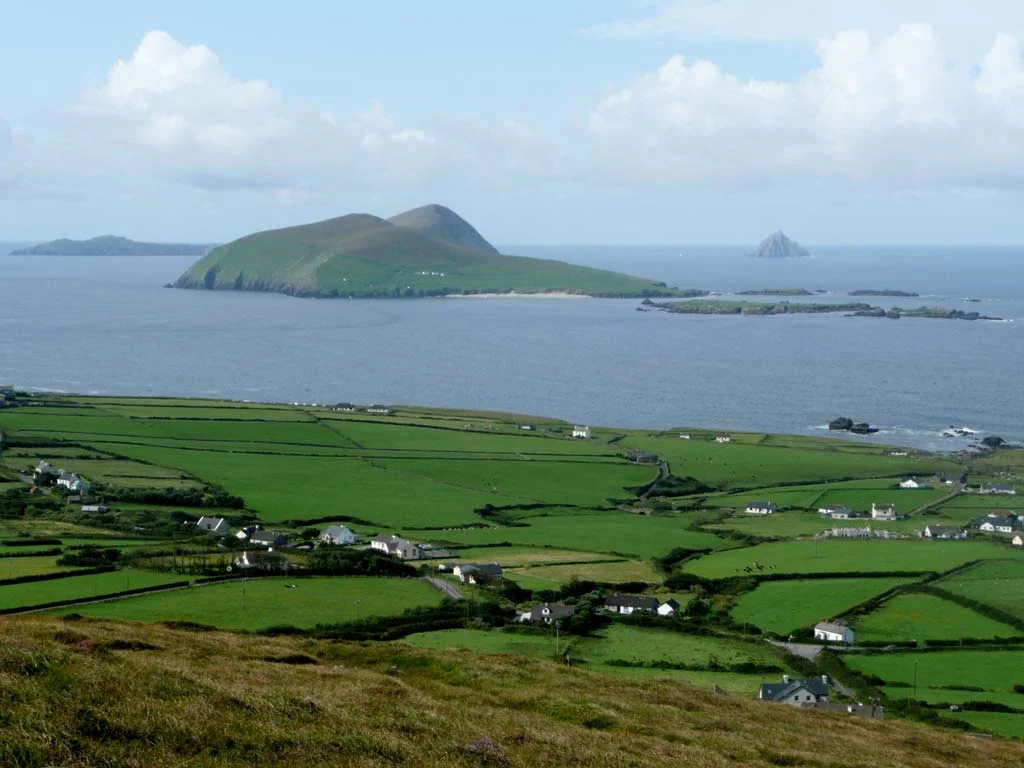

Blasket Islands
On a clear day from the cliffs of Dunquin, the Blasket Islands look like a school of whales drifting west - dark green humps against the silver Atlantic, the furthest of them so far out that lighthouse keepers were the last to leave it. Six principal islands sit off the western tip of the Dingle Peninsula in County Kerry, and for centuries they held one of the most isolated Irish-speaking communities anywhere. When the last twenty-two people stepped off Great Blasket on a November day in 1953, they brought with them something rare and brittle: a way of life that had already, by then, been preserved on the page.
The Sharp Reef of Rock
Nobody is entirely sure what Blasket means. The most persuasive theory traces the name to the Old Norse brasker - sharp reef of rock, or dangerous place - a label any Viking would have understood after rounding these cliffs in foul weather. For a time the islands were called Ferriter's Islands after the local lords of the Dingle Peninsula, and the topographer Charles Smith called the largest of them Inishmore. The first written reference to islanders living out here comes from the late sixteenth century, but the clochans and oratories scattered across the smaller islands suggest monks had been finding solitude on these rocks for a thousand years before that.
An Island That Wrote Itself
Something extraordinary happened on Great Blasket between the 1890s and the 1930s. Linguists and scholars - the Englishman Robin Flower, the classicist George Derwent Thomson, the Celticist Kenneth H. Jackson - climbed across the sound from Dunquin to study a community whose Irish was perhaps the purest in Europe, untouched by the slow attrition of the mainland. They encouraged the islanders to write. The result was a small library of masterpieces in a language most of the world thought was already dying: Tomas O Criomhthain's An tOileanach (The Islandman) and Allagar na hInise (Island Cross-Talk); Peig Sayers's autobiography Peig and her Machnamh Seanamhna (An Old Woman's Reflections); and Muiris O Suilleabhain's Fiche Blian ag Fas (Twenty Years A-Growing). Eilis Ni Shuilleabhain wrote Letters from the Great Blasket. The literature is now taught in Irish schools. Some of it is read with affection; some, famously Peig, with the groans of teenagers. All of it survived because someone wrote it down before the island emptied.
The Evacuation
By the early 1950s, the maths had become impossible. The young had left for America or for Dingle and Tralee, and those who remained could no longer keep a boat to the mainland in winter. Doctors could not always reach the sick. Both the islanders and the Irish government agreed that the village had become untenable, and on 17 November 1953 the last twenty-two residents were transferred to new homes built for them in Dunquin. The O Suilleabhain family were among the most reluctant to go and the last to leave. The first teacher the island ever had, Aine O'Donoghue - posted there at nineteen and great-great-grandmother of the comedian Aisling Bea - belonged to a chain of mainland women who had given parts of their lives to this remote little school. The school went silent. The chimneys went cold.
Haughey's Island
Twenty-one years after the evacuation, the most powerful politician in Ireland bought one of the smaller islands for himself. In 1974, Charles Haughey - then in political exile after the Arms Crisis - purchased Inishvickillane from the descendants of the O Dalaigh family. As Taoiseach he used it as a summer retreat, flew prominent guests in by helicopter, and once hosted French President Francois Mitterrand on its windy slopes. In 1989, Haughey introduced legislation to turn the Blaskets into a national park with compulsory-purchase powers. The Supreme Court ruled the act unconstitutional in 1998. The archipelago's westernmost speck, Tearaght, was inhabited only by lighthouse keepers until the lamp was automated in 1988 and the last paid resident of the Blaskets - any Blasket - locked the door behind him.
Seabirds and Seals
What the islanders left behind, the wildlife inherited. The Blaskets are now one of Ireland's most important breeding sites for grey seals, who pup in the sea caves and haul out on the small shingle beaches in numbers that surprise visitors. At least thirteen species of seabird breed across the archipelago: Manx shearwaters that fly thousands of miles between feeding and nesting, storm-petrels that nest in stone crevices and only come ashore at night, puffins, fulmars, gannets diving offshore. The European Environment Agency has designated the islands and surrounding waters as a Natura 2000 special area of conservation, and BirdLife International has named them an Important Bird Area. Today a ferry runs from Dunquin to Great Blasket for day-trippers, who transfer to a rigid inflatable for the final approach because there is still no proper landing. The stone houses are mostly roofless now. The Irish goes mostly unspoken. The wind keeps the same hours it always has.
From the Air
Located at 52.089 degrees north, 10.547 degrees west, west of the Dingle Peninsula in County Kerry. The archipelago spans about 12 kilometres east to west, with Tearaght's lighthouse marking the westernmost point. Kerry Airport (EIKY) lies about 35 nautical miles east-northeast. Shannon Airport (EINN) lies about 65 nautical miles northeast. The islands sit in often-turbulent Atlantic air; expect strong westerly winds and rapidly changing cloud. Recommended observation altitude 2,500 to 5,000 feet AGL on a clear morning, when the islands' shapes - particularly Inishtooskert's recumbent profile - are most distinct. Be alert for low ceilings and reduced visibility moving in from the west.
Nearby Stories
- Lispole 3.3 km away
- Butler Arms Hotel 3.5 km away
- Skellig Michael 16 km away
- Ballyheigue Castle 25 km away
- Kilkee 80 km away
- The Laki Eruption: The Volcano That Changed World History 1360 km away
- The Northern Lights: The Sky Show That Vikings Thought Was Bridge to the Gods 1460 km away
- Sao Miguel 1919 km away