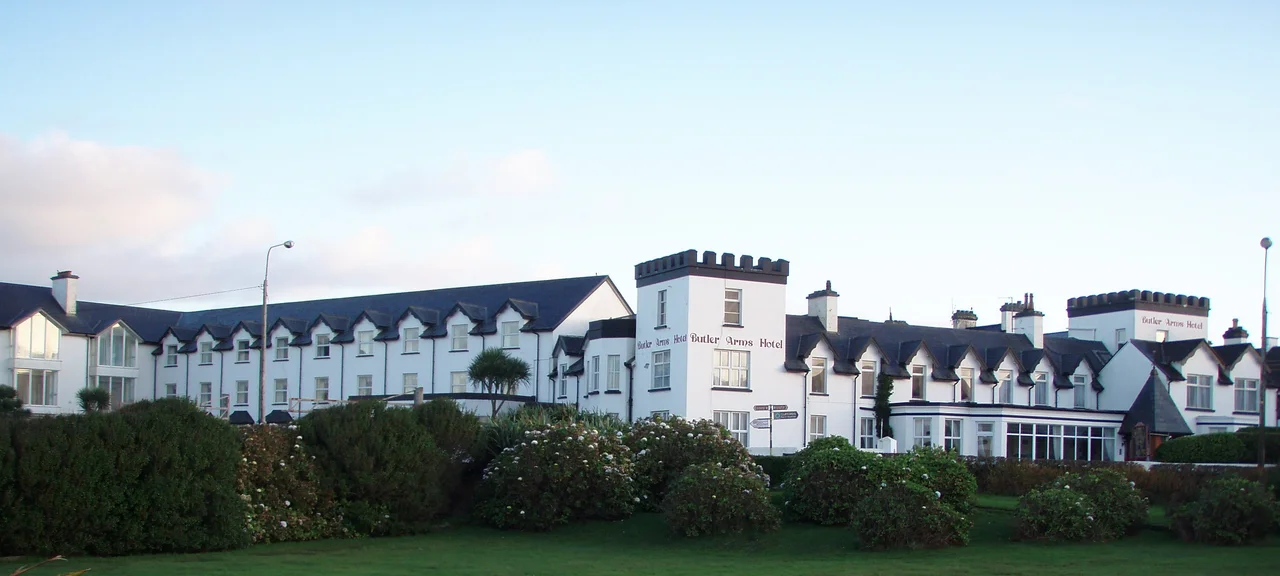

Butler Arms Hotel
Charlie Chaplin came for the fishing. He stayed for twelve summers. From 1959 onward, the Tramp - now seventy years old, exiled from the country that had made him famous, raising children in Switzerland - brought his family across Europe each year to a turreted, white-fronted hotel on the wind-scoured edge of the Atlantic. Waterville suited him. The Butler Arms suited him. The locals, who quickly learned which guest preferred which pew at Mass, suited him most of all.
An Inn Built on a Cable
The Butler Arms opened in 1884, founded by the McElligott family at exactly the moment Waterville turned into something more than a fishing village. The first successful transatlantic telegraph cable had landed in 1866 at nearby Valentia Island, connecting Ireland to Heart's Content in Newfoundland and onward to New York. The cable engineers, the bankers who funded them, the journalists who covered them - they all needed somewhere to stay. The railway pushed west to Killarney around the same time. Bradshaw's Railway Guides started touting the Iveragh Peninsula's salmon lakes and Atlantic light. By the time the Huggard family bought the hotel in 1915 - they would run it for four generations until 2022 - the Butler Arms was already established as the place to come if you wanted the most extreme western edge of Europe in comfort.
The Chaplin Summers
The Chaplins discovered Waterville almost by accident. Charlie loved to fish; the family enjoyed the peninsula's privacy. From 1959 through 1971 the family returned to the Butler Arms annually, sometimes for weeks at a stretch. Oona O'Neill Chaplin, Charlie's wife, brought her Irish-American sensibility to the place. The children - eight of them, eventually - tumbled along the strand and the lakes. The town reciprocated. Today a bronze statue of the Little Tramp stands in Waterville, hat tipped to the sea he loved. Each August the town hosts a Charlie Chaplin Comedy Film Festival - launched in 2011 by Charlie's daughter Josephine - that paints the place black-and-white in his honour. It is a strange and tender bit of geography: a worldwide film legend folded permanently into a Kerry village's identity.
Writers, Bankers, Lords
The Chaplins are only the headline. The American banker J. P. Morgan reportedly stayed in the 1920s. Sir Horace Plunkett came twice in 1891, just after he had been appointed to the new Congested Districts Board that was attempting, with mixed success, to lift the west of Ireland out of grinding poverty. Lord Dunraven, who chaired the 1902 Land Conference that finally untangled the worst of Irish landlordism, was a regular. Virginia Woolf passed through. So did John Steinbeck. Walt Disney signed the register; Michael Douglas and Catherine Zeta-Jones returned generations later. The barrister T. C. Kingsmill Moore stayed in 1932 and afterwards wrote A Man May Fish, a small classic of angling literature in which the Butler Arms and Lough Currane play leading roles. The hotel's guestbook reads like a cross-section of the twentieth century's curious.
Still Standing at Land's End
Press Up Entertainment, Paddy McKillen Junior's hospitality group, took ownership in 2022. The building remains - cream-walled, gabled, looking out across Ballinskelligs Bay toward the Skellig Islands rising twelve kilometres offshore. The Atlantic still rolls in. The Waterville Golf Links still rolls out, one of the highest-regarded courses in Ireland. Lough Currane, with its medieval Church Island, lies just inland. What the Butler Arms offers is what it has always offered: a roof at the absolute western edge of Europe, where the cable came ashore, where Chaplin learned to be quiet, where the next stop is North America.
From the Air
The Butler Arms sits at 51.8277 deg N, 10.1723 deg W on the seafront in Waterville. Approach along the Ring of Kerry; from cruising altitude on a fair day, Ballinskelligs Bay is a deep crescent reaching out toward the silhouettes of Skellig Michael and Little Skellig twelve kilometres offshore. Nearest airport is Kerry (EIKY), 65 km north-east. Atlantic frontal weather and rapidly shifting visibility are typical; low cloud often caps the peninsula's hills below 1500 feet.
Nearby Stories
- Farranfore–Valentia Harbour line 3.3 km away
- Heir Island 4.1 km away
- Inishvickillane 4.4 km away
- Kealkill stone circle 8.7 km away
- Headford Ambush 10 km away
- Dunlough Castle 13 km away
- SM U-68 27 km away
- Sao Miguel 1923 km away