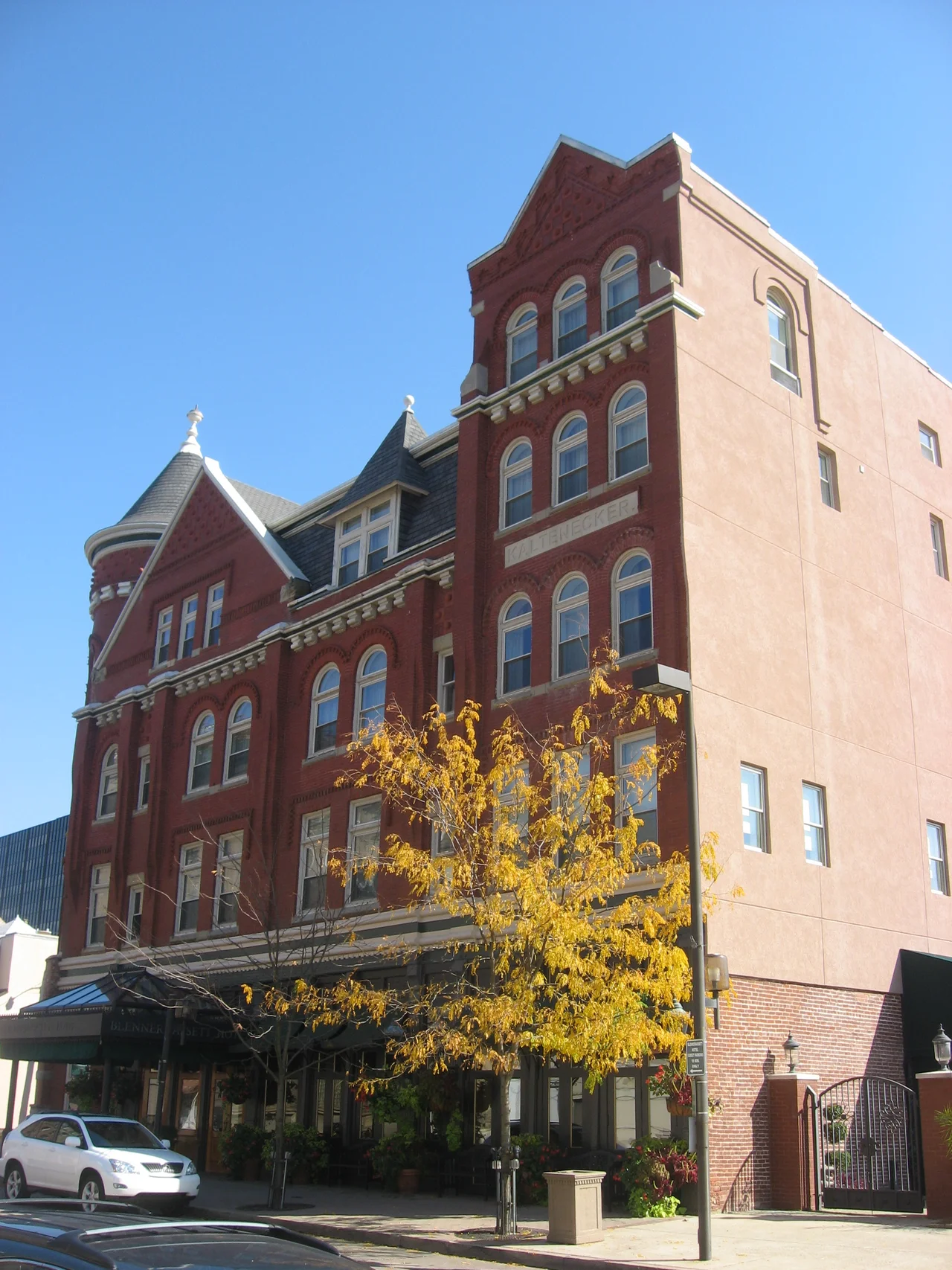

Blennerhassett Hotel
Harman Blennerhassett was a wealthy Irishman with a degree from Trinity College Dublin, a beautiful young wife, and the misfortune of having befriended Aaron Burr. In 1798, the Blennerhassetts settled on an island in the Ohio River across from what would become Parkersburg, West Virginia, and built a Palladian mansion - the most elegant private residence west of the Alleghenies. Eight years later, in 1806, the former Vice President of the United States arrived at the island and asked to use it as the staging ground for a military expedition whose purposes are still disputed. The Blennerhassetts said yes. When the federal militia raided the island in December 1806, the family fled down the Ohio in a flatboat, leaving the mansion behind. They never returned. Eighty-three years later, in 1889, an entirely different establishment - a four-story Queen Anne hotel in downtown Parkersburg - opened bearing the family name. The Blennerhassett Hotel has carried it ever since.
The Original Blennerhassetts
Harman and Margaret Blennerhassett were Irish gentry who had fled Europe partly to escape the consequences of an unconventional marriage - Margaret was Harman's niece - and partly to seek fortune in the new American republic. The island they bought sat in the middle of the Ohio River, about a mile downstream of what is now Parkersburg. The mansion they built between 1798 and 1800 was unlike anything else on the Appalachian frontier. Palladian in design, with formal gardens, classical proportions, and a stable of imported European furnishings, it became a regional curiosity and a magnet for prominent travelers. Aaron Burr visited in 1805 and again in 1806. What was discussed at those visits became the subject of one of the most famous treason trials in early American history.
The Burr Conspiracy
The exact nature of what Burr was planning has been debated for two centuries. The federal government's case, as eventually argued before Chief Justice John Marshall, was that Burr intended to lead an armed expedition to detach the western territories from the United States and establish himself as ruler of an independent western republic, possibly with parts of Spanish Mexico added. Burr's own account was much more modest: he was simply organizing a legitimate settlement venture in disputed territory along the lower Mississippi. The Blennerhassetts, who had loaned money and lent their island to the enterprise, became major figures in the case. In December 1806, Virginia militia raided the island. Harman and Margaret escaped downriver. Burr was eventually tried in 1807 and acquitted. The Blennerhassetts were ruined. They never recovered their property or their standing. The mansion burned in 1811.
The Hotel
In 1889, the Parkersburg businessman William Chancellor opened the Blennerhassett Hotel at 4th and Market Streets. The choice of name was savvy local marketing - the Blennerhassett story was the most romantic episode in the region's history, and the family's association with elegance, tragedy, and conspiracy made for ideal hotel branding. The building was four stories in Queen Anne style, with the elaborate roofline, asymmetrical massing, and turreted corner that distinguished the era's grand commercial architecture. It had approximately 50 guest rooms arranged around a central staircase. Restrooms were located in common areas on each floor - private en-suite bathrooms not yet being standard hotel practice in 1889. The kitchen was on the fifth floor, an unusual choice that may have reflected fire safety considerations of the period. The First National Bank of Parkersburg occupied what is now the hotel's game room. The bank had electricity - a luxury the rest of the building lacked at opening.
The Gaslight Era
Parkersburg in the late 1880s was riding the oil and natural gas boom that had begun at Burning Springs in 1860 and accelerated after the Civil War. Money flowed into the city. The downtown grew. The Blennerhassett was built for the businessmen, salesmen, and travelers that the boom brought to town - and for the locals who needed a venue for the kind of formal social occasions that no private home could quite accommodate. Weddings, anniversaries, banquets, and political gatherings filled the lobby and the dining room. The hotel became a fixture of Parkersburg's civic life in a way that has only intensified over the decades. It is still doing the same work today.
What Survives
The Blennerhassett was added to the National Register of Historic Places in 1982. The hotel's own marketing has occasionally and incorrectly claimed National Historic Landmark status, but the more modest National Register listing is still meaningful - it acknowledges the building as one of the most architecturally and historically significant hotels in West Virginia. The current structure has been carefully restored. The original 50 rooms have been renovated to accommodate modern expectations, the bank has become the bar, and the rooftop kitchen has been moved to ground level. What remains is the building - the Queen Anne facade, the central staircase, the lobby that opens off Market Street, and the long memory of an Irish family who once lived on an island a mile downstream and whose name, against all expectations, became the name of the most prominent hotel in the city they fled.
From the Air
Located at 39.26 degrees N, 81.56 degrees W in downtown Parkersburg, Wood County, West Virginia. The Blennerhassett Hotel sits at 4th and Market Streets in the historic core of the city. Blennerhassett Island, the original family estate, lies in the Ohio River about two miles downstream and is now a state park. Mid-Ohio Valley Regional Airport (KPKB) is the nearest tower-controlled field about 6 nm north. Recommended viewing altitude 3,000 to 4,500 feet MSL. Expect dissected plateau terrain throughout the area; the Ohio River runs along the west side of the city.
Nearby Stories
- Mountaineer Power Plant 5.3 km away
- Burning Springs Complex 7 km away
- Glenville, West Virginia 10 km away
- Strouds Run State Park 11 km away
- Salem University 26 km away
- West Virginia Penitentiary 42 km away
- The Y-Bridge of Zanesville 44 km away
- The Wheeling Suspension Bridge: The Longest Span in the World 81 km away