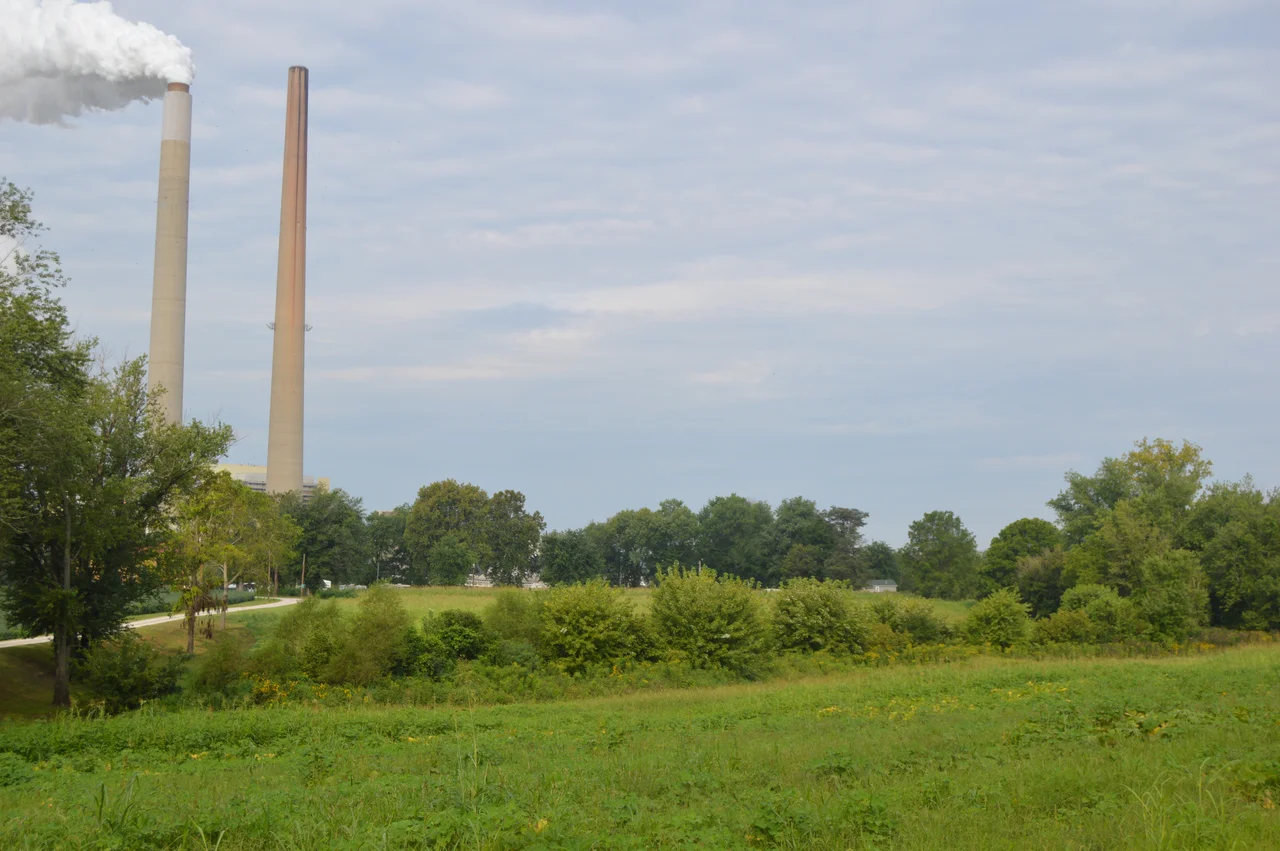

Mountaineer Power Plant
When AEP finished the Mountaineer Power Plant's original chimney in 1980, it stood 336 meters tall - taller than the Eiffel Tower, taller than the Chrysler Building, taller than nearly any free-standing structure in the Western Hemisphere. The idea was straightforward and very 1970s: build the stack high enough that the sulfur dioxide pouring out of it would disperse before anyone downwind had to breathe it. That logic eventually fell out of fashion, and the giant chimney now stands silent, replaced by a slightly shorter, fatter one designed to feed scrubbers and electrostatic precipitators instead of just pushing the problem higher into the sky. The old chimney remains, though, looming over New Haven, West Virginia - a relic from when American utilities believed dilution was solution.
A Single Boiler, Twin Turbines, One City's Worth of Power
Mountaineer is unusual among American supercritical plants in that it runs a single enormous boiler feeding two 740-megawatt turbines, for an installed capacity around 1,480 MW. After the energy required to run the plant itself - fans, pumps, pollution controls - about 1,300 MW actually leaves the site. That is enough electricity to power a city roughly the size of Columbus, Ohio, transmitted out on 765-kilovolt lines, the highest voltage class in routine American use. To make all that power, the plant burns roughly 9,000 tons of coal per day. Some arrives by barge on the Ohio River; the rest used to ride a belt across the road from Big River Mining's underground operation, which closed in 2010 and ended that particular bit of mine-mouth economics.
Living on the River
Mountaineer is a closed-loop plant, which sounds like it should not consume water but does. Cooling water cycles through the system again and again, but the cooling tower exhales about 20,000 gallons of water vapor per hour into the air, and that has to be replaced from the Ohio River below. The plume above the cooling tower is the most obvious visual signature of the place: a fat white column rising on calm days, drifting in a long ribbon downwind on breezy ones. The river itself is the other constant - barges below, transmission lines above, the plant in between, all wired together into the grid that lights the eastern half of the country.
The Ghost of Carbon Storage
Between 2009 and 2011, Mountaineer became the first existing American power plant to attempt to capture and bury its own carbon dioxide. AEP partnered with Alstom on a pilot using chilled ammonia to pull CO2 out of the flue gas, liquefy it, and inject it underground for permanent storage. The pilot worked: it removed somewhere between 100,000 and 300,000 metric tons of CO2 against the plant's roughly 8.5 million annual tons of emissions - a small slice, but a real one. AEP and Alstom spent about $100 million on the project. Then, in July 2011, AEP pulled the plug. Federal climate policy had stalled, the price of carbon was going nowhere, and the company concluded the full-scale build was not commercially defensible. The pilot equipment was dismantled. Mountaineer kept burning coal, kept emitting carbon, and the first attempt to retrofit carbon capture at a working American power plant became one more abandoned experiment.
Graham Station That Was
Locals still call the area Graham Station, even though no station of that name exists on any modern map. Mountaineer and the neighboring Phillip Sporn plant together occupy most of the ground that the old railroad station once organized, and the village name has been swallowed by the industry that replaced it. The plant address is usually given as New Haven, the next town up Route 33, but Mountaineer actually sits outside the town limits on what used to be Graham Station's flatland. Two power plants, a coal-handling yard, transmission corridors, the river - the landscape here is industrial in a way the Ohio Valley has been since the nineteenth century, with each generation's energy economy layered onto the last.
Flying Over a Skyline of Stacks
From altitude, the West Virginia side of this stretch of the Ohio River reads as a string of power plants spaced like beads. Mountaineer's original 336-meter chimney is the tallest single feature, easily picked out from twenty nautical miles away on a clear day. North across the river, the Gavin Power Plant looms even larger as a single facility. South, the Phillip Sporn site sits adjacent. From a small aircraft at cruising altitude, the whole valley becomes a textbook diagram of America's coal-fired infrastructure: river barges below, transmission corridors stretching to the horizon, white plumes rising from the cooling towers.
From the Air
Located at 38.98°N, 81.94°W on the West Virginia bank of the Ohio River, outside New Haven in Mason County. The original 336m chimney remains a major visual landmark visible from 25+ nautical miles in clear air. Nearest airports: Mason County Airport (3I2) about 6 nm northwest, and Mid-Ohio Valley Regional (KPKB) at Parkersburg about 30 nm northeast. Best viewed from 5,000-8,000 feet, where the chimney's scale relative to surrounding terrain becomes apparent.
Nearby Stories
- Wood County, West Virginia 4.7 km away
- Gen. John McCausland House 11 km away
- Salt Reservations 13 km away
- Athens Lunatic Asylum 14 km away
- Ratcliffe Mound 15 km away
- Ironton, Ohio 17 km away
- Burning Springs Complex 22 km away
- Malden, West Virginia 41 km away