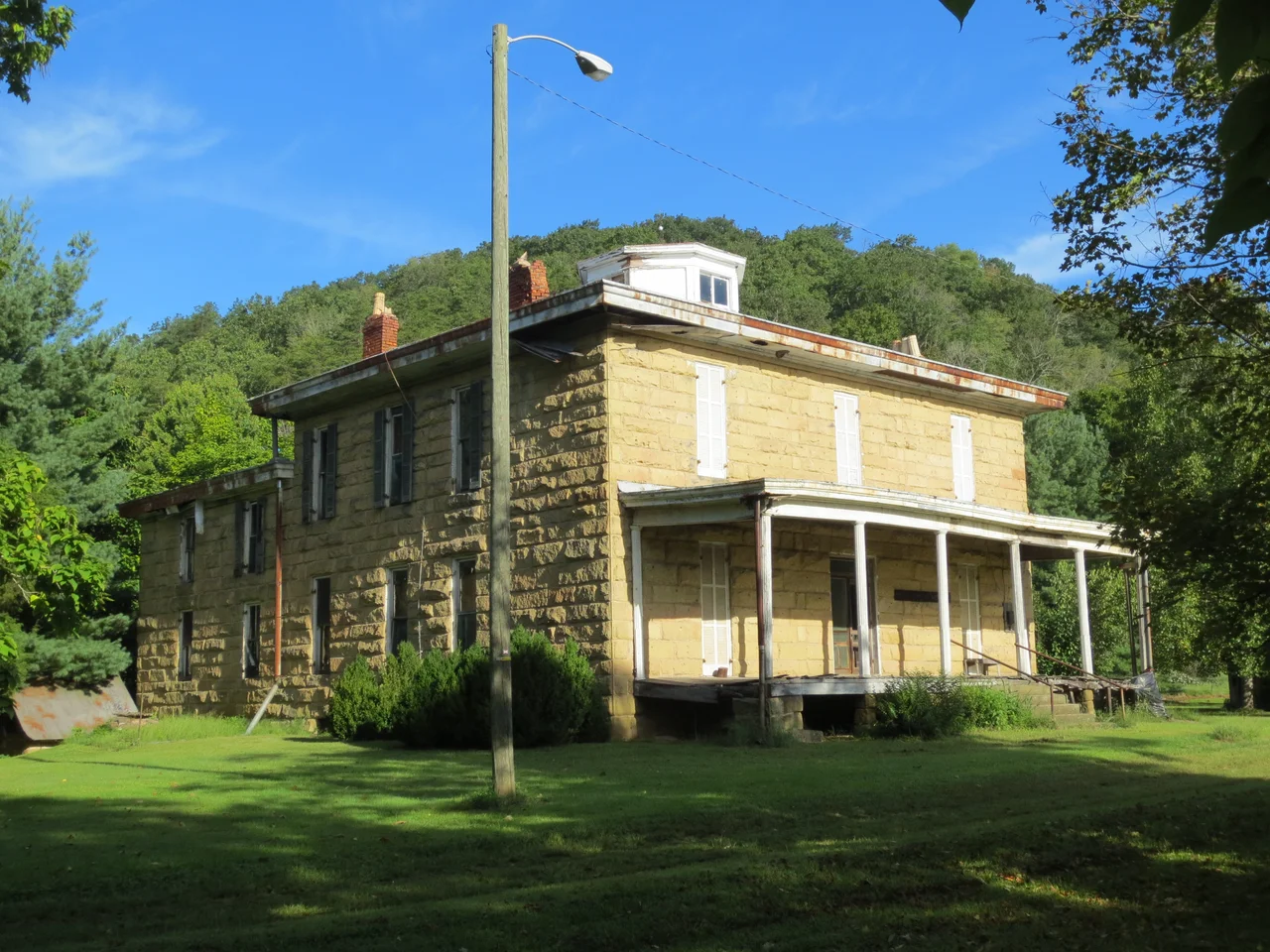

Gen. John McCausland House
John McCausland ordered the burning of Chambersburg, Pennsylvania on July 30, 1864 - a town of three thousand civilians set ablaze when its leaders refused to pay a ransom of $100,000 in gold or $500,000 in U.S. currency. After the Civil War, McCausland refused to apply for the official pardon offered to former Confederate officers. He fled briefly to Mexico, then to Europe, before quietly returning to West Virginia and settling on a Mason County farm he called Grape Hill. He built a sandstone house there in 1885, lived in it for forty-two years, and died in 1927 at age ninety - one of the last surviving Confederate generals. The house still stands above the Kanawha River. It is, in many ways, the most morally complicated building in the county.
Grape Hill
The main house at Grape Hill, completed in 1885, is a two-story sandstone residence with a full-length, one-story porch across the front. Five bays of fluted Doric columns support the porch roof. The hip roof above is covered in standing-seam metal. The whole composition is restrained, even modest - a country gentleman's farmhouse rather than the planter mansion you might expect from a brigadier general. McCausland chose the site for the long view it offered down the Kanawha valley toward the Ohio River, a few miles west. The farm grew up around it: a smokehouse, a corn crib, a chicken house, several barns, tenant houses, and a small log dwelling that may date from as early as 1834, possibly the original cabin on the property. In 2000, the National Register listing was expanded to include 23 additional contributing buildings and 4 contributing structures, designating the whole property as a national historic district.
The Burning of Chambersburg
McCausland was born in St. Louis in 1836, orphaned young, and raised by relatives in western Virginia. He graduated from Virginia Military Institute in 1857 and joined the Confederate army when the war began. He fought through the Vicksburg campaign and was given a cavalry brigade in 1864. That July, Confederate General Jubal Early ordered McCausland to take a cavalry force into Pennsylvania to demand a ransom from the town of Chambersburg as retaliation for Union destruction in the Shenandoah Valley. The town could not - or would not - produce the gold. On July 30, 1864, McCausland's men set fire to the center of Chambersburg. More than five hundred buildings burned, including most of the downtown business district. About three thousand residents were left homeless. Several civilians died. Even within the Confederate command, the burning was controversial. The town of Chambersburg has never quite gotten over it. McCausland never apologized.
The Unreconstructed General
After Appomattox, the United States offered general amnesty to former Confederate soldiers who applied. McCausland would not. The terms required an oath of loyalty to the federal government, and McCausland refused to take it. He left the country, traveling to Mexico and Europe for several years before returning quietly to America. He settled in Mason County, West Virginia, in the early 1870s. He bought farmland near Pliny along the Kanawha River, married, and built the sandstone house. From Grape Hill he ran his farm, raised his children, and outlived almost everyone from the war. He never sought political office. He never applied for the federal pardon. He died at his home on January 22, 1927, at age ninety - one of the last living Confederate generals, and one of perhaps three who never reapplied for U.S. citizenship. The Chambersburg fire was, to the end, the central fact of his public life. He was buried in a private graveyard on the property.
Restoration and Reckoning
The McCausland House was added to the National Register of Historic Places in 1980. The boundary increase in 2000 covered the broader farm and its outbuildings. In 2015, a complete restoration began with the goal of returning the site to its original condition - the sandstone walls cleaned and repointed, the porch rebuilt, the surviving outbuildings stabilized. The work is the kind of thing historic preservation does well: stabilize the building, recover the original details, make the site visitable. The harder question - what does it mean to preserve and present the home of a man who burned a civilian town and never apologized for it - is not one architecture alone can answer. The Chambersburg fire is in the official Pennsylvania historical record. The McCausland House is in the West Virginia one. The truth runs through both.
From the Air
The Gen. John McCausland House sits near Pliny, Mason County, West Virginia at 38.66 degrees north, 81.97 degrees west, on a bench above the Kanawha River about ten miles east of where it joins the Ohio. Best viewed at 3,000 to 5,000 feet AGL: look for the cluster of farm buildings and the sandstone house set back from the river on a slight rise, surrounded by agricultural fields. Mason County Airport (3I2) is about ten miles north; Yeager Airport (KCRW) is about forty miles southeast in Charleston. The confluence of the Kanawha and Ohio rivers at Point Pleasant is the dominant visual landmark.
Nearby Stories
- Malden, West Virginia 2.2 km away
- Point Pleasant 3.5 km away
- Ironton, Ohio 8 km away
- Salt Reservations 22 km away
- Beech Fork State Park 22 km away
- Robey Theatre 25 km away
- Burning Springs, West Virginia 26 km away
- Yatesville Lake 28 km away