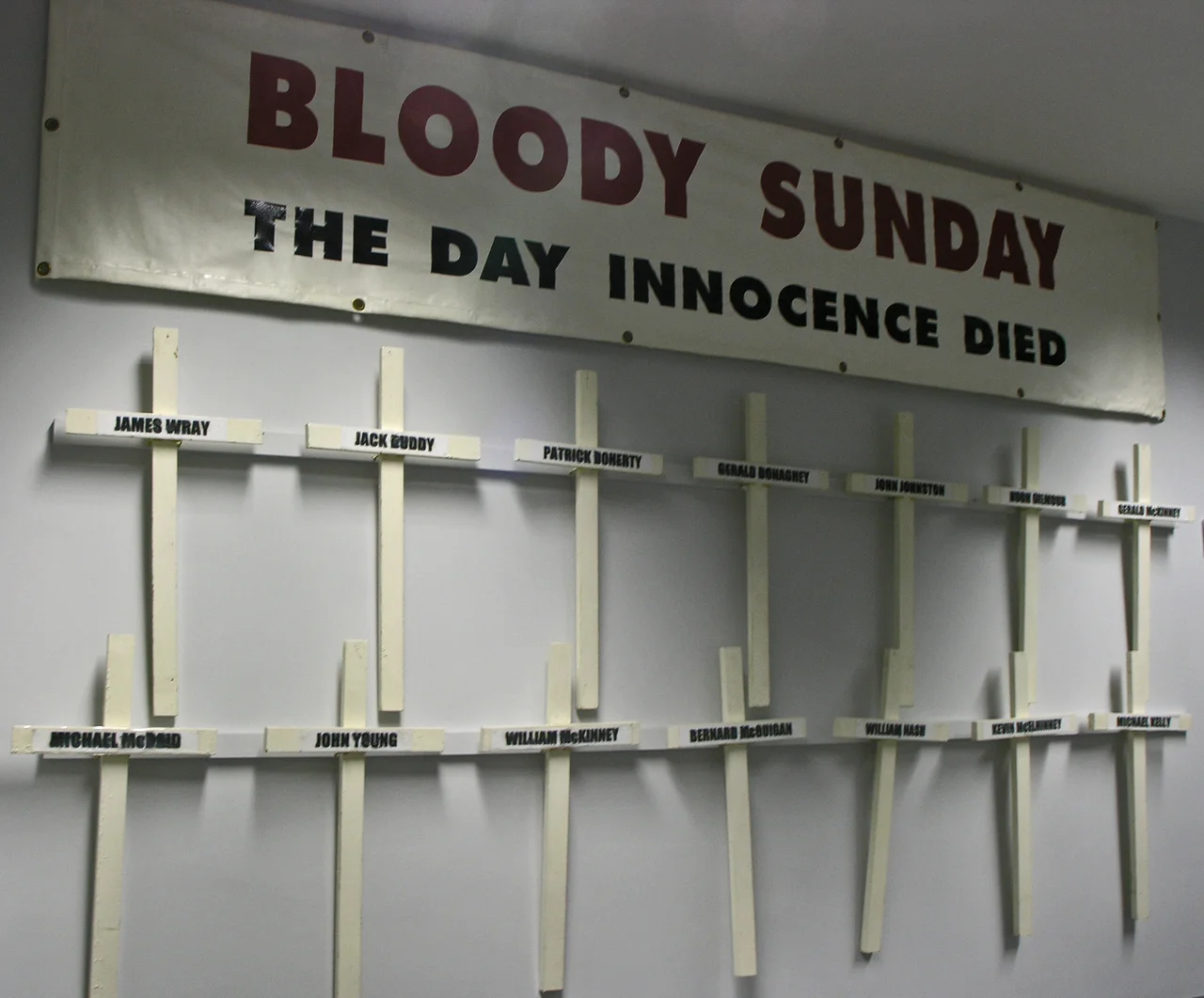

Bloody Sunday (1972)
Father Edward Daly walked at the front of the small group carrying Jackie Duddy through the Rossville Flats car park. Duddy was seventeen years old and had been shot in the chest. Daly waved a white handkerchief stained with the boy's blood so the soldiers would not shoot the men trying to carry him to safety. The photograph of that moment, taken by Stanley Matchett, became one of the most reproduced images of the late twentieth century. It is, on a single black-and-white frame, the entire shape of Bloody Sunday: a priest's white cloth raised against guns that had no reason to be firing, a child's body being taken across a Derry car park toward a hospital that could not save him, and a city about to lose its faith that the institutions which were meant to protect it could be made to do so.
The March
Sunday, 30 January 1972, was meant to be a civil rights march, organised by the Northern Ireland Civil Rights Association against internment without trial. Around fifteen thousand people walked from the Creggan estate down through the Bogside, in the dry cold of a Derry winter afternoon, intending to reach Guildhall Square. The British Army had set up barriers to stop the march reaching the city centre, so the route was diverted toward Free Derry Corner. Most of the crowd dispersed peacefully. A small group of youths confronted soldiers at a barricade, throwing stones in the usual ritual of Bogside afternoons. At ten past four, soldiers of the Parachute Regiment's Support Company moved into the Bogside in armoured vehicles. They had been ordered to make arrests. What they did instead was open fire. Within roughly ten minutes they had shot twenty-six people. Thirteen were killed outright. A fourteenth, John Johnston, died of his wounds in June. Six of the dead were seventeen years old.
The Names
It matters, with this story more than almost any other, to say the names. Jackie Duddy, seventeen, shot while running. Patrick Doherty, thirty-one, shot crawling away. Bernard McGuigan, forty-one, shot in the back of the head as he went to help Doherty, waving a white handkerchief. Hugh Gilmour, seventeen. Kevin McElhinney, seventeen. Michael Kelly, also seventeen. John Young, seventeen. William Nash, nineteen, shot trying to help his father. Michael McDaid, twenty. James Wray, twenty-two, shot once and then shot a second time as he lay wounded on the ground. Gerald Donaghey, also seventeen, around whose body soldiers later claimed to have found nail bombs that none of the civilians who carried him had seen. Gerard McKinney, thirty-five. William McKinney, twenty-six, no relation. John Johnston, fifty-nine, died months later from his injuries. They were schoolboys, fathers, brothers. The whole city knew them or their families. Many of them were carried home through streets where their neighbours stood at doors watching.
The Whitewash
The first official account of what happened was the Widgery Tribunal, rushed to a conclusion within eleven weeks. Lord Chief Justice Widgery effectively blamed the dead for their own deaths, suggesting that nearly all had been carrying weapons or had been associating with people who were. He held the march's organisers responsible for the killings. In the Bogside the slogan WIDGERY WASHES WHITER, a pun on a soap-powder advertisement of the era, was painted on walls. In London the report became the position of the British state. Tony Blair's chief of staff Jonathan Powell would later call Widgery, plainly, a complete and utter whitewash. The families spent the next thirty-eight years carrying photographs of their dead through anniversary marches and waiting for a different verdict. Some of them did not live to see it.
Saville
In 1998, as part of the Northern Ireland peace process, Tony Blair ordered a new public inquiry, chaired by Lord Saville. It became the longest legal proceeding in British history. Nine hundred and twenty-one witnesses gave evidence at the Guildhall in Derry between 2000 and 2004. The Ministry of Defence lost or refused to disclose more than a thousand army photographs, original helicopter video footage, and the guns themselves; some of the missing rifles were later recovered as far away as Sierra Leone and Beirut. A former paratrooper testified that a lieutenant had told them the night before, Let us teach these buggers a lesson, we want some kills tomorrow. The Saville Report was published on 15 June 2010. It concluded, in the calm prose of the law, that the firing by soldiers on Bloody Sunday caused the deaths of thirteen people, none of whom was posing a threat of causing death or serious injury. The soldiers had lost control, had shot fleeing civilians and people trying to help the wounded, and had then lied to cover what they had done. Prime Minister David Cameron told the House of Commons that what happened on Bloody Sunday was both unjustified and unjustifiable. On behalf of the British government, he apologised.
Soldier F
Of the soldiers identified by Saville as having killed unarmed civilians, only one was ever brought to trial. He is known publicly only as Soldier F, his anonymity protected by the courts. He was charged in 2019 with the murders of James Wray and William McKinney and the attempted murders of five others. The case collapsed in 2021, was reinstated in 2022 after an appeal by William McKinney's family, and finally went to trial at Belfast Crown Court in September 2025. On 23 October 2025, Judge Patrick Lynch acquitted him, ruling that the available evidence, primarily statements from other paratroopers who had themselves later given inconsistent or contradictory accounts, did not meet the standard of proof beyond reasonable doubt. The UK government spent more than four million pounds defending him. No paratrooper has ever been convicted of any killing on Bloody Sunday. The families of the dead, many now in their seventies and eighties, said they would keep walking the route on the anniversary every January, with the photographs, until they could not.
What the Bogside Carries
It is possible to argue, and historians do, that the Provisional IRA's long campaign of bombings and shootings was given decisive moral fuel by Bloody Sunday. In the weeks afterward, recruitment to the Provisionals in Catholic communities surged. The killings, the Widgery whitewash, and the absence of accountability hardened the conviction in many young nationalists that justice would not come through politics. Twenty-six more years of war followed. Many of the songs and poems written in the immediate aftermath, by Paul McCartney, John Lennon, Thomas Kinsella, Brian Friel, and later U2, are still performed. The Bogside Artists' murals along the Lecky Road still show the dead in school uniforms and football tops. On the last Sunday of every January the families walk the original route from Creggan, the photographs held high. The white handkerchief that Father Daly raised over Jackie Duddy is in the Museum of Free Derry. The hand that raised it is gone. The argument it made has not yet been settled.
From the Air
Bloody Sunday took place in the Bogside in Derry, at roughly 55.00 degrees north, 7.33 degrees west, west of the medieval city walls and the River Foyle. From cruise look for the bend of the Foyle and the walled hilltop of the old city; the Bogside spreads west and south below the western walls. The Rossville Flats where Jackie Duddy was killed have been demolished, but Free Derry Corner remains painted on Lecky Road, and the Museum of Free Derry stands a few streets away. The nearest controlled airport is City of Derry (EGAE) just outside the city; Donegal Airport (EIDL) lies west across the border. Belfast International (EGAA) is roughly 100 km east. Lough Foyle stretches north of the city; the long ridge of Inishowen rises on the far side.
Nearby Stories
- Portrush Lifeboat Station 1.9 km away
- Main Street, Letterkenny 2.1 km away
- Inishowen 6 km away
- Rosguill 6.3 km away
- County Tyrone 7.1 km away
- St Patrick's College, Maghera 9.6 km away
- St Patrick's Purgatory 11 km away
- Coalisland Canal 17 km away