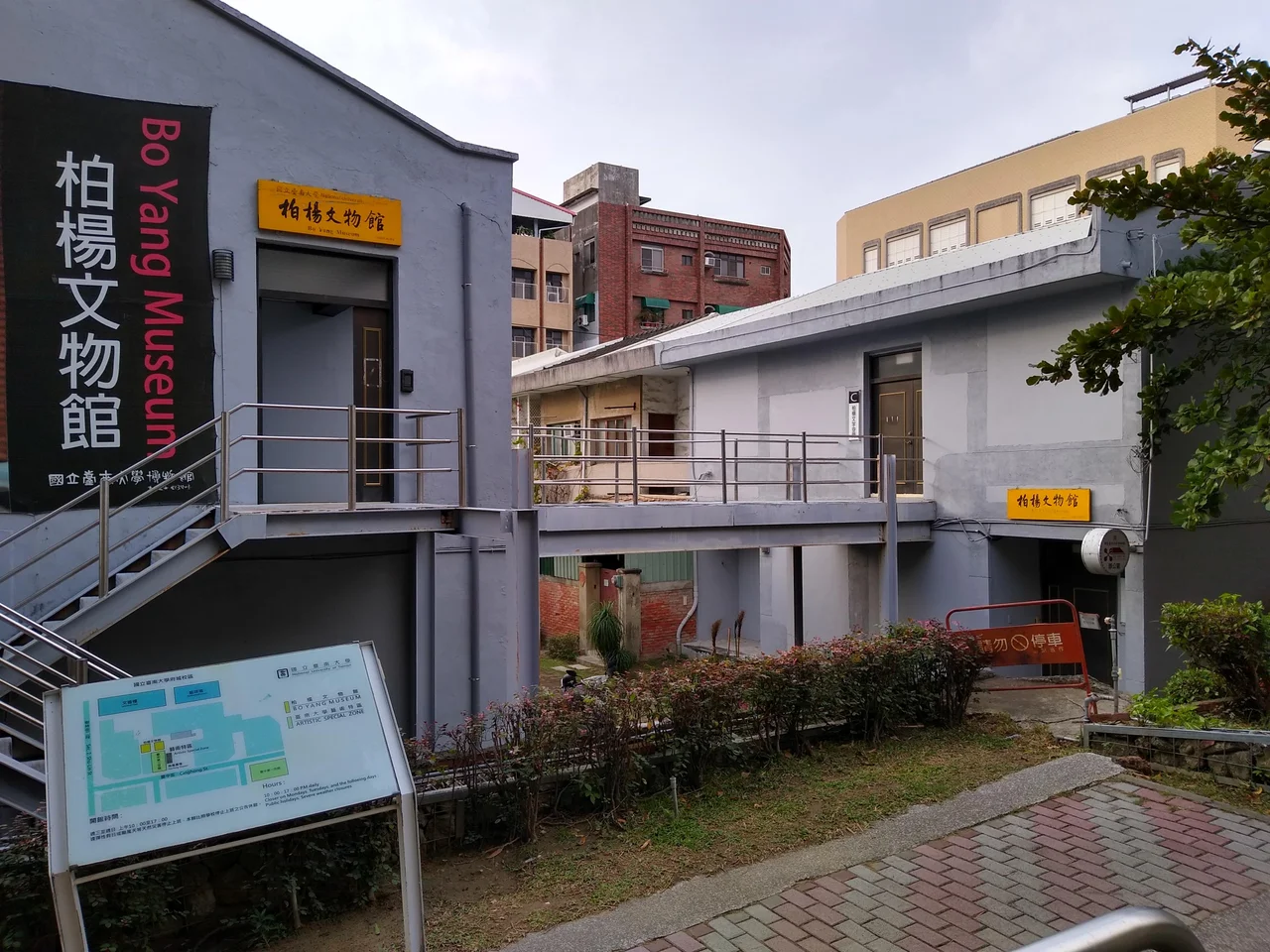

Bo Yang Museum
In 1968, a cartoonist published a Taiwanese translation of a Popeye comic strip in which Popeye and his son, stranded on a small island, mock a government that promises to "take the whole country" to recapture it. The government in question was the Republic of China. The translator was Bo Yang — real name Guo Dingsheng — who had already accumulated a reputation as one of Taiwan's most acerbic social critics. Authorities charged him with sedition. He was sentenced to twelve years, held on the infamous Green Island political prison off Taiwan's eastern coast, and not released until 1977, after roughly nine years of confinement. He emerged and kept writing. The museum in Tainan dedicated to his work and life is a small building with a very large subject.
A Life Measured in Candor
Bo Yang was born Guo Dingsheng on March 7, 1920, in mainland China, and came to Taiwan with the Nationalist government in 1949. He reinvented himself as a writer under his pen name and built a following through journalism and essays that took aim at what he saw as the pretensions and self-deceptions of Chinese culture. His 1985 book, "The Ugly Chinaman" (醜陋的中國人), was his most controversial: a blunt, unsentimental critique of Chinese cultural habits — the noise, the insularity, the tendency toward factional infighting — that infuriated many readers and sold widely anyway. He was not a comfortable writer. He had learned, on Green Island, the cost of saying things that authority would rather leave unsaid, and he kept saying them. Bo Yang died on April 29, 2008, at the age of eighty-eight, in Taipei.
Green Island and the Years of Silence
Green Island, visible as a dark shape off Taiwan's eastern coast, housed one of the most feared political detention facilities of the White Terror period — the decades of martial law, from 1949 to 1987, during which the Nationalist government suppressed political dissent with imprisonment, torture, and execution. Bo Yang arrived there in 1969, one of thousands of political prisoners held in conditions that survivors have described in increasingly detailed memoirs as Taiwan's historical memory has opened. His sentence was for twelve years. Chiang Kai-shek's death in 1975 led to a partial amnesty that reduced his sentence; international pressure from Amnesty International contributed to his eventual release in 1977. He had served roughly nine years for a cartoon. The experience did not silence him. If anything, it clarified his purposes.
The Museum and Its Collections
The Bo Yang Museum opened on June 27, 2007, at the National University of Tainan, located in the city's West Central District. The path to its establishment was not straightforward. Initial discussions about repatriating Bo Yang's belongings began in November 2006; a room to house his collections was inaugurated on March 21, 2007; the Ministry of Education approved funding on May 8, 2007; and the museum formally opened less than two months later. The building is two stories, situated in the university's Special Art District. Inside, it is organized into four sections: the Bo Yang Art Center, which houses visual art connected to his life and work; the Bo Yang Historical Section, covering his biography and the political context of his imprisonment; the Bo Yang Literature Corner, dedicated to his writing; and Bo Yang's Garden House Living Room, a reconstruction of his personal domestic space. Together they make an argument that Bo Yang's life and work belong not just to literature but to Taiwanese political history.
Walking Distance from the Railway Station
The museum's practical accessibility matters. It sits within walking distance south of Tainan Station on the Taiwan Railway — one of the country's oldest rail lines, running the length of the western coastal plain. Tainan itself is Taiwan's oldest city, and its West Central District holds much of the historical architecture from the Dutch, Qing, and Japanese colonial periods. Bo Yang, who spent his adult life in Taiwan and produced his most important work there, fits into this landscape in a particular way: as a figure who experienced both the repression of the Nationalist era and the gradual liberalization that followed, and who used his voice at every stage. The museum is a modest structure, not an overwhelming one, but it holds a life that was anything but modest. For visitors who know his story, standing in it has a particular weight.
From the Air
The Bo Yang Museum is located at approximately 22.985°N, 120.208°E in Tainan's West Central District, within the campus of the National University of Tainan. From the air, Tainan's flat coastal plain is easily identifiable — the city spreads across reclaimed tidal flats and low-lying agricultural land between the Central Mountain Range to the east and the Taiwan Strait to the west. The nearest major airport is RCKH (Kaohsiung International Airport), approximately 40 km to the south; RCNN (Tainan Airport) lies approximately 4 km to the northwest of the museum. Approaching Tainan from the north at lower altitudes, the Tainan Station rail yard and the dense urban grid of the old city center are the primary navigational landmarks, with the university campus a short distance to the southwest of the station.
Nearby Stories
- Chung Li-ho Museum 0.7 km away
- Jingzaijiao Tile-paved Salt Fields 8 km away
- Wanchin Basilica of the Immaculate Conception 9.3 km away
- Namasia District 16 km away
- Battle of Penghu 21 km away
- Shoushan (Kaohsiung) 21 km away
- Penghu Air Raids 62 km away
- Daya Bay 512 km away