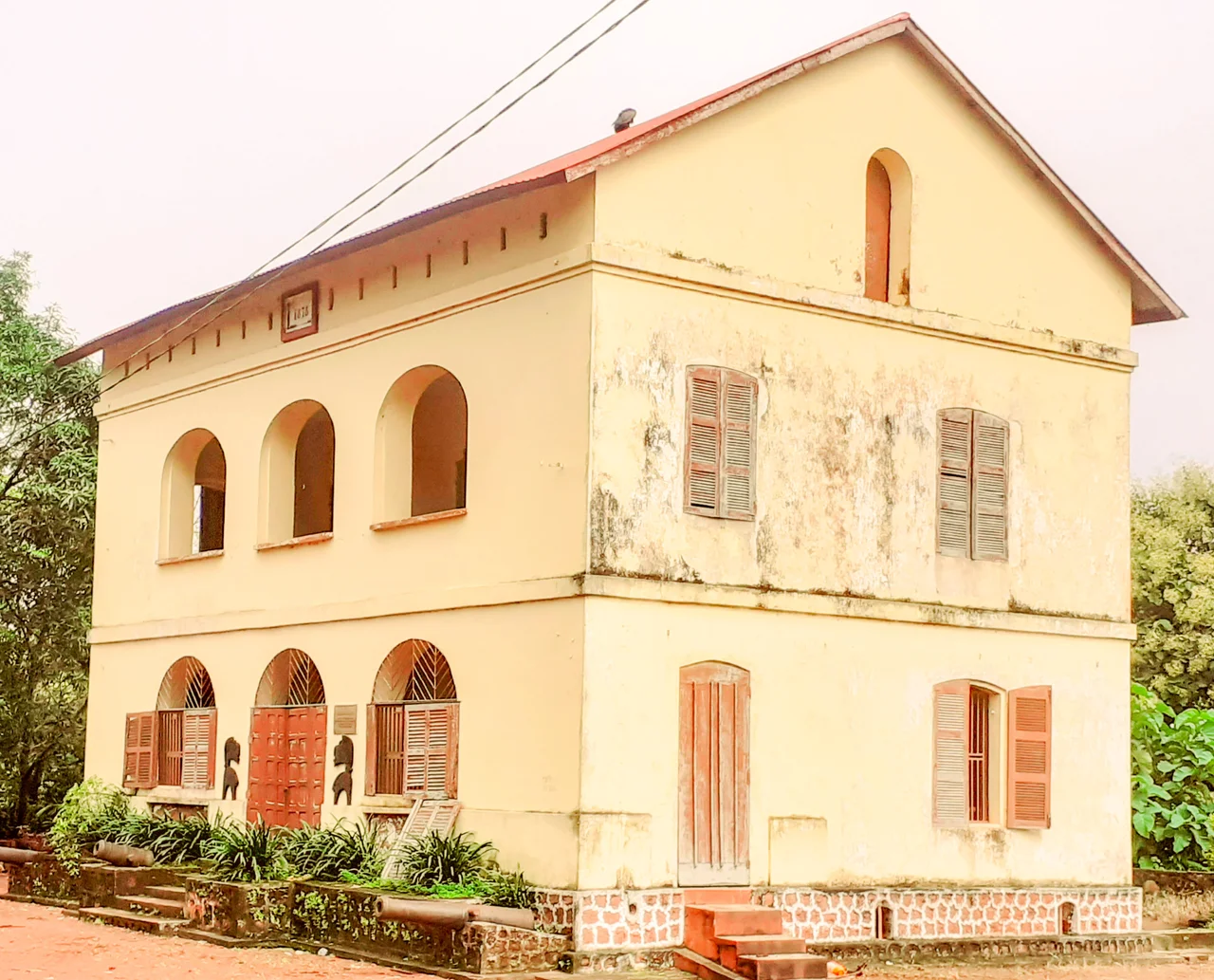

Boké Museum
There are cells in the basement of the Boké Museum. That single detail tells you this building was never meant to house art. The squat stone fort that stands above the Rio Nunez in northwestern Guinea was built in 1878 as an instrument of colonial control, a strongpoint on a river that had carried captives to the Atlantic for generations. Only later, when France was gone and the cells were empty, did it become the Musée Préfectoral de Boké, a place where the masks, drums, and currencies of the region's peoples are kept and shown. The fort that once held prisoners now holds memory.
A Fort on a Slaving River
The Rio Nunez, on which Boké sits, was for decades a trading river much like its neighbour the Rio Pongo, a place where caravans from the interior met European and American traders and where human beings were bought and shipped into bondage. The fort at Boké rose late in that history, as France extended its grip up the rivers from the coast. It served the colonial administration as a garrison and a seat of authority. To understand the museum, you have to understand the building first: not a monument someone chose to honour, but a relic of conquest that a free country decided to repurpose.
The Kings in the Cells
Two African rulers were imprisoned in this fort, and their names anchor its hardest chapter. Alfa Yaya, the ruler of Labé in the Fouta Djallon, and Dinah Salifou, the last king of the Nalu people, were both held here as French power closed over their kingdoms. The basement rooms that now sit beneath display cases were where men were confined and questioned. To walk down into them is to stand in the space where independent African authority was broken and absorbed. The museum does not hide these cells; it keeps them, so that the cost of the colonial order is not lost behind the artefacts upstairs.
From Garrison to Gallery
In 1971, in the years after independence, Guinea's first president Ahmed Sékou Touré had the old fort turned into a museum. It was restored in 1982 by the Friends of the Museum Association and reopened as the prefecture's keeper of regional heritage. The choice carried meaning. A building raised to dominate the people of the Rio Nunez was handed back to them as a place to gather and display their own history. The transformation did not erase what the fort had been, but it changed who controlled the story told within its walls.
What the Collection Holds
The galleries gather objects from the many cultures of the Boké region. There are Baga pieces: communication drums, the drums used in the initiation of women, and the carved Baga serpent that figures in the initiation of boys. There are nimba masks, towering emblems of fertility, and guinzes, the iron "toma currency" once used in trade. Each was made for use, in ritual and daily life, by communities the colonial fort once sought to subdue. Set in this building, on this river, the collection becomes more than a display of craft. It is the survival of the cultures that outlasted the empire that built the walls around them.
From the Air
The Boké Museum stands in the town of Boké, northwestern Guinea, at roughly 10.93°N, 14.30°W, above the Rio Nunez and inland from the Atlantic coast. From altitude Boké appears as a modest town set in green coastal lowland threaded by the dark, mangrove-lined channel of the Rio Nunez, with bauxite-mining infrastructure marking the wider region. Best viewed in the December–April dry season; Harmattan dust can haze the air. Nearest major airport is Conakry International (GUCY) to the south; Boké has a local airstrip.
Nearby Stories
- Maritime Guinea 42 km away
- Pongo River (Guinea) 77 km away
- João Vieira and Poilão Marine National Park 103 km away
- Kindia 140 km away
- Nadir Crater 293 km away
- Dinguiraye 327 km away
- Gouina Falls 459 km away
- Dakar 481 km away