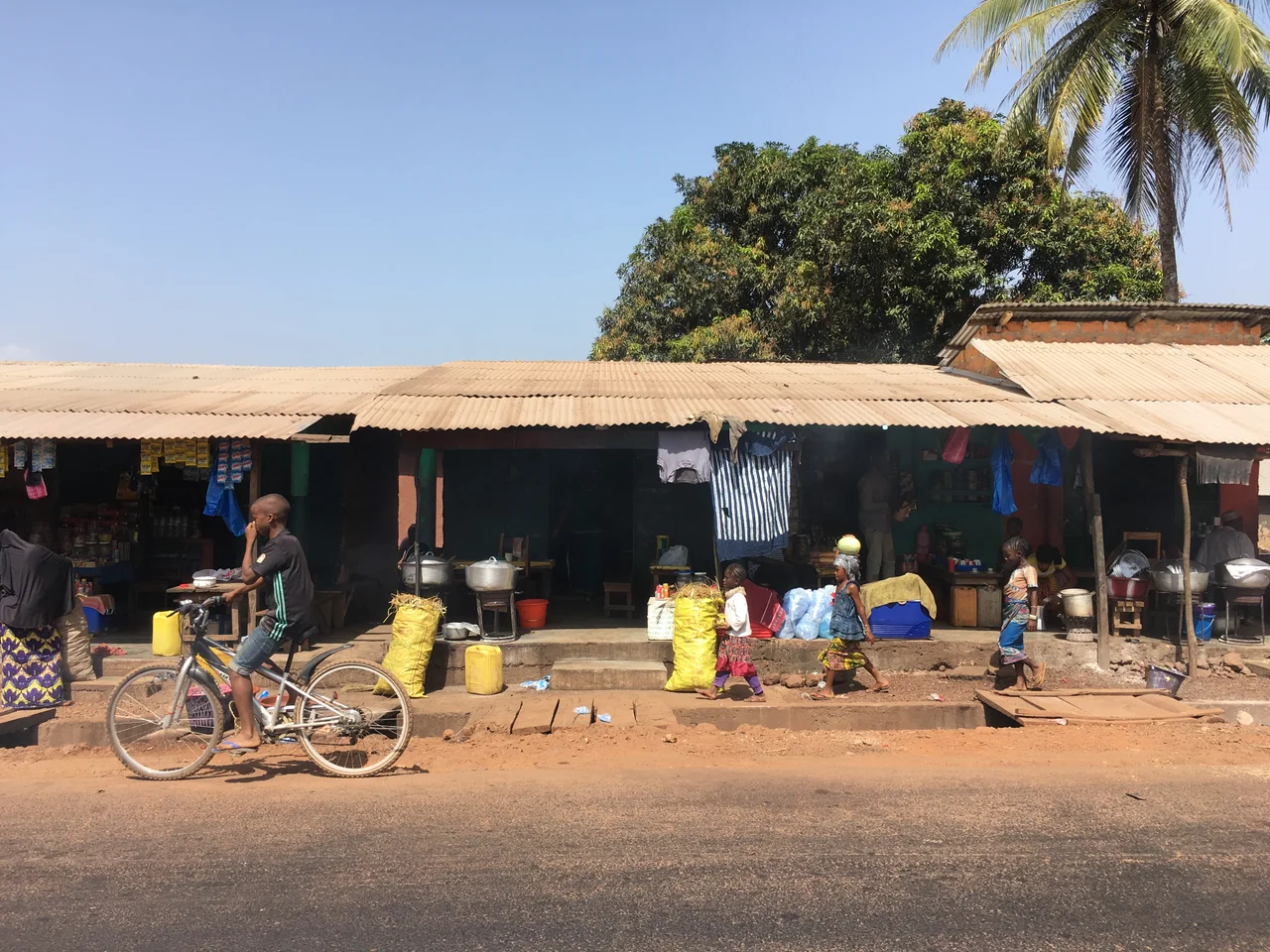

Kindia
Seven kilometers outside Kindia, in the bush at the foot of Mount Gangan, a French doctor once kept chimpanzees in a menagerie built to study them. He called the place Pastoria. Founded in 1922 by Albert Calmette, then assistant director of the Institut Pasteur in Paris, it was meant to be a research station where great apes could be observed and tested in something closer to their own climate. American primatologists came to source animals here. The chimpanzees did not come willingly, and the science done to them sits uneasily with us now. But it is part of why this railway town in western Guinea matters, and only part.
Born of the Railway
Kindia did not grow up slowly. It was founded in 1904 as a station on the new railway being driven from the coast at Conakry inland toward Kankan, and the town took its shape from the line. Photographs from 1905 show the main street and the gare, the railway station, already laid out with colonial purpose. Around the tracks grew banana plantations, and for decades Kindia shipped fruit down to the port. Then the railway closed, the bananas faded, and the town had to become something other than a depot. Today it is Guinea's fourth-largest city and the capital of its own region, with an estimated population well over 180,000 and rising.
The Bride's Veil
Just outside town, a river throws itself off a cliff and the water spreads as it falls until it hangs against the rock like a sheet of white silk. The French called it the Voile de la Mariée, the bride's veil, and at full flow in the rainy season the name is exact: a pale curtain seeming to drape from the lip of the escarpment. Giant bamboo and rainforest crowd the gorge below, and the cascade has become one of the best-loved natural sights in Guinea. Nearby, Mount Gangan lifts its forested bulk, the first real rampart of the Fouta Djallon, the highland massif whose edge Kindia guards.
A City of Many Tongues
Kindia is a meeting place, and its population shows it. The Susu form the majority and the Susu language is understood by nearly everyone, as it is across western Guinea. The Mandinka follow, and virtually every ethnic group in the country keeps a presence here. After Conakry, Kindia holds the second-largest Sierra Leonean community in Guinea, some nine thousand people, many now Guinean citizens, a reminder that this corner of West Africa has long been porous to people moving in search of work and safety. The result is a town that feels like a crossroads even now that the trains have stopped running.
What the Ground Remembers
Not all of Kindia's history is gentle. In October 2002, mass graves were uncovered near the town, holding hundreds of bodies; one grave was reported to contain four hundred. Most of the dead had been killed on 17 and 18 October 1971 under the regime of Ahmed Sékou Touré, Guinea's first president, during one of the waves of repression that scarred his rule. These were teachers, soldiers, officials, ordinary people swept up in a paranoid purge, and for three decades their families did not know where they lay. To stand in Kindia is to feel both the openness of a crossroads and the long shadow of what a state can do to its own.
From the Air
Kindia lies at roughly 10.05 N, 12.85 W, about 85 miles (135 km) northeast of Conakry. The nearest major airport is Conakry's Ahmed Sékou Touré International (GUCY / CKY); Kindia has its own airstrip for regional and light traffic. From the air, look for the urban grid threaded by the old Conakry-Kankan rail alignment, the wooded mass of Mount Gangan to the north, and the white thread of the Voile de la Mariée waterfall on the escarpment nearby. The town sits at the western edge of the Fouta Djallon, so terrain rises sharply to the east. A viewing altitude of 6,000 to 9,000 feet frames the city against the highland wall; clearest conditions come in the November-March dry season.
Nearby Stories
- Maritime Guinea 19 km away
- Outamba-Kilimi National Park 32 km away
- Dalaba 36 km away
- Operation Green Sea 47 km away
- Camp Boiro 73 km away
- Battle of Porédaka 74 km away
- Fugumba 96 km away
- Sandervalia National Museum 103 km away