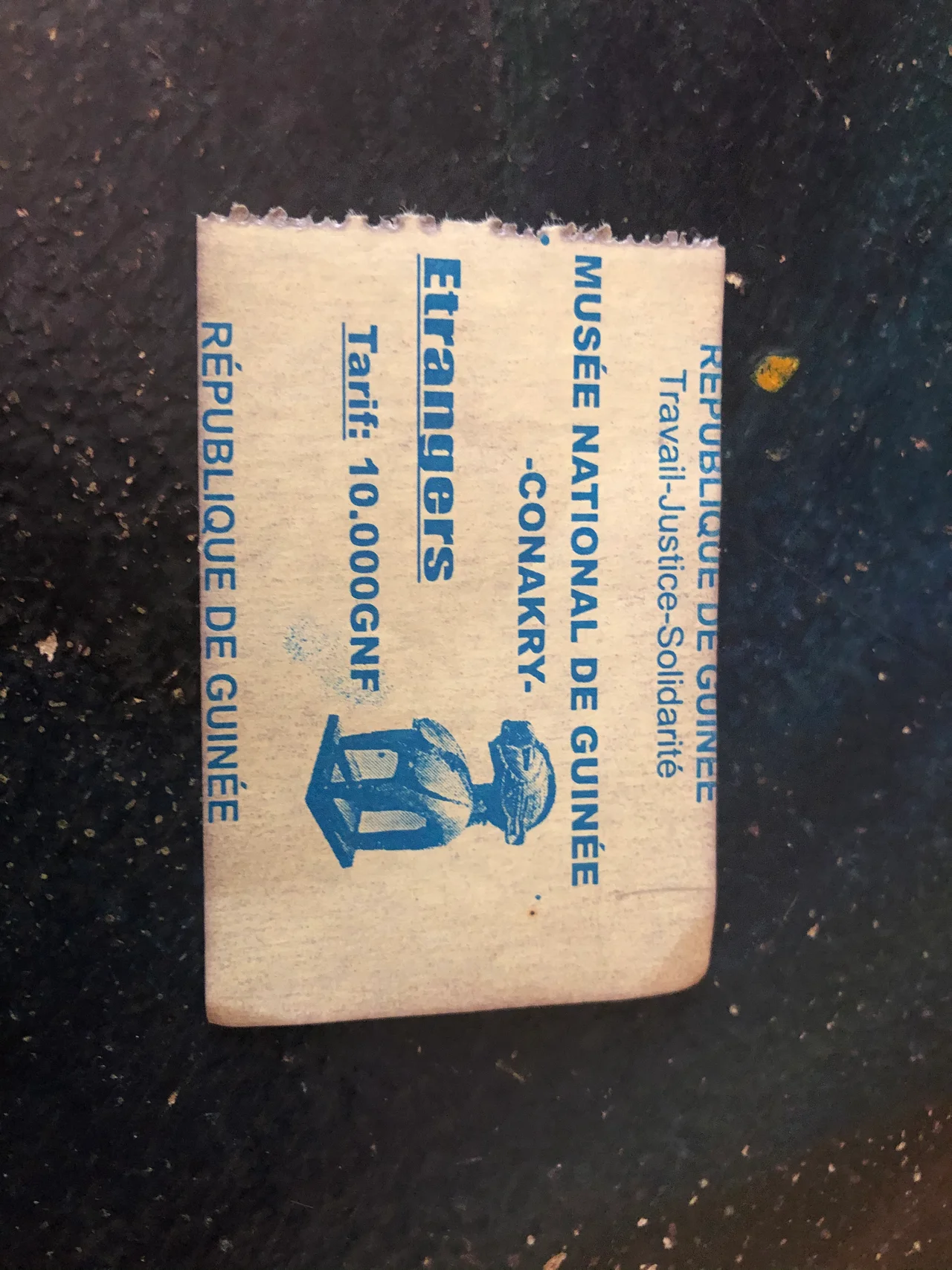

Sandervalia National Museum
Most of the rooms are empty. That is the first thing a visitor notices at the Sandervalia National Museum, Guinea's national museum, set in a quiet park near the tip of the Conakry peninsula. The grand purpose announced by the name and the courtyard statues runs up against a humbler reality inside: a single room of masks, a model of village houses, an artisan's gallery where fabrics and carvings are for sale. The emptiness is not neglect alone. It is the visible scar of a chapter in Guinea's history when the state itself turned against the country's own art.
A Museum Against the Tide
The museum opened in 1960, two years after independence, as part of a deliberate cultural program. The same government that founded it also made Les Ballets Africains — founded in Paris in 1952, then adopted as Guinea's national ensemble at independence — and the national broadcaster, Radio Guinée, into pillars of the new state, championing traditional folklore as an expression of the new nation. But this was a contradictory patronage. Between 1959 and 1984 the state established Islam as the official religion and confiscated almost all religious art across the country. A museum built to celebrate Guinea's traditional arts existed alongside a policy that stripped many of those arts from the hands of the people who made and used them. Much of what the museum might have held was lost before it could ever be displayed.
The Courtyard of Ghosts
Step into the courtyard and the colonial era stares back in stone. Statues moved here over the years represent the figures who shaped, and seized, this corner of West Africa. There is Almamy Samori Ture, the Mandinka leader who built an empire and fought the French for years before his capture. There is Aimé Olivier de Sanderval, the French adventurer who gave the district its name, alongside Governor Noël Ballay, the physician Victor Le Moal, and Monseigneur Raymond René Lérouge, the latter carved surrounded by musicians and a fishing family. The courtyard's railings are decorated, oddly, with colonial pith helmets, and the cafeteria hut wears a giant helmet of its own, a strange and slightly mocking tribute to the colonizers whose monuments now share the yard with the African king who resisted them.
What Remains
After the 1984 coup, the restrictions on indigenous religion lifted, and the museum, its oldest pieces long vanished, found a quieter second life. It became a gathering place for Conakry's small artistic community, hosting conferences in the early 1990s and, in later years, sheltering working artists in its rooms. By 2016 the painter Papus kept his studio here. One restored wing owes its survival to support from the Embassy of Japan. A masonry arch built in 1896 stands by the entrance, and artists sometimes hang their canvases on it. The surviving display, masks and musical instruments from across Guinea's regions, beside a model of the country's varied houses, is small. But in a building so marked by loss, it is also a quiet act of holding on.
From the Air
The Sandervalia National Museum sits in the Kaloum district near the tip of the Conakry peninsula, Guinea, at approximately 9.505°N, 13.709°W, near the Ignace Deen Hospital on the 7th boulevard. The peninsula points southwest into the Atlantic, with the museum close to sea level near the city's western shore. Conakry International Airport (ICAO GUCY) lies about 14 km to the northeast. Navigate by the narrow finger of the Kaloum peninsula and the open ocean on three sides; coastal haze and wet-season rains (April to November) often limit visibility.
Nearby Stories
- Pongo River (Guinea) 23 km away
- Kindia 28 km away
- Maritime Guinea 79 km away
- Operation Barras 88 km away
- King's Yard 98 km away
- Outamba-Kilimi National Park 110 km away
- Boké 152 km away
- Rocas Atoll 2633 km away