
Outamba-Kilimi National Park
Some mornings at Outamba-Kilimi, a troop of green monkeys will commute across the breakfast table while you eat, swinging through the simple riverside huts as if the guests were the curiosity. This is Sierra Leone's wild north, where tall-grass savanna gives way to ribbons of forest along the rivers, and where the country protects some of the last West African chimpanzees. Two separate blocks of land, named for a mountain and a river, hold a country's worth of wildlife near the Guinea frontier.
A Park in Two Halves
Outamba-Kilimi spreads across the Karene District in north-west Sierra Leone, hard against the border with Guinea. It is really two parks joined under one name: Outamba, the larger block at 741 square kilometers, and Kilimi, at 368. Each carries the name of its defining feature, Outamba for Mount Outamba, its highest peak, and Kilimi for the River Kilimi that threads through the other. The terrain is mostly flat, broken by a few hills, with large rivers running southwest toward the sea. The land first became a game reserve in 1974, chosen above all because it sheltered a large number of chimpanzees, and was formally gazetted as a national park in October 1995.
Where Savanna Meets Forest
The genius of this landscape is its variety. Outamba is country of tall-grass savanna and woodland, stitched through with patches of closed-canopy forest; Kilimi opens into more spacious savanna woodland. Both hide pockets of raffia palm swamp forest and riverine grassland along the watercourses, a mosaic of gallery forest, woodland, and open grass. That blend of habitats is exactly why the wildlife is so rich. The park shelters the largest chimpanzee population in Sierra Leone, with an estimated 1,020 individuals, alongside a small population of forest elephants and at least nine primate species, among them red colobus, sooty mangabey, and olive baboons. More than 260 bird species have been recorded, and the rivers hold crocodiles, while the elusive, endangered pygmy hippopotamus moves through the wetter ground.
The Susu and the Land
People belong to this story as much as the chimpanzees do. The Susu, also spelled Soso, live in and around the park, and most of its staff are Susu. When the boundaries were drawn, some villages found themselves inside protected land, and most agreed to move to the surrounding buffer zone. An exception was made, and it matters: families with ancestral sites and graves within the park were allowed to remain, on the condition that they harvest only by sustainable means. Mining and hunting are barred inside the park itself. The National Tourism Board has tried to grow visitor numbers partly to offset what local people gave up, turning the wildlife into a livelihood rather than a loss.
Living on the Edge
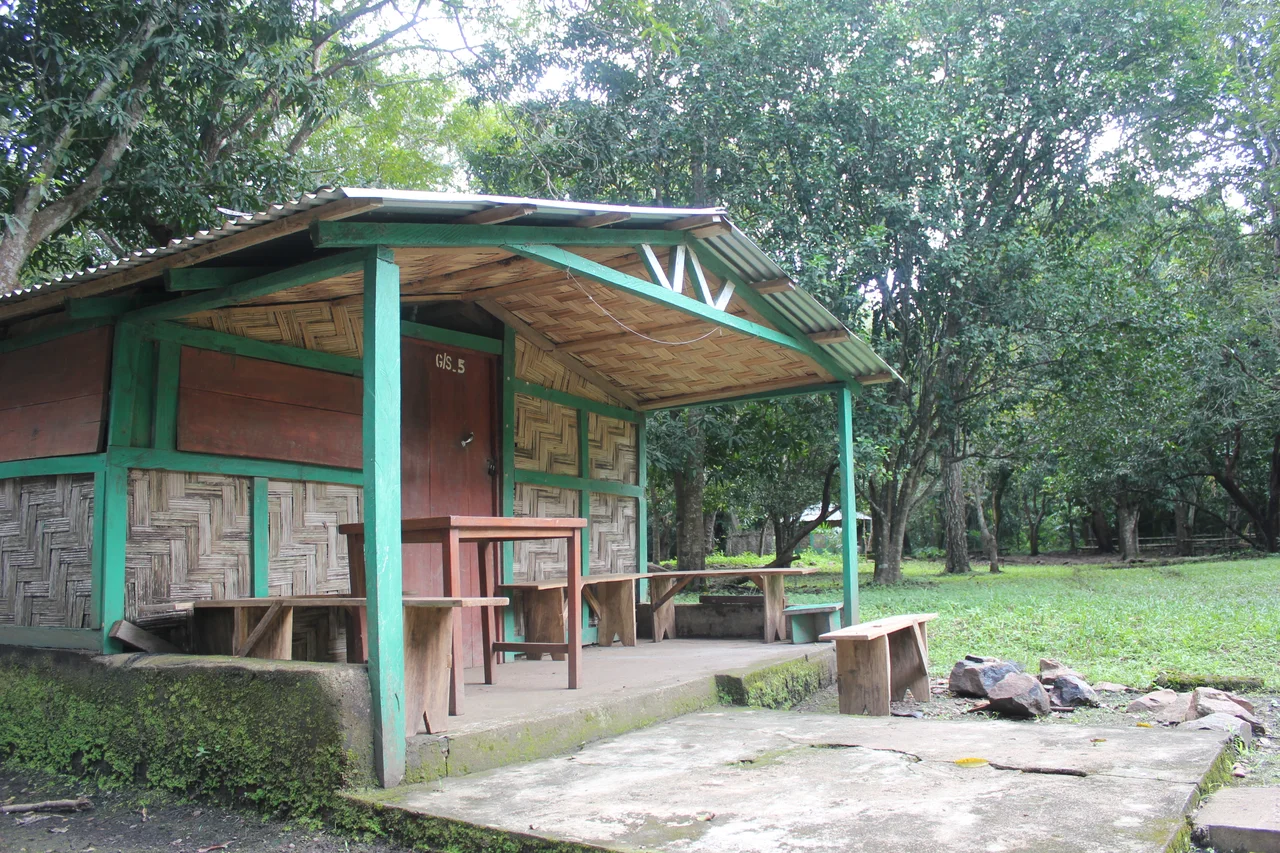
Around the park runs a one-kilometer buffer zone, where most of the villages sit and the rules relax. Here hunting is permitted, except for protected species; farming continues; and stands of fast-growing gmelina trees have been planted to supply the firewood, furniture, and building timber that the protected forest can no longer provide. For visitors who make the journey, the welcome is deliberately simple, single-bed and group huts built from local materials, the kind of lodging that leaves a small footprint. There is no luxury here, only the chance to wake to the sound of monkeys overhead and the rivers running on toward Guinea, in one of the least-visited and most quietly extraordinary corners of West Africa.
From the Air
Outamba-Kilimi National Park lies around 9.77°N, 12.03°W in north-west Sierra Leone, straddling the approach to the Guinea border. From the air the park reads as a mottled expanse of pale savanna grassland threaded by darker gallery forest along southwest-flowing rivers, with Mount Outamba the most prominent relief feature. The nearest major airport is Freetown-Lungi International (GFLL), roughly 150 km southwest. Best viewed in the dry season (December to April), when the grasslands turn golden and skies are clear; the wet season brings dense green and frequent cloud over the river valleys.
Nearby Stories
- Kindia 22 km away
- Lake Sonfon 29 km away
- Makeni 69 km away
- Timbo, Guinea 76 km away
- The Loma Mountains: Sierra Leone's Rooftop and Last Refuge 84 km away
- Operation Barras 105 km away
- Operation Green Sea 114 km away
- Dinguiraye 172 km away